Everyone needs a proper break, children most of all. But a summer with no learning at all usually means walking back into school in September a step behind where they finished in July. Here is what actually happens over the holidays, and the small things that stop it.
What the “summer slide” actually is
Skills you don’t use go rusty. That’s true for a language, a musical instrument, or a sport, and it turns out to be true for schoolwork too. Leave maths and writing untouched for six weeks and a lot of children quietly lose some of what they worked hard to build up over the year. Teachers call it the summer slide, and it has been studied for decades.
One often-quoted review of the research put the average loss at roughly a month of learning across the holidays. That figure hides something important, though: the loss isn’t shared evenly across subjects.
Maths takes the biggest hit
Reading tends to hold up reasonably well, because children still bump into words all summer in books, on screens, on signs, in conversation. Maths is different. It rarely comes up by accident on a beach holiday, so without a bit of practice the number facts and methods start to fade.
Studies generally put the maths loss at somewhere between one and three months of progress, and some go further, suggesting children can forget a big chunk of the maths they learned that year. For a child heading into SATs, the 11+, or the first proper year of GCSE content, that is ground you would much rather not give back.
~1 monthaverage learning lost over the summer
Mathsthe subject hit hardest
+4 monthsprogress small-group tuition can add over a year (EEF)
Why a month matters more than it sounds
A month here or there doesn’t sound like a disaster. Two things make it one. First, teachers usually spend the opening weeks of term re-teaching rather than moving on, so the slide eats into the whole class’s progress, not just your child’s. Second, it stacks up. A child who slips a little every summer can watch the gap grow year on year, at exactly the point the work is getting harder.
The good news: the same research that shows learning can slip also shows how much the right support helps. The Education Endowment Foundation puts the impact of small-group tuition at around four extra months of progress over a year. Spend a little of that over the summer and a child can come back in September not just level, but genuinely ahead.
How to turn the slide into a head start
You don’t need to run a school day at the kitchen table. A small, regular amount of focused learning is enough to protect progress, and often to build on it. The summers that work tend to look like this:
Little and often. A weekly hour beats a frantic fortnight in late August, because what keeps skills warm is consistency.
Aimed at the right topics. Working on the bits a child finds hard, and getting a look at what’s coming next year, is worth far more than a stack of random worksheets.
Actual teaching, not just videos. Children get unstuck faster when someone can spot a misconception and fix it on the spot.
In a small group, so the session stays sociable and motivating while the tutor still tailors it to each child.
Light enough to leave the holidays intact. A couple of daytime sessions a week is plenty.
What a realistic summer looks like
For most families, one or two subjects at an hour a week keeps things ticking over nicely. Children working towards something big, SATs, the 11+, or the GCSE years, usually do well with a bit more, especially in maths and the topics they’ll meet first in the new term.
Get your child summer-ready with ClassTutor
A proper small-group summer programme with real tutor support, not a large online lecture. UK-qualified, DBS-checked tutors, Years 1 to 11, built around next year’s exam topics. From £12/hour, with 20% off your first invoice when you pay within 24 hours.
The holidays should be for resting and having fun, and they can be. But a steady hour or two of good teaching each week is one of the simplest ways to make sure your child starts the new school year confident and a step ahead, rather than spending September catching up.
Sources: research summaries on summer learning loss (reviews of multiple studies pointing to around one month of average loss, with maths most affected) and the Education Endowment Foundation Teaching and Learning Toolkit estimate of +4 months’ progress for small-group tuition.
Year 10 to Year 11: Summer Preparation Guide | ClassTutor
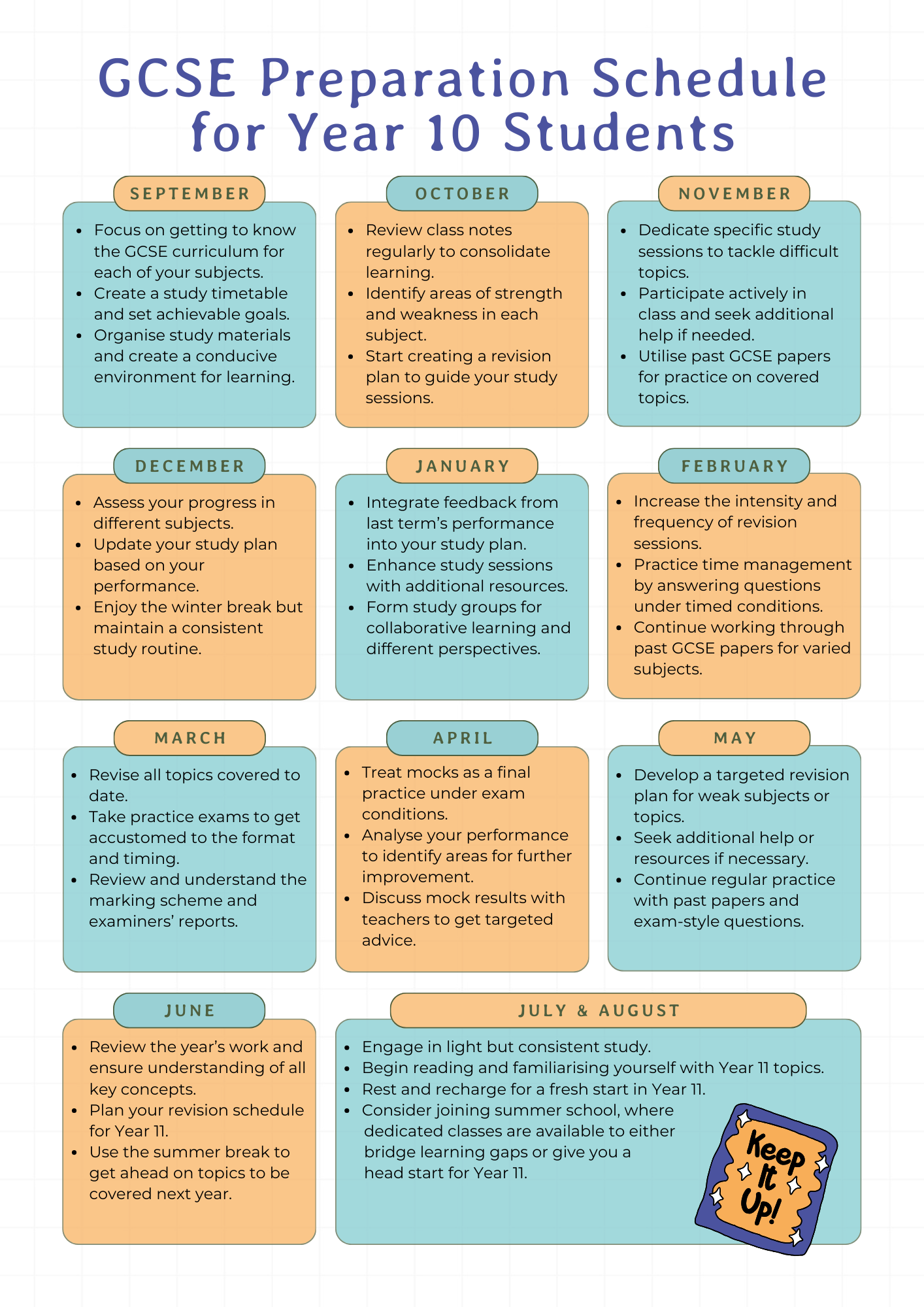
Your child has just finished Year 10. They have completed their first year of GCSE content, possibly sat some end-of-year exams, and now they are looking at six weeks of summer stretching ahead of them. As a parent, you are probably wondering: should they be revising? How much? Is it too early to start preparing for exams that are still a year away?
Here is the truth: the summer between Year 10 and Year 11 is one of the most valuable and most wasted windows in your child’s education. It is long enough to make real progress on weak areas, but short enough that it does not feel like endless revision. Used well, it can transform a student’s confidence and readiness for the intense year ahead. Used poorly, it can mean starting Year 11 already behind, scrambling to remember content that has slipped away over the break.
This guide will help you and your child strike the right balance: enough preparation to hit the ground running in September, without burning out before the real work begins.
Why This Summer Matters More Than You Think
Year 11 is intense. From September, your child will be learning new content, revising old content, sitting mock exams, and dealing with the pressure of knowing that these grades actually count. Teachers will be pushing harder, homework will increase, and the reality of GCSEs will feel very close.
The problem is that Year 11 does not give students much time to go back and fix gaps from Year 10. If your child did not fully grasp quadratic equations, or struggled with the poetry anthology, or never quite understood ionic bonding, Year 11 is not designed to reteach those topics. The curriculum assumes that foundation is already solid.
That is why summer matters. It is the last real opportunity to:
Identify and fill gaps in Year 10 knowledge before they cause problems in Year 11
Build confidence in subjects where your child has been struggling
Get ahead on Year 11 topics so the new content feels manageable
Develop study habits that will sustain them through the challenging months ahead
This does not mean six weeks of intensive revision. Far from it. But it does mean being intentional about how at least some of this time is spent.
1 Reflect on Year 10
Before any summer work begins, you need to understand where your child actually stands. This is not about judging them. It is about being strategic.
Gather the evidence
Collect together:
End-of-year reports and predicted grades
Results from any Year 10 assessments or mock exams
Feedback from parents’ evenings
Your child’s own sense of which subjects feel secure versus shaky
Look for patterns. Are there subjects where the grade has dropped over the year? Topics that keep coming up as weaknesses? A mismatch between effort and results that suggests something is not clicking?
Have an honest conversation
Sit down with your child, not to lecture but to listen. Ask them which subjects they feel most confident in, which ones worry them, whether there are specific topics they know they do not understand, and what they think would help.
Students often have a clearer picture of their weaknesses than adults realise. They know when they have been copying off a friend, when they have zoned out in lessons, when they have scraped through an assessment without really understanding the content. Creating a safe space for them to be honest is the first step to actually addressing those gaps.
Parent tip: Target grades vs current grades
If your child’s target grade is a 7 but they are currently working at a 5, that is a two-grade gap to close in one year. It is achievable, but it will not happen by accident. Summer is the time to start that journey, not September.
2 Get Organised
One of the most practical things your child can do this summer is get their materials in order. It sounds boring, but students who start Year 11 with organised notes and a clear understanding of what they are working towards perform significantly better than those who do not.
Sort through Year 10 work
Over the summer, have your child go through their folders, books, and files from Year 10. The goal is to:
Keep anything that will be useful for revision: notes, worksheets with model answers, past assessments
Organise materials by topic so they are easy to find later in Year 11
Identify any gaps: missing notes, topics with incomplete work
Discard anything that is genuinely not needed, but err on the side of keeping things
Know the specifications
Every GCSE subject has a specification document listing everything that can be examined. These are freely available on exam board websites (AQA, Edexcel, OCR, and others). Download and print the specifications for your child’s subjects. Going through them together can be eye-opening: students often do not realise how much content they have already covered, or what is still to come in Year 11.
Use the specification as a checklist. Highlight topics in green (confident), amber (needs work), or red (do not understand). This creates a visual revision map that will be invaluable throughout the year.
Set up revision resources
Summer is a good time to invest in revision guides and resources that will be used throughout Year 11. Worth considering:
CGP or Collins revision guides for core subjects
Flashcard apps like Anki or Quizlet, or physical flashcards
Past paper collections from exam board websites
A dedicated revision folder or binder system
Having these ready in September means your child can start revising immediately, rather than spending the first half-term trying to get organised.
3 Create a Realistic Summer Study Plan
Your child needs a proper break. Six weeks of intensive revision would be counterproductive: they would burn out before Year 11 even begins. But six weeks of nothing will leave them rusty and behind. The sweet spot for most students is two to three hours of focused study per week, spread across the summer. That is enough to maintain momentum without feeling like a second school term.
A suggested structure
Period
Focus
Week 1
Complete break. No academic work. Decompress from Year 10.
Weeks 2 to 3
Organisation and reflection. Sort materials, review Year 10 performance, identify priorities.
Weeks 4 to 5
Targeted revision on two to three weak areas. Focus on understanding, not memorisation.
Week 6
Light review. Skim notes, prepare for September. Final week before term should be relaxed.
The key is consistency over intensity. Three 45-minute sessions spread across the week will stick better than one exhausting three-hour block.
What to actually study
Summer study should be strategic, not random. Based on your reflection from Step 1, identify two to three priority areas:
A subject that is significantly below target, which is often Maths or Science for many students
A specific topic that has caused repeated problems and keeps tripping your child up
Foundation content that Year 11 builds upon: algebra skills for Maths, bonding concepts for Chemistry, key quotes for Literature texts
Do not try to revise everything. The goal is to fix specific weaknesses, not create a complete revision programme.
4 Subject-Specific Summer Priorities
Different subjects benefit from different types of summer work. Here is what matters most for the core GCSEs.
Approach: Make flashcards for key definitions and processes
Languages
Regular vocabulary practice prevents the summer slip
Even 10 minutes on a vocab app helps maintain retention
Grammar review of Year 10 tenses and structures
Humanities
Ensure Year 10 content is properly noted and organised
Clear records of topics already studied, ready for Year 11 revision
Skim any key case studies or examples that felt shaky
5 Build the Habits That Matter
Beyond specific content, summer is an opportunity to establish routines that will serve your child well throughout Year 11.
Independent study skills
Year 11 requires far more independent revision than Year 10. Students who have not developed self-study skills often struggle when teachers tell them to revise without specifying exactly what to do. Summer practice helps with:
Planning study sessions: deciding in advance what to cover and for how long
Active revision techniques: practice questions, flashcards, and teaching content back rather than passive re-reading
Self-assessment: marking their own work against mark schemes and identifying where marks were lost
Managing distractions: phone in another room, social media blocked during study time
Sleep and routine
Summer holidays often mean late nights and late mornings. That is fine for rest, but the final week before term should involve gradually resetting the body clock. Move bedtime and wake-up time 15 to 20 minutes earlier each day during that last week. Returning to school exhausted because they have been sleeping until noon all summer makes the first week of Year 11 much harder than it needs to be.
The summer slide is real
Research consistently shows that students lose one to two months of learning over the summer holidays. For students who were already struggling, this can mean returning to Year 11 further behind than when Year 10 ended. Even minimal summer study, just a few hours per week, significantly reduces this learning loss.
When Extra Support Makes Sense
For some students, independent summer study is enough. For others, more structured support can make a real difference, especially if there are significant gaps to address or confidence has taken a knock.
Consider extra support if:
Your child is more than one grade below their target in a core subject
They have struggled all year and need foundational gaps addressed properly
They lack confidence and would benefit from expert reassurance
Independent study has not worked well in the past
You want them to start Year 11 with momentum rather than catching up
Support does not need to be intensive. Even a few sessions focused on specific problem areas can transform understanding and build confidence. The advantage of summer is time: during term, tutors are often reacting to homework and upcoming tests. In summer, there is space to go back to fundamentals, fill gaps properly, and build real understanding rather than quick fixes.
The Bottom Line
The summer between Year 10 and Year 11 is a window of opportunity. Not for cramming or intensive revision, but for thoughtful preparation that sets your child up for success in the most demanding year of their school career so far.
Rest is essential. Your child needs to recharge and that is not negotiable.
A little goes a long way. Two to three hours per week of focused study is enough to maintain momentum.
Be strategic. Target specific weaknesses rather than trying to revise everything.
Organisation matters. Starting Year 11 with sorted materials and clear goals makes a real difference.
Get help early. If support is needed, summer is the time to put it in place, not October.
September will arrive quickly. Students who have used summer wisely will walk back into school feeling prepared, confident, and ready for the challenge ahead.
Start Year 11 With Confidence
ClassTutor’s summer lessons help Year 10 students fill gaps and build the foundations they need for a strong Year 11. Our UK-qualified, DBS-checked tutors work with your child on exactly the topics and skills identified in this guide. From £12/hour:
Small group lessons (typically 4 to 6 students) in Maths, English, and Science
Flexible scheduling that fits around your summer plans
Specialist tutors who know the GCSE specifications and mark schemes
Space to address gaps properly, without the pressure of term-time deadlines
Book a free trial lesson and see the difference before September.
Everything you have revised over the past weeks or months comes down to how you perform in the exam room. The night before and the morning of your exam are not the time to cram more content. They are the time to protect the preparation you have already done and give yourself the best possible conditions to perform on the day.
This guide covers exactly what to do in the final eighteen hours before an exam: what to do with your evening, how to handle the morning, and what to do once you are in the exam room itself. Most of it is straightforward. What makes it worth reading is that students who follow it consistently outperform students of equivalent preparation who ignore it.
The Night Before Your Exam
Stop revising by early evening
The single most important thing you can do the night before an exam is stop revising at a reasonable hour. For most students, stopping by 7pm or 8pm and spending the rest of the evening doing something genuinely relaxing produces better results than revising until midnight.
There are two reasons for this. First, new information learned in the final hours before sleep is poorly consolidated compared to information learned earlier and given time to process. You are unlikely to retain anything meaningful from late-night cramming, and the anxiety it creates can actively harm your performance. Second, sleep itself is when your brain consolidates everything you have already learned. Cutting into it to revise is trading long-term memory for short-term exposure.
If you feel you absolutely must do some revision in the evening, limit it to a light review of key facts, formulae, or topic summaries you already know. This is reinforcement, not cramming. Set a hard stop time and stick to it.
Prepare everything you need before you go to bed
Do not leave practical preparation for the morning. The morning of an exam is not the time to be searching for your student ID, realising your calculator battery is flat, or working out which bus to catch. Do all of it the night before.
Night-before checklist
Pens (at least two black or blue ballpoints), pencils, rubber, ruler, and any other stationery required
Calculator, if permitted, with fresh or confirmed working batteries
Any materials your school has said you are allowed to bring in (e.g. a clear pencil case)
Student ID, exam entry slip, or any documentation your school requires
Water bottle (clear, label removed if required by your exam centre)
Your route to school or the exam centre, and how long it takes, accounting for any travel disruption
Your alarm set for a time that gives you a relaxed morning, not a rushed one
Eat a proper meal in the evening
A good evening meal the night before an exam matters more than most students realise. Avoid anything very heavy that might disrupt your sleep, but make sure you eat a proper meal rather than snacking. Going to bed hungry or with unstable blood sugar affects sleep quality and, in turn, cognitive performance the following morning.
Wind down deliberately
Anxiety the night before an exam is normal. What varies is how students manage it. The habits that consistently support better sleep before exams include:
Putting your phone away at least an hour before bed, or switching it to do not disturb
Doing something that genuinely relaxes you: watching something easy, reading, listening to music, a short walk
Avoiding conversations that increase anxiety, including those with friends about how much they have or have not revised
Writing down any remaining concerns on paper before bed as a way of externalising them rather than replaying them mentally
Prioritise sleep above everything else
Aim for 8 to 9 hours. This is not a luxury. Sleep deprivation measurably impairs working memory, attention, and the ability to retrieve information under pressure, which are precisely the cognitive functions exam performance depends on. A student who goes into an exam having slept well and revised moderately will consistently outperform a student who has stayed up all night cramming.
If you struggle to fall asleep due to anxiety, focus on keeping your body still and your breathing slow rather than trying to force sleep. The rest alone has value even if sleep takes time to arrive.
Your Night-Before Timeline
5pm to 7pm
Light revision only, if at all
A brief review of key notes, formulae, or topic summaries. No new content. Set a hard stop time and commit to it.
7pm to 8pm
Practical preparation
Pack your bag. Check your stationery. Confirm your route and timing. Set your alarm. Do all of this now so the morning is clear.
8pm onwards
Wind down and rest
No revision. Phone away. Something relaxing. A proper meal if you have not had one. Aim to be in bed with enough time for 8 to 9 hours of sleep.
The Morning of Your Exam
Give yourself more time than you think you need
Rushing on exam morning creates stress that follows you into the exam room and takes time to dissipate once you are there. Set your alarm so that you have enough time to wake up properly, eat breakfast, travel without rushing, and arrive at school with time to spare before you need to go in.
For most students, arriving 15 to 20 minutes before the exam starts is about right. Arriving much earlier can increase anxiety as you wait; arriving late is simply not an option.
Eat breakfast
This is one of the most consistent findings in exam performance research: students who eat breakfast perform better than those who do not. You do not need anything elaborate. Something with slow-release energy is ideal: porridge, eggs, wholegrain toast, or a combination. Avoid very sugary foods that produce a spike and then a drop in blood sugar mid-exam.
If you genuinely cannot eat before exams due to nerves, try something small: a banana, a handful of nuts, or a glass of milk. Something is significantly better than nothing.
Limit your phone use in the morning
Group chats and social media in the hour before an exam are reliably anxiety-inducing. Reading about what other students have or have not revised, encountering predictions about what will come up, or simply absorbing general stress from your peer group are all things that will make you worse at the exam, not better. Put your phone away after your alarm and do not pick it up again until after the exam.
Do a brief, calm review if it helps
Some students find that reading through a single page of key notes over breakfast helps them feel settled and focused. If this works for you, do it. If reviewing notes in the morning makes you panic about what you have not covered, skip it entirely and trust your preparation. Know which type of person you are and act accordingly.
Talk to friends carefully
Conversations with classmates outside the exam hall immediately before an exam can be helpful or harmful depending on what is said. Avoid any conversation that involves comparing how much you have revised, predicting what will come up, or expressing significant anxiety. If your friends are in this mode, it is entirely reasonable to step away and spend the last few minutes quietly on your own.
Your Morning-Of Timeline
Wake up
Give yourself enough time
Set your alarm so you wake up without rushing. A second alarm five minutes later is a sensible backup.
Breakfast
Eat something with slow-release energy
Porridge, eggs, wholegrain toast. Avoid high-sugar foods. Something is better than nothing if nerves reduce your appetite.
Before you leave
Quick bag check
Confirm your bag is packed from the night before. Nothing forgotten. Leave with enough time to travel without rushing.
15 to 20 minutes before
Arrive at school
Arrive with time to settle. Avoid anxiety-inducing conversations. A brief, calm review of key notes if it helps you; nothing if it does not.
In the Exam Room
Once you are sitting down and the paper is in front of you, the preparation is done. Everything from here is execution.
Read the instructions before you start writing
Take 60 seconds to read the front of the paper. Check how many questions there are, whether there are sections, and whether any questions are optional. Students who begin writing without reading the instructions occasionally miss a section entirely or attempt the wrong questions. Sixty seconds of reading prevents this.
Read each question twice before answering
Misreading a question is one of the most common and most avoidable sources of lost marks. Read the question once to understand what it is asking. Underline the command word and the focus. Then read it again before you begin writing. This takes ten seconds per question and regularly prevents answers that address the wrong thing entirely.
Manage your time from the start
Before you write anything, quickly divide the exam time by the marks or questions available and get a rough sense of how long each section or question should take. In a 90-minute paper worth 90 marks, each mark is roughly a minute. In essay-based subjects, allocate time to planning as well as writing. Check the clock at the halfway point of the exam and adjust your pace if needed.
Attempt every question
Never leave a question blank. An attempted answer can earn marks. A blank answer cannot. If you are stuck on a question, write whatever you know that is relevant, even if it is incomplete. Then move on and come back if time allows. Spending ten minutes frozen on one question while leaving three others unattempted is a reliable way to lose more marks than the stuck question was worth.
Show your working
In Maths, Science, and any subject with calculation questions, show every step of your working. A wrong final answer with correct working earns method marks. A bare wrong answer earns nothing. Even in subjects where working is not explicitly required, showing your reasoning helps the examiner follow your thinking and can earn partial credit where the full answer is incomplete.
Use any remaining time well
If you finish before time is called, do not sit passively. Read back through your answers and check for anything you can improve, correct, or expand. Check that you have not misread any questions. In Maths and Science, verify calculations by substituting your answer back into the original equation. Even two or three minutes of careful checking regularly recovers marks.
Exam Day: What to Do and What to Avoid
When
Do
Avoid
Night before
Stop revising early, prepare your bag, eat well, wind down, sleep 8 to 9 hours
Late-night cramming, social media, anxiety-inducing conversations, poor sleep
Morning of
Eat breakfast, give yourself time, arrive early, brief calm review if it helps
Rushing, skipping breakfast, checking your phone, stressful pre-exam conversations
In the exam
Read instructions, read each question twice, manage time, attempt everything, show working, check at the end
Starting without reading, leaving blanks, spending too long on one question, not checking
Still Building Your Exam Confidence?
If you want to arrive at your exams feeling genuinely prepared, not just hoping for the best, ClassTutor’s small group GCSE and A-Level lessons focus on exactly the skills that move grades: subject knowledge, exam technique, and the confidence that comes from having practised properly. From £12/hour, you get:
UK-qualified, DBS-checked tutors with subject and exam board expertise
Small group lessons (typically 4 to 6 students) focused on performance, not just content
Past paper practice and exam technique built into every session
Support across GCSE and A-Level in Maths, English, Science, and more
Preparation is what happens before exam day. Exam day is where that preparation pays off.
SATs week arrives in May and for many Year 6 families it is the first time a child has sat formal exams. That combination of unfamiliarity and significance can make the whole thing feel more daunting than it needs to be. This guide is written for parents who want to support their child’s preparation effectively, without adding unnecessary pressure or confusion.
It covers what SATs actually are and what they test, how the results are used, what good preparation looks like at home, and how to help your child arrive at SATs week feeling ready rather than anxious.
1 What Are SATs and Why Do They Matter?
SATs stands for Standard Assessment Tests. They are national tests taken by all children in Year 6 at the end of Key Stage 2. They assess the knowledge and skills children are expected to have developed across primary school in English and Maths, and the results are used in two main ways.
First, they give the government data on how schools are performing nationally. This is the primary purpose of SATs from a policy perspective, and it is worth knowing because it means the tests are designed to measure the school’s teaching as much as your child’s individual ability.
Second, secondary schools receive the results as part of your child’s transition information. Some secondary schools use SATs scores to inform setting decisions in Year 7, though practices vary significantly between schools.
Important for parents to know
SATs results do not appear on any formal qualification or certificate your child will ever need. They do not affect secondary school admissions, and they do not follow your child through their academic career in the way GCSE or A-Level results do. They are a snapshot of attainment at the end of primary school.
This does not mean preparation is not worthwhile. It means preparation should be proportionate and calm, not a source of significant stress for your child or your household.
2 What the SATs Papers Cover
SATs are taken across two days in May, typically the second week of the month. The papers cover English and Maths, with specific tests for different skills within each subject.
English SATs
ReadingOne paper, 60 minutes. Children read a booklet of texts and answer questions on comprehension, inference, vocabulary, and language.
Grammar, Punctuation and Spelling (GPS)Two papers: a spelling test (around 15 minutes) and a GPS paper testing knowledge of grammar and punctuation rules (45 minutes).
WritingNot a SATs paper. Writing is teacher-assessed throughout Year 6 and submitted separately. It is not part of the tested papers week.
Maths SATs
Paper 1: Arithmetic30 minutes. Tests calculation skills: addition, subtraction, multiplication, division, fractions, decimals, and percentages.
Paper 2: Reasoning40 minutes. Tests the application of Maths to problems: worded questions, data interpretation, geometry, and measures.
Paper 3: Reasoning40 minutes. A second reasoning paper with similar content to Paper 2, covering a different range of topics and question types.
Children are given a scaled score for each subject. A scaled score of 100 represents the expected standard. Scores above 100 indicate above-expected attainment; scores below indicate below-expected. The maximum scaled score is 120.
3 When to Start Preparing and How Much Is Enough
Most Year 6 teachers begin SATs-specific preparation in January, working through practice papers and past questions alongside the normal curriculum. By the time SATs week arrives, your child will have had several months of school-based preparation.
At home, the amount of additional preparation that is helpful depends on your child. A child who is performing confidently at the expected standard across both subjects may need very little at home beyond the school’s provision. A child who is finding certain areas difficult, or who has significant anxiety about the tests, may benefit from more structured support.
As a general guide:
From January, short regular practice sessions of 20 to 30 minutes, two to three times per week, are more effective than long infrequent sessions
Focus home practice on the areas your child’s teacher has identified as needing work, rather than covering everything equally
Use published practice papers rather than random worksheets, so your child becomes familiar with the actual format, question style, and time pressure of the real tests
Increase the frequency slightly in April as SATs week approaches, but avoid intensive cramming in the final days before the tests
4 How to Support Maths Preparation at Home
Maths is the area where targeted home support tends to make the most difference, because the arithmetic paper in particular rewards fluency with calculation that improves with practice.
Arithmetic: build calculation fluency
The arithmetic paper tests speed and accuracy on a large number of calculation questions in a short time. Children who can recall multiplication tables automatically, add and subtract confidently with large numbers, and handle fractions and percentages without needing to work from first principles every time will complete this paper much more comfortably than those who cannot.
Practise times tables regularly until recall is fast and automatic up to 12 x 12
Work on short division and long multiplication methods, as these appear consistently
Practise converting between fractions, decimals, and percentages
Time your child on arithmetic practice papers to build familiarity with working under time pressure
Reasoning: develop problem-solving confidence
The reasoning papers test whether children can apply their Maths knowledge to unfamiliar situations. Many children who can perform calculations correctly in isolation struggle when the same skill is presented in a worded problem or a data context.
Encourage your child to read worded questions carefully, identify what is being asked, and decide which operation or method is needed before calculating
Practise reading tables, charts, and graphs and drawing conclusions from them
Work on geometry: perimeter, area, angles, coordinates, and properties of shapes all appear regularly
Discuss any questions your child gets wrong together, focusing on understanding why the correct answer is correct rather than simply correcting the mistake
5 How to Support English Preparation at Home
Reading comprehension
The reading paper tests a range of skills including retrieval (finding information stated in the text), inference (working out what is implied), vocabulary (understanding words and phrases in context), and language analysis (explaining the effect of a writer’s choices). Many children lose marks not because they cannot read but because they do not answer what the question is actually asking.
Read with your child regularly and discuss what you have read: what happened, why a character acted as they did, what a particular word or phrase suggests
Practise identifying the type of question being asked and what kind of answer it requires: a retrieval question needs a specific answer from the text; an inference question requires explanation of what is implied
Encourage your child to use evidence from the text in their answers, particularly for questions worth more than one mark
Work through past reading papers together, discussing the questions rather than just marking right and wrong
Grammar, punctuation and spelling
The GPS paper tests specific knowledge of grammar terminology and rules, as well as punctuation usage. Many children find this paper difficult because it requires them to name and identify grammatical features rather than just use them correctly in their own writing.
Make sure your child knows the key grammatical terms: noun, verb, adjective, adverb, pronoun, conjunction, preposition, clause, phrase, subject, object, active and passive voice
Practise punctuation rules: commas in lists and subordinate clauses, apostrophes for possession and contraction, inverted commas, colons and semi-colons
For spelling, focus on common Year 5 and Year 6 statutory spelling words, which are published by the government and appear frequently in the spelling test
Use short daily spelling practice rather than long infrequent sessions, as regular exposure is far more effective for spelling retention
6 Managing Your Child’s Anxiety
Exam anxiety in Year 6 children is common and understandable. For many children, SATs are the first time they have sat in a hall and answered questions under timed conditions. The unfamiliarity of the experience can create anxiety even in children who are academically well-prepared.
Keep perspective at home
The language parents use around SATs has a significant effect on how children experience them. If SATs are described as very important, high-stakes, or something the family is worried about, children will carry that anxiety into the test room. A calm, matter-of-fact approach, where preparation is treated as normal and the tests themselves are presented as something your child is well-equipped to handle, is genuinely protective.
This does not mean dismissing your child’s feelings if they express worry. It means not amplifying those feelings with your own anxiety, and being honest that while the tests matter, they are one snapshot and not a judgement of your child’s worth or potential.
Practical steps that help
Practise under timed conditions a few weeks before SATs so the experience of working against a clock is familiar rather than shocking
Talk through what will happen on the day: where they will sit, how the papers work, that they can ask an adult if they do not understand an instruction
Make sure your child knows it is fine to skip a question and come back to it rather than sitting stuck on one answer
Prioritise sleep in the week before SATs; a tired child will underperform regardless of how much they have revised
Ensure your child has a good breakfast on test days and arrives at school with enough time to settle before the papers begin
Plan something enjoyable for after each day of SATs to give your child something positive to look forward to
If anxiety is severe
If your child’s anxiety about SATs is affecting their sleep, appetite, or daily wellbeing, speak to their class teacher or the school’s SENCO. Schools have experience supporting children through this and can put additional measures in place. Children with identified needs may be entitled to access arrangements such as extra time or a separate room.
7 What to Expect on SATs Week
SATs week typically takes place in the second week of May. Papers are sat in the morning, and children generally return to normal lessons in the afternoon. Here is what the week looks like:
Day
Papers
Monday
Grammar, Punctuation and Spelling Paper 1 (Spelling) and Paper 2 (GPS)
Tuesday
Reading
Wednesday
Maths Paper 1 (Arithmetic)
Thursday
Maths Papers 2 and 3 (Reasoning)
Friday
No national tests (used for any catch-up arrangements)
Results are typically returned to schools in July, shortly before the end of the summer term. Your child’s school will share the results with you at that point, usually alongside their end-of-year report.
8 How to Talk to Your Child’s Teacher
Your child’s Year 6 teacher is your most valuable source of information about where your child is and what they specifically need to focus on. Do not wait for parents’ evening if you have concerns. Most teachers welcome a brief conversation or email from parents who want to support preparation at home.
Useful questions to ask include:
Which areas of Maths and English would most benefit from additional practice at home?
Is my child performing at, above, or below the expected standard in each subject currently?
Are there any specific question types or topics that my child consistently finds difficult?
What resources does the school recommend for home practice?
This conversation gives you targeted information that makes home practice far more efficient than working through everything without direction.
9 Useful Resources for SATs Preparation
There is a large amount of SATs preparation material available, and it varies considerably in quality. The most useful resources are those that closely replicate the actual test format.
Past SATs papers: Available free from the Standards and Testing Agency (STA) website and through sites like SATs-Papers.co.uk. Working through actual past papers is more useful than any worksheet or workbook.
KS2 Maths and English CGP revision guides: Reliable, curriculum-aligned, and written at the right level for Year 6 children to use independently or with a parent.
BBC Bitesize KS2: Free online resources covering the Maths and English content tested in SATs, with interactive practice activities suitable for home use.
Times tables practice: Times Tables Rock Stars and similar apps make multiplication table practice engaging for children who respond better to game-based learning than written drills.
Year 5 and 6 statutory spelling list: Available free from the government website. These words appear in the spelling test and are worth practising systematically in the months before SATs.
SATs Preparation: A Summary for Parents
Area
What Helps Most
Maths Arithmetic
Times tables fluency, short division and long multiplication practice, timed arithmetic papers
Maths Reasoning
Worded problem practice, reading tables and charts, geometry and measures
Reading
Regular reading, inference discussion, understanding question types, using text evidence
GPS
Grammar terminology, punctuation rules, daily spelling practice on statutory word list
Anxiety
Calm language at home, timed practice in advance, good sleep and routine on test days
Overall approach
Short regular sessions from January, targeted by teacher feedback, past papers over worksheets
SATs Support From ClassTutor
ClassTutor offers small group online lessons for Year 6 students preparing for SATs, covering Maths and English with UK-qualified, DBS-checked tutors who understand exactly what the tests require. From £12/hour, your child gets:
Focused sessions on the Maths and English skills that SATs actually test
Small group lessons (typically 4 to 6 students) in a supportive online environment
Tutors experienced in preparing Year 6 children for SATs week
Sessions that complement school preparation rather than duplicating it
Find out more and book a free trial lesson at classtutor.co.uk.
Six weeks before your A-Level exams is not the time to panic. It is the time to get organised. With a structured plan, six weeks is enough to close significant knowledge gaps, complete meaningful past paper practice across all your subjects, and arrive at your first exam feeling genuinely prepared rather than overwhelmed.
This guide gives you a week-by-week framework for the six weeks before your A-Level exams. It is built around how students actually improve in this window, not around what sounds reassuring. Follow the structure, adapt it to your specific subjects and timetable, and treat each week as having a distinct purpose rather than a continuous grind of the same activities.
Before You Start: Set Up Your Timetable
The most important thing you can do before week one begins is to sit down and map out your actual exam dates and subjects. This gives you the structure everything else hangs from.
What to do before day one
List every exam you are sitting, with its date, time, and duration
For each subject, list every topic or module on the specification and rate your current confidence on each one: strong, shaky, or not yet revised
Identify your three or four highest-priority subjects based on which exams are earliest, which topics have the largest gaps, and which subjects have the most content remaining
Decide on your daily revision hours. For most A-Level students in the final six weeks, five to seven focused hours per day is realistic and sustainable. More than this without adequate breaks tends to produce diminishing returns.
Do not skip this setup step. Students who begin revising without a subject-level topic audit almost always end up spending too long on material they already know and not enough time on their real weaknesses.
The Six-Week Plan
Each week has a primary focus that shifts as you move closer to the exams. The overall arc moves from content consolidation in the early weeks to intensive past paper practice in the middle weeks to targeted consolidation and exam-readiness in the final weeks.
Week 1 Content audit and active recall
The first week is about establishing an honest picture of where you are across every subject. Work through your topic list for each subject and test yourself on each area using active recall: close your notes and write down everything you know about a topic from memory, then check what you missed.
The goal is not to master every topic this week. It is to identify, with precision, which topics are solid, which are shaky, and which are genuine gaps. This information makes every subsequent week more efficient.
MorningActive recall: work through topics systematically, subject by subject
AfternoonReview gaps from morning session; make flashcards for weak areas
EveningSpaced repetition: review flashcards from earlier in the week
End of weekProduce a prioritised gap list for each subject to use in weeks two and three
Week 2 Targeted content revision on weak areas
Using the gap list from week one, spend this week doing focused content revision on the topics you identified as shaky or not yet covered. Work through them systematically using active recall rather than re-reading: the act of testing yourself on material, getting it wrong, and re-learning it is far more effective than passive review.
For content-heavy subjects like Biology, History, and Economics, this week is particularly important. For Maths and Physics, shift more time into worked examples and calculation practice rather than pure content review.
PriorityWeakest topics from your gap list; do not revise what you already know well
MethodActive recall, worked examples, past paper questions on each topic as you finish it
CheckBy the end of this week, every topic on your specification should have been touched at least once
EveningContinue spaced repetition of flashcards; update your gap list as topics improve
Week 3 First full past papers under timed conditions
From week three, past papers become the centrepiece of your revision. Attempt at least one full paper per subject this week under genuine exam conditions: timer set, notes away, phone out of the room. Mark each paper honestly using the official mark scheme from your exam board.
For every mark you lose, identify the cause: knowledge gap, technique problem, timing issue, or misread question. This analysis is the most valuable part of the exercise. The number at the top of the marked paper matters less than the pattern of where marks were lost.
MorningTimed full past paper in one subject
AfternoonMark the paper; categorise every lost mark; revise the topics it revealed
EveningFlashcard review and spaced repetition of persistent weak areas
TargetOne full paper per subject completed and marked by end of week
Week 4 Past paper volume and exam technique
Week four builds on week three. Complete a second round of full past papers across your subjects and increase your focus on exam technique alongside content. By this point you should be noticing patterns in where you lose marks: certain question types, certain topics, certain sections of papers. These patterns are your revision agenda for the remainder of the plan.
This is also the week to study mark schemes in depth. Read the examiner commentary where available. Understand the difference between a Level 2 and a Level 3 response in essay-based subjects. In Maths and Sciences, make sure you know which equations are provided and which must be memorised.
MorningTimed past paper or timed sections from multiple papers
AfternoonMark scheme analysis; study model answers for question types you struggle with
Technique focusCommand words, essay structure, mark allocation, timing per section
TargetTwo full papers per subject completed and marked by end of week
Week 5 Final content fixes and paper repetition
Week five is the last opportunity to do substantive content work before the final consolidation phase. Any topics that are still weak after four weeks of revision need a concentrated effort now. Do not attempt to learn entirely new topics from scratch at this stage. Focus on the areas that are almost there but not yet reliable under pressure.
Continue with past paper practice, but start to increase your focus on the specific paper formats your exams will use. If your subject has a synoptic paper or a data-based paper, make sure you have practised its specific format and demands explicitly rather than treating all papers as equivalent.
PriorityRemaining weak topics from your list; final content gaps only
PapersContinue timed practice; focus on specific paper formats for each exam
No new topicsDo not begin entirely new content areas; consolidate what you have already covered
WellbeingProtect sleep; schedule at least one full afternoon off this week
Week 6 Consolidation, confidence, and exam readiness
The final week before exams is not the time to learn new material. It is the time to consolidate what you know, build confidence through repetition, and arrive at each exam in the right physical and mental state.
Do shorter, focused sessions rather than long exhausting days. Review your flashcards. Work through individual past paper questions on your most persistent weak spots. Read through your gap list and confirm that each item has been addressed. In the two days before each exam, do light review only: no new content, no long papers, nothing that will undermine your confidence going in.
MorningLight focused review: flashcards, individual questions, key formula or term practice
AfternoonReview your gap list; confirm each weak area has been addressed
EveningRest; no intensive revision after 8pm in the final week
Night beforePrepare everything you need for the exam; read through brief notes only; sleep
1 How to Build Your Personal Timetable
The six-week framework above gives you the structure. Here is how to make it specific to your situation.
Work backwards from your exam dates
List your exams in date order. The subjects with the earliest exams need to reach peak readiness first, which means front-loading them in weeks one to four. Subjects with later exams can have their most intensive past paper phase in weeks four and five.
Allocate time in proportion to need, not preference
Most students naturally gravitate towards revising the subjects they find easiest or most enjoyable. This is understandable but counterproductive. Time should be weighted towards subjects where you are furthest from your target grade and topics where your confidence is lowest. A student aiming for an A in Chemistry who is currently performing at a C needs more Chemistry time than their strongest subject, not less.
Build in buffer and rest
Every week should include at least one full day off and several half-day breaks. Revision without rest produces fatigue, not learning. Buffer days also allow you to recover from inevitable days when everything goes wrong: you feel ill, you have a family commitment, or you simply cannot focus. A timetable with no flexibility breaks the moment life intervenes.
Plan sessions by topic, not by hours
A session goal of “revise two topics in Organic Chemistry” is more useful than “revise Chemistry for two hours”. Topic-based goals give you a clear completion point, make it easy to assess whether you achieved what you set out to do, and prevent the trap of sitting at your desk for the allocated time without actually engaging with the material.
2 Subject-Specific Notes for the Six-Week Window
Mathematics and Further Mathematics
Maths improves through doing, not reading. Past paper practice should begin from week one or two, not week three. Work through questions on every topic in the specification, focusing on the question types that consistently cost you marks. Identify whether your errors come from not knowing the method, making arithmetic mistakes, or misreading what the question is asking. Each requires a different response. In the final two weeks, practise full papers to time and treat timing pressure as a skill to train, not a fact about how you perform under pressure.
Sciences (Biology, Chemistry, Physics)
Content volume in A-Level Sciences is substantial. Week one’s topic audit is particularly important here. For Biology and Chemistry, vocabulary precision matters enormously in mark schemes: train yourself to use the exact terms examiners credit. For Physics and Chemistry, equation fluency and unit conversion accuracy need to become automatic through repeated practice. Required practicals appear on every paper and follow predictable formats; make sure you can describe, evaluate, and explain results for every one on your specification.
Extended writing in essay subjects is marked against level descriptors, and understanding the difference between bands is the single most valuable thing you can do with past mark schemes. Study model answers. Practise planning and writing timed essays from week three onwards. Your written speed and essay structure are skills that improve significantly with repetition in the six-week window, and students who spend this time writing essays consistently outperform those who spend it reading about how to write essays.
Languages
Language skills degrade without daily contact. Short daily vocabulary, grammar, and listening practice across all six weeks produces better results than irregular long sessions. Translation and writing practice need to be timed from week three. For speaking exams, practise with a partner, a tutor, or by recording yourself and reviewing the result.
3 Staying on Track When It Gets Difficult
Six weeks is a long time to maintain consistent effort, and there will be days when motivation disappears, the material feels impossible, or the pressure feels genuinely unbearable. Here is how to manage those moments without losing the plan.
Adjust the plan, do not abandon it. If you fall a day behind, redistribute the missed work across the next few days rather than treating the whole timetable as broken. A revised plan is far better than no plan.
Track completion, not hours. Mark topics as done when you have genuinely tested yourself on them and performed to a satisfactory level. Ticking off completed topics gives you a concrete sense of progress that abstract revision hours do not.
Sleep is not optional. Consistently sleeping 8 to 9 hours improves memory consolidation and exam performance more than the equivalent time spent revising late at night. This is not motivational advice. It is the finding of sleep research applied to exam preparation.
Talk to someone if it becomes too much. Exam anxiety at A-Level is real and significant. Your school’s wellbeing team, a trusted teacher, a parent, or a friend are all better options than carrying it alone. Seeking support is not a distraction from revision. It is part of being able to revise at all.
Remember what the six weeks is for. You are not trying to become an expert in your subjects. You are preparing to perform on a specific set of questions on specific dates. Keep that goal in view and make every revision decision in service of it.
The Six-Week Plan at a Glance
Week
Primary Focus
Key Output
Week 1
Topic audit and active recall across all subjects
Prioritised gap list for each subject
Week 2
Targeted content revision on weak areas
Every topic on spec touched at least once
Week 3
First full timed past papers
One marked paper per subject; updated gap list
Week 4
Past paper volume and mark scheme analysis
Two marked papers per subject; technique improvements identified
Week 5
Final content fixes and format-specific practice
Remaining weak topics addressed; exam format familiarity
Week 6
Consolidation, light review, exam readiness
Confidence, rest, and preparation for each exam day
Make the Most of Your Six Weeks With ClassTutor
If you are heading into the final six weeks with significant gaps or subjects where you are not performing at your target grade, ClassTutor’s A-Level group lessons can make a real difference. Our specialist tutors focus on exactly the topics and techniques that move grades in the time available. From £12/hour, you get:
UK-qualified, DBS-checked tutors with A-Level subject expertise across all major boards
Small group lessons (typically 4 to 6 students) that fit around your revision timetable
Sessions targeting your specific gaps rather than covering everything from scratch
Exam technique support alongside content, so you know how to turn knowledge into marks
Getting a poor A-Level mock result hits differently to a bad GCSE. The stakes feel higher, university offers are on the horizon, and the pressure from all sides can make a disappointing grade feel like a catastrophe. But it isn’t – and this guide will explain exactly why, and exactly what to do next.
A-Level mocks are typically sat in January or February, leaving three to four months before the real exams in May and June. That window is more than enough time to make a meaningful difference to your grade – if you use it well. Students who treat a poor mock as a wake-up call, rather than a verdict, consistently outperform those who either panic or brush it off.
1 Understand What A-Level Mocks Are Actually For
It’s worth being clear on this, because the pressure around A-Levels can distort how students interpret their mock results.
Mock exams at A-Level serve two purposes. First, they give your teachers the data they need to write predicted grades for UCAS applications – so they matter in that sense. Second, and more importantly, they show you and your teachers where you currently are so that the remaining months of the course can be targeted effectively.
They are not a rehearsal of your final result. They are a progress check. A student who scores a D in January and earns a B in June has not failed – they’ve done exactly what the mock was designed to help them do.
2 Get the Detail on What Went Wrong
Vague disappointment is not useful. Specific analysis is. Before you do anything else, get your paper back and go through it properly. Ask yourself:
Which topics or question types did you lose the most marks on?
Were you losing marks on knowledge, or on how you applied and communicated that knowledge?
Did you run out of time, or did you finish but still underperform?
Were there any sections you simply hadn’t revised at all?
Did you misread or misinterpret any questions?
Once you have answers to these questions, book time with your subject teacher. Ask them to go through your paper with you, and ask specifically what a higher-band answer to the questions you struggled with would look like. Most A-Level teachers are very willing to do this – and it’s genuinely one of the most efficient uses of your time.
3 Recalibrate Your Revision Strategy
Most students who underperform in A-Level mocks are revising – they’re just not revising effectively. The two most common problems are passive revision (re-reading, highlighting, making notes that never get tested) and unfocused revision (spending equal time on everything rather than targeting weak areas).
Switch to active recall
Close your notes and try to write down everything you know about a topic from memory. Then check what you missed. This process – called retrieval practice – is one of the most evidence-backed revision techniques available and is far more effective than re-reading the same material repeatedly.
Use spaced repetition
Rather than cramming a topic once and moving on, return to it at increasing intervals: after one day, then three days, then a week, then two weeks. Apps like Anki automate this process and work particularly well for content-heavy subjects like Biology, History, and Economics.
Prioritise your weakest areas
It feels better to revise the topics you already know well – but it won’t move your grade. Spend the bulk of your revision time on the areas your mock identified as weakest, while maintaining the topics you’re already comfortable with through lighter review sessions.
Build a subject-by-subject timetable
Map out the weeks between now and your exams. Assign specific topics to specific days. At A-Level, where each subject has significantly more content than GCSE, an unplanned approach almost always leads to gaps. A clear timetable also reduces the anxiety of feeling like there’s too much to do – because you can see exactly how it fits.
4 Master A-Level Exam Technique
Exam technique is worth more at A-Level than at any other stage of secondary education – and it is one of the most commonly neglected areas of preparation. A student can have solid subject knowledge and still underperform significantly if they don’t know how to translate that knowledge into marks.
Know your command words
A-Level mark schemes are built around command words. Analyse, evaluate, assess, discuss, explain, and justify all demand different types of responses. Writing a descriptive answer to an evaluative question – no matter how detailed – will not access the top mark bands. Learn what each command word requires and practise writing specifically to it.
Study the mark scheme
Download past mark schemes from your exam board and study them closely. Understand the difference between a Level 1 and a Level 3 response. Notice how marks are allocated. This knowledge alone can significantly change how you approach extended questions.
Practise under timed conditions
Many students do past papers at home with their notes open, taking as long as they need. This builds familiarity with the content but does nothing to prepare you for the actual exam. Set a timer, put your notes away, and write to time. It will feel uncomfortable at first – that discomfort is exactly what you’re training yourself out of.
Plan extended answers before you write them
For essay-based subjects (History, English, Sociology, Psychology, Law), spending two to three minutes planning before you write almost always produces a better answer than diving straight in. A clear structure – argument, evidence, analysis, counter-argument, conclusion – gives markers exactly what they are looking for.
5 Do Past Papers – Properly
Past papers are the single most effective revision tool available to A-Level students. But only if you use them correctly.
Complete papers in full, timed, without your notes
Mark your answers using the official mark scheme – be honest about part-marks
For every question where you lost marks, identify whether it was a knowledge gap, a technique gap, or a timing issue
Keep a log of recurring mistakes so you can see patterns and address them directly
Past papers for all major exam boards are available free:
Aim for at least three to four full past papers per subject in the run-up to your exams. The earlier you start, the more useful the feedback loop.
6 Talk to Your Teachers – and Be Honest
Your subject teachers want you to do well. They also have a clearer picture of where you are and what you need to do than almost anyone else – but only if you’re honest with them about how you’re feeling and what you’re struggling with.
If you’re behind on content, tell them. If there’s a topic you genuinely don’t understand, ask for help rather than hoping it won’t come up. If you’re struggling with how to structure your answers, ask them to show you what a strong response looks like.
Many Sixth Forms also offer one-to-one support sessions, revision workshops, or subject surgeries in the run-up to exams. Use every resource available to you – there’s nothing to be gained from going it alone if you don’t have to.
7 Consider Extra Support
If your mock results suggest you’re significantly behind where you need to be, or if there are specific topics or subjects you’re really struggling with, targeted external support can make a substantial difference in the time available.
Options worth considering:
Subject-specific revision courses run by schools or independent providers
Free A-Level resources: Physics & Maths Tutor, Revision World, and Mr Bruff on YouTube for English
Online group tutoring – effective for students who need structured sessions and accountability to stay on track
One-to-one tutoring for students who need highly personalised support on specific topics or technique
The key is matching the type of support to what your mock results actually revealed. If it’s a broad content gap across a subject, structured group lessons are efficient and cost-effective. If it’s a very specific weak area, targeted sessions focused on that topic alone may be more appropriate.
8 Manage the Pressure – It’s Real, But It’s Manageable
A-Level stress is significant. The combination of academic pressure, university applications, and the feeling that everything rides on these exams can be genuinely overwhelming – and a poor mock result in the middle of that is hard.
A few things worth keeping in mind:
University offers are not rescinded based on mock grades. Predicted grades matter, and your teachers will factor your trajectory into those predictions – not just your January mock result.
Sleep is not a luxury. Consistently getting 8 hours improves memory consolidation, focus, and performance under pressure more than an equivalent amount of extra revision time.
Breaks are part of the revision process. Scheduled downtime prevents the burnout that causes students to fall apart in the final weeks before exams.
Talk to someone. Whether that’s a friend, parent, teacher, or school counsellor – carrying this alone makes it harder, not easier.
If anxiety is significantly affecting your ability to study or sleep, speak to your school’s wellbeing team. Access arrangements and additional support are available for students who need them, but you have to ask.
How Much Can You Realistically Improve?
Significantly – if you act now.
The gap between A-Level mocks and final exams is typically three to four months. For students who identify the right problems and work on them specifically, improvements of two or three grade boundaries are common. Moving from a D to a B, or a C to an A, is entirely achievable in that timeframe.
What it requires is honesty about where you are, a structured plan to address the gaps, and consistent effort in the right areas. None of that is easy – but all of it is within your control.
Quick Summary: How to Bounce Back After A-Level Mocks
#
Action
1
Understand mocks are a progress check, not a final verdict
2
Analyse your paper in detail – knowledge, technique, or timing?
3
Switch to active recall and spaced repetition revision
4
Learn and practise A-Level exam technique and command words
5
Complete timed past papers and study mark schemes
6
Talk to your teachers honestly about where you’re struggling
7
Consider group or one-to-one tutoring for persistent gaps
8
Protect your sleep, wellbeing, and manage exam pressure
A-Level Support from ClassTutor
If your mock results have shown you need targeted help before the real exams, ClassTutor’s small group A-Level lessons are built for exactly this situation. From £12/hour, you get:
UK-qualified, DBS-checked tutors with A-Level subject expertise
Small group lessons (typically 4-6 students) aligned to your exam board
Focused sessions that tackle specific gaps rather than covering everything
Subjects including Maths, English, Biology, Chemistry, Physics, History, Geography, Psychology, and more
There is still time to turn this around. The students who act now are the ones who look back in June and are glad they did.
One hundred days is a significant amount of time. It is also, for many GCSE students, roughly the distance between the end of the February half term and the start of the summer exam season. Used well, 100 days is enough to turn a grade around, close significant content gaps, and arrive at your first paper feeling genuinely prepared. Used poorly, it disappears faster than any period of time you have ever experienced.
This guide gives you a structured, phase-by-phase revision plan for the full 100 days. It is built around how students actually learn and retain information, not around what feels productive in the moment. Follow it, adapt it to your specific subjects and timetable, and treat each phase as a distinct goal rather than a continuous grind.
The Three-Phase Approach
A 100-day revision plan works best when it is divided into three distinct phases, each with a different focus. Trying to do everything at once from day one is one of the most common reasons students burn out or plateau before their exams arrive.
Phase 1Days 1 to 40 · Content and Foundations
The first phase is about making sure you actually know the content. You are building the foundation everything else sits on. The goal is not to memorise everything perfectly, but to cover all topics across all subjects and identify where your genuine knowledge gaps are.
Phase 2Days 41 to 75 · Practice and Technique
The second phase shifts from learning content to applying it. You move into past papers, mark schemes, and exam technique. This is where most of the grade improvement actually happens, because knowing content and being able to perform under timed exam conditions are two very different skills.
Phase 3Days 76 to 100 · Consolidation and Confidence
The final phase is about consolidating what you know, shoring up remaining weaknesses, and arriving at your exams in the right mental and physical state. This is not the time for new content. It is the time to refine, practise, and build confidence through repetition of what you already know.
1 Phase 1: Days 1 to 40 — Content and Foundations
Set up your revision timetable
Before you revise a single topic, spend half a day creating your timetable. List every subject and every topic within each subject. Then assign topics to specific days across the 40-day phase. Be realistic about how long each topic needs. A topic you already understand well needs a shorter session than one you have barely touched.
Build in at least one full rest day per week. Revision without recovery does not work. Students who take scheduled rest consistently retain more than those who attempt to work every day without a break.
Use active recall from the start
Do not re-read your notes and highlight them. This feels productive but produces very little learning. Instead, read a topic once, close your notes, and write down everything you can remember. Then check what you missed. This process of retrieval is one of the most evidence-backed revision techniques available and it works significantly better than passive review.
Flashcards, self-testing, and blank page recall are all forms of active recall. Apps like Anki or Quizlet can help you build a system that covers all your subjects efficiently.
Keep a running list of weak areas
As you work through content, keep a notebook or document specifically for topics you find difficult or cannot recall confidently. This list becomes the foundation of Phase 2. Do not try to fix these gaps immediately in Phase 1. Note them and keep moving. The goal of this phase is coverage, not mastery.
What a Phase 1 day looks like
Morning session (45 to 60 minutes): Active recall on a new topic in your most demanding subject
Afternoon session (45 to 60 minutes): Active recall on a topic from a second subject
Evening review (20 minutes): Re-visit a topic from two or three days ago using spaced repetition
You do not need to revise for six hours a day in Phase 1. Two focused sessions of genuine active recall will outperform five hours of passive note-reading every time.
2 Phase 2: Days 41 to 75 — Practice and Technique
Start doing past papers properly
From day 41, past papers become the centrepiece of your revision. Set a timer for the full exam duration, put your notes away, and attempt the paper under genuine exam conditions. Then mark it using the official mark scheme from your exam board.
Do not mark yourself generously. A mark scheme is clear about what earns credit and what does not. Honest marking gives you accurate data about where you actually are. Papers are available free from AQA, Edexcel, OCR, and WJEC on their websites.
Work from the mark scheme backwards
For every question where you lost marks, read the mark scheme carefully and understand exactly what was required. Ask yourself whether you lost marks because you did not know the content, or because you did not express what you knew in the way the examiner was looking for. These are different problems and they require different fixes.
For content gaps, return to that topic and revise it using active recall. For technique gaps, practise writing answers to that question type until your structure and language matches what the mark scheme rewards.
Target your weak areas list
The list you built in Phase 1 now becomes your priority list. Spend a meaningful portion of each week’s sessions on the topics you identified as weakest. It is tempting to revise what you already know well because it feels good. Resist this. Your grade rises when your weak areas improve, not when your strong areas get stronger.
Learn your exam boards and command words
Make sure you know which exam board you are sitting for each subject and that you are practising on the correct past papers. Command words vary slightly between boards. Know what describe, explain, evaluate, analyse, and compare each require in terms of answer structure and depth. Writing the wrong type of answer to a question is one of the most common and most avoidable reasons for losing marks.
What a Phase 2 day looks like
Morning (60 to 90 minutes): Timed past paper section or full paper in one subject
Afternoon (45 minutes): Mark your paper, identify errors, and work on the specific gaps it revealed
Evening (20 to 30 minutes): Flashcard review of weak topics from your Phase 1 list
3 Phase 3: Days 76 to 100 — Consolidation and Confidence
No new content
This is the rule that most students break and regret. In the final 25 days, do not attempt to learn entirely new topics from scratch. The time investment required to learn new material properly is not available, and attempting to do so creates anxiety and disrupts the consolidation of what you already know well.
If there are topics you have not revised at all, spend one or two short sessions on the key facts only. But the bulk of Phase 3 should be spent refining and consolidating what you have already covered.
Rotate past papers across all subjects
Work through at least one or two more full past papers per subject in Phase 3. Your focus this time is on speed and consistency. You should be aiming to answer questions with less hesitation than in Phase 2, and your marks should be improving relative to your Phase 2 scores.
If they are not, identify the specific topics still causing problems and do one final targeted revision session on each before moving on.
Practise your exam day routine
In the final two weeks, sit at least some of your timed practice sessions at the same time of day as your actual exams. If your Maths paper starts at 9am, practise Maths at 9am. Your brain performs better when it is used to being in exam mode at that time of day. It sounds like a small detail and it genuinely makes a difference.
Protect sleep above everything else
Consistent sleep of 8 to 9 hours in the weeks before your exams will do more for your performance than any additional revision session you could squeeze in late at night. Memory consolidation happens during sleep. Going into an exam exhausted because you stayed up revising the night before is one of the most counterproductive things a student can do.
What a Phase 3 day looks like
Morning (60 to 90 minutes): Full timed past paper or exam-style section practice
Afternoon (30 to 45 minutes): Review errors, short targeted revision on remaining weak spots
Evening (15 minutes): Light flashcard review only, no intensive new work
How to Stay on Track for 100 Days
The hardest part of a 100-day plan is not the revision itself. It is maintaining consistency over a long period when motivation fluctuates, life gets in the way, and the exams still feel far off.
Review your timetable weekly. Adjust it if you have fallen behind rather than abandoning it entirely. A revised plan is better than no plan.
Track your progress visibly. A simple chart marking off completed days or topics gives you a concrete sense of momentum that abstract revision does not.
Tell someone your goals. Sharing your plan with a parent, friend, or tutor creates accountability that makes it harder to quietly give up on a session.
Reward completion, not hours. Judge a revision session by whether you completed the planned task, not by how long you sat at your desk.
Plan for bad days. You will have sessions where nothing goes in. Build buffer days into your timetable from the start so that one lost afternoon does not derail the whole plan.
Applying the Plan to Specific Subjects
The three-phase structure works across all GCSE subjects, but the balance of time shifts depending on the subject type.
Content-heavy subjects
History, Geography, Biology, Chemistry, Physics, and similar subjects require more Phase 1 time because the volume of knowledge to cover is large. Flashcards and mind maps work well here. Prioritise understanding over memorisation where possible, as exam questions in these subjects reward application of knowledge rather than recall of facts in isolation.
Skills-based subjects
Maths and English benefit from an earlier shift into Phase 2 practice. In Maths, past paper practice is the most effective revision method available from very early in the process. In English, practising timed essay and analysis writing is more valuable than re-reading the texts you have already studied.
Language subjects
French, Spanish, and other languages require consistent daily contact rather than long infrequent sessions. Short daily vocabulary and grammar practice across all 100 days will produce significantly better results than intensive cramming in the final phase.
The 100-Day Plan at a Glance
Phase
Focus and Key Actions
Days 1 to 40 Foundation
Cover all topics across all subjects using active recall. Build your weak areas list. Set up your timetable. Rest one day per week.
Days 41 to 75 Practice
Timed past papers under exam conditions. Mark using official mark schemes. Target weak areas identified in Phase 1. Learn command words and exam technique.
Days 76 to 100 Consolidation
No new content. Rotate past papers across subjects. Practise exam-time routines. Prioritise sleep. Light evening review only.
What Matters Most
A 100-day plan only works if you start it. The students who look back at their GCSE results with satisfaction are not always the ones who revised the most hours. They are the ones who revised consistently, in the right way, and kept going when it got difficult.
You have 100 days. That is not a small amount of time. It is enough to make a real difference to every subject you are sitting. Start on day one, follow the phases, and adjust as you go. The plan is a framework, not a rigid schedule. What matters is showing up.
Want Support Through Your 100 Days?
ClassTutor’s small group GCSE lessons are designed to complement exactly this kind of structured revision plan. Whether you need help closing content gaps in Phase 1, working through past papers in Phase 2, or consolidating specific topics before your exams, our tutors work alongside your existing revision rather than replacing it. From £12/hour, you get:
UK-qualified, DBS-checked tutors with GCSE subject expertise across all major boards
Small group lessons (typically 4 to 6 students) that fit around your school timetable
Focused sessions on the topics and exam techniques that move your grade
Subjects including Maths, English, Science, History, Geography, French, and more
Most GCSE Maths students don’t fail because they haven’t revised. They lose marks on a small set of topics that trip up students year after year. Knowing which topics those are, and understanding exactly why students drop marks on them, is one of the most efficient ways to improve your grade before the real exams.
This guide covers the most commonly mishandled topics in GCSE Maths across both Foundation and Higher tiers. For each one, we explain the typical mistakes students make and what to do instead. Whether you’re preparing for AQA, Edexcel, OCR, or WJEC, these topics appear across all boards and are worth getting right.
1 Fractions, Decimals and Percentages
Questions involving fractions, decimals, and percentages are some of the most reliable on any GCSE Maths paper, yet they account for a disproportionate number of dropped marks. The reason is almost always one of two things: rushing through what feels like an easy topic, or shaky foundations that were never fully addressed.
Common mistakes
Adding fractions by adding numerators and denominators separately (for example, writing 1/2 + 1/3 = 2/5)
Confusing percentage increase and decrease with finding a percentage of a number
Errors when multiplying or dividing by decimals, particularly values between 0 and 1
Forgetting to convert fractions to a common denominator before comparing them
What to do
Practise converting fluently between all three forms. Make sure you can find a percentage of an amount, apply a percentage increase or decrease, and work backwards from a percentage to find the original value. These reverse percentage questions appear regularly and catch students who only learnt the forward method.
2 Ratio and Proportion
Ratio and proportion questions are consistently among the most poorly answered on GCSE papers. They often appear in context, requiring students to apply the concept rather than just recognise it, which is where many students come unstuck.
Common mistakes
Dividing a quantity in the wrong order when sharing in a given ratio
Not simplifying ratios before working with them
Confusing direct and inverse proportion
Errors in unit conversions when ratio questions involve different units
What to do
Always write out the total number of parts first, then divide. For proportion questions, identify whether an increase in one variable causes an increase or decrease in the other before deciding which method to use. Practise both direct and inverse proportion in worded contexts, as these are the formats most likely to appear in the exam.
3 Algebra: Expanding, Factorising and Solving
Algebra underpins a large portion of the GCSE Maths paper, particularly at Higher tier. Errors in basic algebraic manipulation cause knock-on mistakes throughout multi-step questions, multiplying the marks lost from a single misunderstanding.
Common mistakes
Incorrectly expanding double brackets, particularly when negative terms are involved
Failing to factorise fully, stopping at a partial factorisation
Sign errors when solving equations, especially with negative values
Confusing expanding brackets with factorising (doing the reverse operation to what the question asks)
Errors when rearranging formulae, particularly when the subject appears more than once
What to do
Practise expanding brackets systematically using FOIL or the grid method. When factorising, always check your answer by expanding it back out. For equations, write each step on a separate line and apply the same operation to both sides explicitly. Slow, methodical working catches far more marks than rushed mental arithmetic.
4 Graphs and Coordinates
Graph questions span a wide range of the GCSE Maths specification, from plotting straight lines to interpreting real-world graphs and sketching quadratics. Students frequently lose marks through careless plotting, misreading scales, or not knowing what a question is actually asking for.
Common mistakes
Plotting points inaccurately due to misreading the scale on one or both axes
Not extending lines far enough when drawing a linear graph from an equation
Confusing gradient and y-intercept when reading from or writing the equation of a line
Drawing curves as a series of straight line segments rather than smooth curves
Misidentifying the gradient from a real-life graph such as a distance-time or velocity-time graph
What to do
Before plotting anything, check the scale on both axes carefully. Use a ruler for straight line graphs and draw through at least three points to verify accuracy. For y = mx + c, be clear on which value is the gradient and which is the intercept. Practise reading gradients from real-life graphs and interpreting what they represent in context.
5 Geometry: Angles, Area and Perimeter
Geometry questions are accessible to most students but drop marks consistently because of formula confusion, incorrect rounding, and missing angle rules.
Common mistakes
Using the wrong area formula, particularly confusing the area of a trapezium with that of a parallelogram
Forgetting that the formula for the area of a circle uses the radius, not the diameter
Not applying angle rules correctly in multi-step angle problems
Rounding intermediate answers in multi-step calculations, causing the final answer to be inaccurate
Failing to include units, or including the wrong units, in area and perimeter answers
What to do
Learn all area formulae and be able to apply them without a formula sheet. When solving multi-step angle problems, write down the rule you are using alongside each step. Do not round until the final answer. Always check whether a question asks for area or perimeter, as confusing the two is a common and entirely avoidable error.
6 Pythagoras and Trigonometry
Both Pythagoras’ theorem and trigonometry appear regularly across Foundation and Higher papers, yet they generate a high volume of incorrect answers each year. The errors are usually procedural rather than conceptual.
Common mistakes
Using Pythagoras to find a shorter side but adding rather than subtracting the squares
Selecting the wrong trigonometric ratio (confusing which sides are opposite, adjacent, and hypotenuse)
Forgetting to use the inverse function when finding a missing angle
Applying trigonometry to non-right-angled triangles without using the sine or cosine rule (Higher tier)
Working in degrees when the calculator is set to radians, or vice versa
What to do
Memorise SOH CAH TOA and practise labelling sides before setting up any equation. For Pythagoras, always identify whether you are finding the hypotenuse or a shorter side and write out the formula before substituting values. Check your calculator is in degree mode before every trigonometry question.
7 Probability
Probability questions are worth a meaningful number of marks across both tiers and involve a broad range of sub-topics: single events, combined events, tree diagrams, Venn diagrams, and frequency tables. Each one has its own set of common errors.
Common mistakes
Writing probability as a ratio (e.g. 3:7) rather than as a fraction, decimal, or percentage
Adding probabilities when they should be multiplied (for independent combined events)
Errors in conditional probability, particularly when events are not replaced
Misreading frequency tables or two-way tables due to rushing
Forgetting that probabilities in a tree diagram on a single branch must sum to 1
What to do
Always express probability as a fraction, decimal, or percentage unless the question specifies otherwise. For combined events, draw a tree diagram and label every branch. For conditional probability without replacement, update the denominator on the second set of branches. Check that all branches from each node sum to 1 before calculating.
8 Number: Powers, Roots and Standard Form
Questions involving indices, surds, and standard form appear on nearly every GCSE Maths paper and are reliable mark-droppers, particularly for students who rush through what they assume will be straightforward.
Common mistakes
Confusing the rules of indices, particularly when multiplying or dividing powers with different bases
Incorrect handling of negative or fractional indices
Errors when adding or subtracting numbers in standard form without converting to the same power of ten first
Misinterpreting very small numbers in standard form (for example, confusing 3 × 10⁻⁴ with 0.0003 or 0.00003)
Not simplifying surds fully or making errors when rationalising the denominator (Higher tier)
What to do
Write out the laws of indices and make sure you can apply each one fluently. For standard form calculations, convert both numbers to the same power of ten before adding or subtracting. Practise converting between standard form and ordinary numbers in both directions until it is automatic.
9 Statistics: Mean, Median, Mode and Range
Statistics questions are accessible but frequently lose marks through carelessness or misunderstanding of what each measure actually represents.
Common mistakes
Calculating the mean from a frequency table by dividing by the number of rows rather than the total frequency
Not ordering a data set before finding the median
Confusing median and mean, particularly in context questions asking which average is most appropriate
Finding the range incorrectly by subtracting a middle value rather than the maximum minus the minimum
Errors in estimated mean calculations when working with grouped data
What to do
For frequency table questions, always multiply each value by its frequency and divide by the total frequency, not the number of groups. For grouped data, use the midpoint of each class interval. Practise identifying which average is most suitable for a given data set and being able to explain your reasoning in writing, as this comes up in context questions.
10 Problem Solving and Multi-Step Questions
The final section of most GCSE Maths papers consists of multi-step problem solving questions worth three to five marks each. These are the questions students most often leave blank or abandon partway through, and they are where the difference between a grade 4 and a grade 6 is frequently decided.
Common mistakes
Not attempting the question at all when the route to the answer is not immediately obvious
Failing to show working, meaning method marks are lost even when the final answer is wrong
Missing a step in the chain of reasoning and arriving at an incomplete answer
Not reading the question carefully and answering a different question to the one being asked
What to do
Always write something. Even a partial attempt with clear working earns method marks. Break the question into steps: what do I know, what do I need to find, and what is the link between them? Most multi-step questions require two or three techniques applied in sequence, and identifying which techniques are needed is itself a skill that improves with practice on past papers.
Quick Reference: Topics and the Most Common Mistakes
Getting your mock exam results back is never easy – especially if they didn’t go the way you hoped. It can feel like a punch to the stomach, and the panic that follows is completely understandable. But here’s the truth: failing your mocks is not the same as failing your GCSEs or A-Levels. Mocks are a practice run – a diagnostic tool designed to show you where you are, not where you’ll end up.
Many students go on to dramatically improve their results between mocks and the real thing. In this guide, we’ll walk through exactly what to do after a disappointing mock result – from managing the emotional fallout to putting together a practical revision plan that will actually move the needle.
1 Don’t Panic – Mock Exams Are Meant to Reveal Weaknesses
First things first: take a breath. Mock exams are intentionally challenging. Teachers and examiners set them knowing that most students won’t perform at their peak – that’s the whole point. The mock is there to identify gaps before they cost you in the real exam.
It’s also worth remembering that mock conditions are often harder than the real thing. You might have been under more pressure, less prepared, or still working through content that hadn’t been fully taught yet. That’s normal.
What matters most right now is what you do next.
2 Understand Where It Went Wrong
Before you can improve, you need an honest picture of what happened. Dig into your marked paper and ask yourself:
Was it a knowledge problem? (You didn’t know the content)
Was it a skills problem? (You knew the content but couldn’t apply it under exam conditions)
Was it a time management problem? (You ran out of time or rushed key sections)
Was it an exam technique problem? (You misread questions or lost marks on method/structure)
The answer will shape everything that comes next. A student who ran out of time needs a different fix to a student who simply hasn’t revised the topic at all.
Talk to your teacher. Ask them to go through your paper with you, or at minimum, ask for the mark scheme so you can self-review. Understanding where marks were lost is genuinely more valuable than re-reading your notes from scratch.
3 Talk to Someone – You Don’t Have to Handle This Alone
A lot of students feel shame after a bad mock result and try to deal with it quietly. That isolation makes things worse, not better.
Tell a parent or trusted adult. Tell your form tutor or subject teacher. If you’re in Sixth Form, speak to your head of year. You may be surprised how willing people are to help – but only if you let them in.
If your school offers a study support service or learning mentor, now is exactly the right time to use them. These resources exist specifically for moments like this.
4 Build a Realistic Revision Plan
Once you know where the gaps are, it’s time to get organised. A good revision plan after poor mocks should be:
Prioritised, not comprehensive
You don’t have time to revise everything from scratch – and you don’t need to. Focus on the topics that came up in the exam, the areas where you dropped the most marks, and the topics you know are likely to appear again.
Spaced and structured
Cramming doesn’t work for long-term retention. Use spaced repetition – revisiting topics at increasing intervals – to move content into long-term memory. Apps like Anki or Quizlet can help with this.
Active, not passive
Re-reading notes feels productive but often isn’t. Instead, practise retrieval: past paper questions, flashcards, teaching the content out loud, or writing answers from memory. Active recall is consistently shown to outperform passive review.
Time-blocked with realistic daily targets
Break each subject into specific topics, assign each a revision slot, and track your progress. Aim for 45–60 minute focused sessions with a 10–15 minute break. Having a written plan makes it far easier to stay on track – and helps prevent the paralysis that comes from not knowing where to start.
5 Do Past Papers Under Timed Conditions
One of the most common reasons students underperform in mocks is simply a lack of practice doing the real thing. Reading your textbook is not the same as sitting down, timing yourself, and answering exam questions in exam style.
Aim to complete at least two or three full past papers for each subject before your next exam. Mark them using the official mark scheme, identify patterns in your mistakes, and keep a log of the question types you consistently struggle with.
Past papers are available for free through the major exam boards:
If you’re not sure which exam board you’re on, ask your teacher or check your student portal.
6 Consider Getting Extra Support
Sometimes the gap between where you are and where you need to be is too wide to close on your own. That’s not a failure – it just means you need targeted support, and there’s no shame in that.
Options worth exploring include:
After-school revision clubs at your school
Free resources like BBC Bitesize, Seneca Learning, and Save My Exams
Online tutoring – particularly useful for subjects where you’ve fallen significantly behind or lack confidence in exam technique
7 Work on Your Exam Technique – Not Just Your Knowledge
A common pattern with struggling students is this: they know more than their marks suggest. The gap isn’t always content – it’s knowing how to express that content in a way that earns marks.
Exam technique includes:
Reading the question carefully – and answering what’s actually asked, not what you wish was asked
Understanding command words: describe, explain, evaluate, and discuss all require different types of responses
Allocating your time in proportion to the marks available
Structuring extended answers with clear points, evidence, and explanation (especially in Humanities and English)
Showing your working in Maths and Science, even when you’re not certain of the answer
These skills are learnable – and the earlier you develop them, the more of an advantage they’ll give you.
8 Look After Your Mental Health
This might not be the first thing you expect to read in a revision guide, but it matters. Exam anxiety and stress after a poor result are real, and they affect your ability to focus, retain information, and think clearly.
Some practical steps that genuinely help:
Sleep: Prioritising 8–9 hours improves memory consolidation and concentration more than any late-night revision session
Exercise: Even a 20-minute walk has been shown to improve mood and reduce cortisol levels
Downtime: Scheduled breaks and activities you enjoy aren’t a distraction – they’re part of sustainable revision
Talking: If you’re feeling overwhelmed, speak to someone you trust. Your school may also have a counsellor you can access
Students who manage their wellbeing alongside their revision consistently outperform those who grind themselves into the ground.
How Much Can You Really Improve Before the Real Exams?
More than you probably think.
The gap between mocks (typically January–February) and the real exams (May–June) is three to four months. That’s a significant amount of time if you use it well. Students who take mock results seriously and make targeted changes frequently improve by two or three grade boundaries – sometimes more.
The key word is targeted. Unfocused revision in that window is far less effective than structured, evidence-based practice built around your actual weaknesses. That’s why analysing your mock paper properly, as outlined in Section 2, is so important.
Quick Summary: What to Do After a Failed Mock
#
Action
1
Don’t panic – mocks are diagnostic, not final
2
Analyse your paper to identify knowledge, skills, or technique gaps
3
Speak to your teacher, parent, or a trusted adult
4
Build a prioritised, time-blocked revision plan
5
Complete past papers under timed conditions
6
Consider extra support such as tutoring or revision clubs
If your mock results have highlighted gaps you’re not sure how to close on your own, ClassTutor’s small group online lessons are a practical, affordable solution. From £12/hour, you’ll get access to:
UK-qualified, DBS-checked tutors with subject specialist expertise
Small group lessons (typically 4–6 students) for focused, interactive learning
Lessons aligned to AQA, Edexcel, OCR, and WJEC exam boards
Subjects including Maths, English, Science, Computer Science, French, History, Geography, and Business Studies
Introduction: When “I Forgot” Becomes a Nightly Battle
It’s 8pm on a Sunday evening. You ask your child if they’ve done their maths homework. They look at you with genuine surprise: “Oh. I forgot.”
If this scene feels familiar, you’re far from alone. Homework avoidance is one of the most common sources of conflict between parents and children, particularly when it comes to maths and science. The nightly battle of wills—the nagging, the excuses, the last-minute panic—can leave everyone exhausted and frustrated.
But here’s the thing: when a child repeatedly “forgets” their homework, the forgetting is rarely the real problem. It’s usually a symptom of something deeper—anxiety, confusion, boredom, or simply a lack of the organisational skills that adults take for granted.
Understanding why your child avoids homework is the first step toward actually solving the problem—rather than just fighting about it.
This article will help you identify what’s really going on, give you practical strategies to address the root cause, and show you how the right tools and routines can transform homework from a battleground into something manageable—perhaps even productive.
We’ll also look at how platforms like ClassTutor, which combines online tutoring with auto marked homework, can support children who struggle with homework completion by reducing anxiety, providing structure, and giving parents visibility without requiring them to hover over every question.
Common Reasons Children Avoid or “Forget” Homework
Before you can fix the problem, you need to understand it. Children avoid homework for many different reasons, and the solution that works for one child may be completely wrong for another.
Let’s look at the most common causes—and how to spot which one might be affecting your child.
Anxiety About Getting Things Wrong
For many children, particularly in maths and science, homework feels high-stakes. Every question is an opportunity to fail, to confirm their fear that they’re “just not good at this.” The blank page feels threatening. The thought of getting things wrong—and having to show that to a teacher or parent—creates genuine anxiety.
Avoidance becomes a coping mechanism. If they don’t try, they can’t fail. If they “forget,” they don’t have to face that uncomfortable feeling of not knowing the answer.
Says “I can’t do it” before even trying
Gets upset or frustrated quickly when stuck
Rushes through work just to get it done
Avoids asking for help even when struggling
These children often have a fixed mindset about their abilities. They believe that being good at maths or science is something you either are or aren’t—and they’ve decided they aren’t. Every piece of homework feels like further proof of this belief.
Feeling Overwhelmed or Lost
Sometimes children genuinely don’t understand the topic well enough to complete the homework. They sat through the lesson, perhaps nodded along, but the concepts didn’t really land. Now they’re staring at questions they don’t know how to approach.
Rather than admitting this—which feels embarrassing, especially to parents—they push the homework to the back of their mind. They tell themselves they’ll figure it out later. Later never comes, and suddenly it’s Sunday night.
Can’t explain what the homework is asking
Says “we didn’t learn this” (even when they did)
Starts homework but gets stuck immediately
Avoids specific subjects more than others
The longer they leave it, the more overwhelming it becomes. What started as a manageable gap in understanding grows into a mountain of confusion—especially in cumulative subjects like maths, where each concept builds on the last.
Boredom and Lack of Relevance
Let’s be honest: not all homework feels meaningful. Repetitive worksheets, questions that seem disconnected from anything real, tasks that feel like busywork rather than genuine learning—these drain motivation quickly.
Children are more perceptive than we give them credit for. If they can’t see why something matters, if it feels like homework is just ticking boxes, their engagement drops. The work gets pushed aside in favour of things that feel more interesting or rewarding.
Says “this is boring” or “this is pointless”
Completes work carelessly, just to finish
Shows interest in other activities but not schoolwork
Asks “why do I need to know this?”
This doesn’t mean children should only do homework they find exciting—that’s not realistic. But it does mean that making the experience smoother, more engaging, and more connected to visible progress can make a real difference.
Poor Routines and Organisation
Some children aren’t avoiding homework deliberately. They simply haven’t developed the executive function skills needed to keep track of assignments, manage their time, and remember what needs to be done.
These skills—planning, organisation, prioritisation—develop gradually through childhood and adolescence. Some children develop them earlier than others. Without external support, a child with weaker organisational skills will genuinely forget homework, lose worksheets, and be surprised when deadlines arrive.
Often loses worksheets or forgets books
Doesn’t know what homework they have
Surprised by deadlines they “didn’t know about”
Disorganised in other areas of life too
For these children, the solution isn’t motivation or willpower—it’s structure. They need external systems to compensate for skills that haven’t fully developed yet.
Underlying Learning Difficulties
In some cases, persistent homework avoidance can be a sign of an underlying learning difficulty such as dyslexia, dyscalculia, or ADHD. If your child struggles significantly despite genuine effort, or if homework battles are accompanied by other concerns about learning or attention, it may be worth speaking to their school or a specialist.
This doesn’t mean every child who forgets homework has a learning difficulty—most don’t. But if you’ve tried various strategies without success, and your child seems to be struggling more than their peers, it’s worth exploring further.
Strategies to Address the Root Cause
Once you’ve identified why your child is avoiding homework, you can choose strategies that actually address the problem—rather than just adding more pressure.
For Anxiety and Fear of Failure
If your child is anxious about getting things wrong, the goal is to make mistakes feel less catastrophic. This is easier said than done, but there are practical approaches that help.
💡 Key Insight
Children who fear mistakes need to experience making mistakes safely—and see that nothing terrible happens. This gradually reduces the anxiety that drives avoidance.
Reframe mistakes as learning. When your child gets something wrong, respond with curiosity rather than disappointment. “Oh, interesting—what happened there?” is very different from “You got that wrong again.” Over time, this changes how they view errors.
Separate effort from outcome. Praise the process, not just the result. “I noticed you really concentrated on that” matters more than “well done for getting them all right.” This builds a growth mindset—the belief that ability develops through effort.
Use auto marked homework to lower the stakes. When feedback is instant and comes from a computer rather than a teacher or parent, mistakes feel less personal. Platforms like ClassTutor provide immediate feedback on maths and science questions, allowing children to see where they went wrong and try again without anyone watching over their shoulder. This turns homework into low-stakes practice rather than a test to be judged on.
For Confusion and Overwhelm
If your child doesn’t understand the work, no amount of nagging will help. They need support to fill the gap—and strategies to make the task feel manageable.
Break it down into smaller chunks. Instead of “do your maths homework,” try “let’s just look at the first question together.” Small steps feel less overwhelming and build momentum. Once they’ve completed one question successfully, the next feels more approachable.
Identify the specific gap. If your child is stuck, try to pinpoint exactly what they don’t understand. Is it the whole concept, or one particular step? Sometimes a brief explanation of the missing piece unlocks everything else.
Use worked examples. Seeing how a problem should be solved—step by step—can be more helpful than just being told the answer. Good auto marked homework systems include worked solutions that children can study when they get stuck.
Get support before the gap grows. In subjects like maths and science, small confusions compound quickly. A tutor who can identify and address gaps early—before they become major obstacles—is worth the investment. ClassTutor’s online tutoring combines live lessons with auto marked homework, so tutors can see exactly where a child is struggling and address it in the next session.
M
Marcus
Year 7 · Algebra
Marcus had been avoiding his maths homework for weeks. His parents assumed he was being lazy, but when they sat down with him, they discovered he’d missed a key lesson on algebraic notation and had been lost ever since. Everything after that point felt incomprehensible. A few targeted sessions with his ClassTutor tutor—focused specifically on filling that gap—transformed his confidence. The avoidance disappeared once he actually understood what he was being asked to do.
For Boredom and Low Motivation
You can’t make every piece of homework thrilling. But you can reduce friction and make the experience more engaging.
Connect work to progress. Children are more motivated when they can see themselves improving. Platforms that track progress visibly—showing scores over time, topics mastered, streaks maintained—tap into this. The work itself might not be exciting, but watching a progress bar fill up can be satisfying.
Make it interactive where possible. Auto marked homework, with its instant feedback and retry options, is more engaging than filling in a worksheet and waiting days to find out how you did. The tight loop of attempt-feedback-retry keeps children mentally engaged.
Set small rewards. This doesn’t have to be elaborate. “Finish your homework and then you can have screen time” creates a clear structure. The key is consistency—the reward should be reliable and immediate enough to motivate.
Acknowledge the feeling while maintaining the expectation. “I know this feels boring, and you still need to do it” is more effective than pretending the work is fascinating. Children appreciate honesty, and it models how to handle tasks we don’t enjoy.
For Poor Organisation and Routines
If your child genuinely forgets homework because they lack organisational skills, the solution is external structure—not lectures about responsibility.
Create a consistent routine. Homework happens at the same time, in the same place, every school day. No negotiation, no “I’ll do it later.” When it’s automatic, there’s no decision to be avoided.
1
Choose a specific time
Right after school, after a snack, or after dinner—whatever works for your family. The key is consistency.
2
Designate a homework space
A clear, quiet area with everything they need. This could be the kitchen table or a desk in their room.
The routine isn’t a punishment—it’s just what happens at 4:30pm on school days. Treat it as matter-of-fact.
Use visual reminders. A whiteboard in the kitchen listing homework for the week, a checklist they tick off each day, or a calendar with deadlines marked clearly—these external cues compensate for developing memory and planning skills.
Check in briefly, not intensively. You don’t need to sit with them for every question. But a quick “what homework do you have today?” at a consistent time, followed by “can I see what you’ve done?” later, provides enough accountability to keep things on track.
How Reminder Systems and Accountability Structures Help
Children’s brains are still developing the executive function skills that adults use for planning and self-management. Expecting them to remember homework without support is often unrealistic—especially for younger children or those who naturally struggle with organisation.
The good news is that external systems can bridge this gap until those skills mature.
The Power of Digital Reminders
We live in a world of notifications. Used thoughtfully, these can support homework completion rather than just adding to digital noise.
Calendar alerts. A simple reminder at 4pm—”Homework time in 30 minutes”—gives children a chance to mentally prepare rather than being surprised by the expectation.
Platform notifications. Many homework platforms, including ClassTutor, can send reminders when tasks are waiting to be completed. A gentle nudge from the platform feels different from nagging from a parent—and it happens automatically.
Phone alerts for older children. If your child has a phone, help them set up their own reminders. This builds self-management skills while still providing the external cue they need.
💡 Timing Matters
Reminders work best when they come before the situation becomes urgent. A prompt at 4pm is more effective than a panicked realisation at 9pm. Build in buffer time.
Light-Touch Accountability
Accountability doesn’t mean hovering over every question. It means creating a structure where someone notices whether homework happens—and your child knows this.
Check dashboards, not answers. If your child uses a platform like ClassTutor, you can log in and see whether homework has been completed, and how they performed, without needing to mark anything yourself. This gives you information without requiring expertise in Year 9 algebra.
Brief daily check-ins. “What homework do you have?” at the start of homework time, and “How did it go?” at the end. These don’t need to be long conversations—just enough to show you’re paying attention.
Tutor accountability. If your child works with a tutor, the tutor can set specific tasks to be completed before the next session. Knowing that their tutor will ask about the homework—and can see whether it’s been done—creates natural accountability without parental nagging.
How ClassTutor Supports Homework Completion
ClassTutor is designed to make homework completion easier, not through punishment or pressure, but through structure, feedback, and visibility.
Scheduled tasks
Tutors can assign specific auto marked homework to be completed before each session, creating clear expectations and natural deadlines.
Instant feedback
Children see immediately whether they’ve got questions right, reducing anxiety about being judged and allowing them to learn from mistakes in real time.
Progress tracking
Both parents and tutors can see completion rates and scores, providing accountability without requiring parents to understand the subject matter.
Tutor visibility
Tutors review homework results before each session, so they know exactly what to focus on—and children know their work will be seen.
The goal isn’t to turn home into a surveillance state. It’s to create an environment where doing homework is easier than avoiding it—where the path of least resistance leads to completion rather than conflict.
Building Toward Independence
The ultimate goal isn’t to manage your child’s homework forever. It’s to gradually transfer responsibility to them as their skills develop.
Start with high support—reminders, check-ins, clear routines. As your child demonstrates they can handle the responsibility, gradually step back. Remove one reminder. Check in less frequently. Let them experience the natural consequences of forgetting (a conversation with their teacher) rather than always rescuing them.
This is a gradual process that happens over years, not weeks. But with the right foundation—routines established, anxiety reduced, gaps filled—most children do develop the ability to manage their own homework eventually.
What Doesn’t Work (and Can Make Things Worse)
Before we finish, it’s worth acknowledging some common approaches that tend to backfire.
Nagging and lecturing. Repeating “have you done your homework?” multiple times doesn’t work. It creates conflict, damages your relationship, and often entrenches avoidance rather than solving it. If you find yourself nagging, it’s a sign that the underlying structure isn’t working.
Punishments without addressing the cause. Taking away screens because homework wasn’t done might feel logical, but if your child is avoiding homework because they’re anxious or confused, punishment doesn’t help. It just adds another layer of stress.
Doing the homework for them. When you’re desperate to avoid conflict, it’s tempting to just “help” by essentially completing the work yourself. This solves the immediate problem but teaches nothing—and makes future avoidance more likely.
Assuming they’re being lazy. “Lazy” is rarely an accurate or helpful label. Children avoid homework for reasons—anxiety, confusion, boredom, disorganisation. Identifying and addressing those reasons is far more effective than accusations of laziness.
The homework battle is almost never actually about homework. It’s about underlying feelings, skills, or gaps that homework brings to the surface. Address those, and the battles tend to fade.
Frequently Asked Questions
Memory is selective, and we tend to remember things that feel important, interesting, or emotionally significant. If homework feels stressful, boring, or disconnected from your child’s life, their brain may deprioritise it. This isn’t deliberate—it’s how memory works. The solution is to make homework more routine (so it becomes automatic) and less threatening (so it doesn’t trigger avoidance).
Natural consequences can be valuable learning experiences—but only if your child has the skills to do better. If they genuinely forgot due to disorganisation, experiencing a consequence at school might motivate them to accept more structure at home. However, if they’re avoiding homework due to anxiety or confusion, school consequences may just increase stress without solving the underlying problem. Use your judgment based on what you know about your child.
Enough to get them unstuck, but not so much that you’re doing the work. A good rule: help them understand how to approach a problem, then let them do it. If they can’t do it independently after your explanation, that’s useful information—it suggests they need more teaching on that topic, perhaps from a tutor. Your role is to support, not to complete.
Yes, particularly for children who avoid homework due to anxiety about being wrong. Auto marked systems provide instant, non-judgmental feedback—children see immediately whether they’re right or wrong, without waiting for a teacher’s red pen. This makes mistakes feel lower-stakes and more like useful information. Platforms like ClassTutor also provide structure (set tasks, progress tracking) that supports children who struggle with organisation.
Occasional homework battles are normal. However, if your child consistently avoids homework despite your best efforts, shows significant anxiety about schoolwork, struggles much more than their peers, or has other concerns about learning or attention, it may be worth speaking to their school or seeking a professional assessment. Persistent difficulties can sometimes indicate underlying issues that benefit from specialist support.
Conclusion: From Battleground to Routine
Homework doesn’t have to be a nightly battle. When you understand why your child is avoiding it—whether that’s anxiety, confusion, boredom, or disorganisation—you can choose strategies that actually address the problem rather than just adding more pressure.
For anxious children, the goal is to make mistakes feel safe. For confused children, the goal is to fill gaps and break tasks into manageable pieces. For bored children, the goal is to reduce friction and connect effort to visible progress. For disorganised children, the goal is to build external structure until their internal skills catch up.
Tools like ClassTutor’s auto marked homework can support all of these goals—providing instant, low-stakes feedback that reduces anxiety, identifying gaps that tutors can address, making progress visible, and creating natural accountability through scheduled tasks and tutor check-ins.
But tools are only part of the answer. The foundation is understanding your child, responding to what they actually need, and building routines that make homework feel like a normal part of the day rather than something to be dreaded and avoided.
It takes time. There will be setbacks. But with patience, the right strategies, and appropriate support, most children can move from “forgetting” homework to completing it without drama—and even, occasionally, without being asked.
Need support with maths and science homework?
ClassTutor combines expert online tutoring with auto marked homework—so your child gets the practice they need, the feedback that helps them learn, and the structure that keeps homework on track.
Think back to your own school days. You’d hand in your maths homework on a Monday, and by Friday—if you were lucky—you’d get it back with a few ticks, some crosses, and perhaps a comment like “see me” or “check your working.”
By then, you’d completely forgotten why you’d written what you wrote. The thinking that led to that wrong answer? Gone. The moment when you could have understood where you went wrong? Missed entirely.
This is the reality for millions of children today. They complete homework, hand it in, and wait. Days pass. When the marked work finally returns, the lesson has moved on, new topics have been introduced, and that original piece of homework feels like ancient history.
In subjects like maths and science, where each concept builds on the last, a small misunderstanding left uncorrected can snowball into something much bigger.
A child who doesn’t quite grasp fractions will struggle with percentages. A student confused about basic forces will find physics increasingly bewildering. These early gaps have a habit of compounding over time.
This is where auto marked homework changes everything. Instead of waiting days to discover whether they’ve understood something, children find out immediately. They see their result while the problem is still fresh in their mind. They can ask themselves, “Why did I get that wrong?” and actually remember what they were thinking.
Put simply, auto marked homework is work completed online and checked instantly by software instead of a human. The child submits an answer and receives instant feedback—correct or incorrect—within seconds. This allows them to learn from their mistakes at exactly the right moment.
This is why platforms like ClassTutor have built auto marked homework into their online maths and science lessons. It’s not about replacing teachers or tutors. It’s about making sure children get the right information at the right time, when it can actually make a difference to how they learn.
Let’s explore why this matters so much, and how instant feedback can genuinely transform the way your child learns maths and science.
What Is Auto Marked Homework?
Before we go further, let’s be clear about what auto marked homework actually means in practice.
An auto-marked homework system is an online platform where students complete tasks—typically multiple choice questions, short numerical answers, drag-and-drop activities, or equation-based problems—and the system checks their responses against the correct answers instantly. There’s no waiting for a teacher to collect, mark, and return the work. The feedback arrives the moment the child clicks “submit.”
This type of digital homework marking works particularly well for subjects where answers are structured and objective. Maths is the obvious example: 7 × 8 is always 56, and a quadratic equation has a definite solution. Science questions about calculations, definitions, or processes also lend themselves perfectly to this approach.
Features of a Good Auto-Marked System
Not all auto marked homework platforms are created equal. The best systems offer more than just a tick or a cross. Here’s what to look for:
Instant right/wrong feedback
The child knows immediately whether their answer is correct, allowing them to reflect while the reasoning is still fresh.
Hints and worked solutions
When a child gets something wrong, they can see how the problem should have been approached—not just the final answer.
Questions mapped to year groups and topics
Tasks are tailored to what the child is actually learning, from Key Stage 2 through to GCSE level and beyond.
Progress tracking and reports
Students, parents, and teachers can all see which topics have been mastered and which need more attention.
It’s worth noting where auto marking works best. For structured questions in maths and science—calculations, equations, formulae, multiple choice—it’s extremely effective. For essays, creative writing, or open-ended analysis, human marking remains essential. The goal isn’t to replace teachers entirely, but to handle the routine checking automatically so that valuable human time can be spent on deeper teaching.
The Psychology of Immediate Feedback vs Delayed Marking
To understand why instant feedback in learning is so powerful, it helps to understand a little about how children actually learn—especially in subjects like maths and science.
How Children Build Understanding
When a child tackles a maths problem or a science question, they’re not just retrieving facts from memory. They’re actively building what psychologists call a “mental model.” They’re making connections, testing ideas, and reasoning their way to an answer.
This process is messy and imperfect. Children make guesses. They try strategies that might not work. They follow logical paths that sometimes lead to the right answer and sometimes don’t.
Here’s the crucial point: the moment a child submits an answer is the moment their brain is most ready to learn from feedback.
At that precise instant, all the thinking that led to that answer is still active. The child remembers why they chose that method. They can trace their reasoning. If they find out immediately that they got it wrong, they can examine their thinking and spot where it went off track.
But if feedback is delayed by days? That mental model has faded. The child has moved on to new topics, new homework, new concerns. When they finally see a red cross next to their answer, they often have no idea why it’s wrong—and no way to reconstruct their original thinking.
Why Delayed Marking Reinforces Mistakes
This is where things get particularly problematic for how children learn maths and science.
When a child practises something incorrectly and doesn’t receive feedback, they’re not just failing to learn. They’re actively reinforcing the wrong approach. Each time they repeat a flawed method, it becomes more embedded in their memory.
Imagine a Year 5 student who misunderstands how to add fractions with different denominators. They develop their own (incorrect) method and use it consistently across ten homework questions. Without instant feedback, they submit the work feeling confident. A week later, the homework comes back covered in red marks.
By now, the wrong method has been practised multiple times. It feels familiar. Unlearning it becomes harder than learning it correctly would have been in the first place.
Instant feedback for maths prevents this entirely. The child discovers the mistake on question one, corrects their understanding, and approaches question two with the right method fresh in their mind.
The Emotional Impact: Growth Mindset in Action
There’s also an emotional dimension that parents often underestimate.
When children consistently receive marked work days after completing it, homework starts to feel disconnected from learning. It becomes something you “hand in and forget about”—a chore rather than an opportunity to improve.
Worse, when a child repeatedly sees poor marks without understanding why, they start to form beliefs about themselves. “I’m just bad at maths.” “Science isn’t for me.” These beliefs, once formed, are remarkably persistent.
Homework feedback for children delivered instantly reframes the experience entirely. Mistakes become useful information, not proof of failure. Children see that getting something wrong is simply part of the process—and that understanding comes from examining those mistakes while they’re still fresh.
This connects directly to what psychologists call a “growth mindset”: the belief that abilities can be developed through effort and good strategies. Instant feedback supports this mindset by showing children, in real time, that their understanding is improving with each attempt.
How Auto Marked Homework Helps Children Correct Mistakes While the Lesson Is Fresh
Let’s get practical. How does instant feedback actually work in the context of online maths and science homework?
The Learning Loop
The most effective learning happens in a tight, continuous loop:
1
Attempt
The child tries to answer a maths or science question, applying what they’ve learned.
2
Instant Feedback
They immediately see whether they got it right or wrong—no waiting, no uncertainty.
3
Reflection
They think about why. What did they do correctly? Where did they go wrong? What can they learn?
4
Retry or Progress
They either have another go with corrected understanding, or move confidently to the next question.
This loop can happen in seconds with auto marked homework. Compare that to traditional homework, where the loop might take a week or more—and where steps 3 and 4 often don’t happen at all because the moment has passed.
Why This Matters for Maths and Science
Maths and science are cumulative subjects. Each new concept builds on what came before, like layers of a building.
If a child doesn’t fully understand how to balance chemical equations, they’ll struggle with stoichiometry. If they’re shaky on basic algebra, solving physics equations becomes nearly impossible. If fractions don’t make sense, percentages, ratios, and probability will be a constant source of confusion.
Instant feedback for science and maths catches these gaps early, before they compound into bigger problems that become increasingly difficult to address.
Consider a child working through questions on calculating speed, distance, and time. If they’re consistently making the same error—perhaps confusing which value to divide by which—instant feedback highlights this pattern immediately. The child can pause, review the method, and correct their approach before practising the wrong technique twenty more times.
Encouraging Children to “Have a Go”
One of the less obvious benefits of instant feedback is that it encourages experimentation and reduces fear.
When homework is marked days later, children become cautious. They don’t want to try an approach unless they’re certain it’s right, because getting it wrong feels like failure—and they won’t know for ages whether they’ve succeeded.
With instant feedback, the stakes feel lower. Children are more willing to attempt a question even when they’re not sure, because they’ll find out immediately whether their reasoning worked. This willingness to experiment is exactly what we want in subjects like maths and science, where problem-solving, resilience, and learning from mistakes matter as much as getting the right answer.
The Benefits of Auto Marked Homework for Students, Parents, and Teachers
The advantages of auto marked homework extend to everyone involved in a child’s education. Let’s look at the specific benefits for each group.
For Students
Immediate clarity
Children know straight away whether they’ve understood a topic, rather than wondering for days whether their homework was correct.
More opportunities to practise
Because feedback is instant, children can attempt more questions in the same time—and learn more from each one.
Visible progress
Scores, improvements, and streaks become visible over time, building genuine confidence through evidence of growth.
Reduced anxiety
Mistakes feel less permanent when you can learn from them immediately and try again.
For Parents
No need to mark tricky maths yourself
Many parents feel anxious when their child asks for help with maths or science homework. “I haven’t done this in twenty years” is a common refrain. Auto marked homework removes this pressure—the system provides the feedback.
Clear overview of strengths and weaknesses
Parents can see exactly which topics their child is confident in and which need more attention, without having to check every piece of work themselves.
Less homework conflict
When feedback is instant and objective, there’s less arguing about whether homework is done “properly.” The system settles it fairly.
For Teachers and Tutors
Huge time savings
Traditional marking of routine calculations is enormously time-consuming. Auto marking handles this automatically, freeing teachers to focus on explanation and deeper understanding.
Data-driven insights
Teachers can see patterns: which questions most students get wrong, which topics need revisiting, which individual students are struggling.
Better lesson planning
When a tutor knows exactly where a child is struggling before a lesson, they can tailor their teaching to address those specific gaps.
Understanding the Limitations
It’s important to be honest about what auto marked homework can and can’t do. It works brilliantly for structured questions with clear right or wrong answers—the bread and butter of maths and science practice. But it’s not designed for essays, extended writing, or questions requiring creative or analytical responses.
Auto marking should complement, not replace, human teaching and feedback. The goal is to handle routine checking efficiently, so that valuable human attention can be directed where it’s needed most.
How ClassTutor Uses Auto Marked Homework in Maths and Science
ClassTutor is an online tutoring and homework platform designed specifically for children learning maths and science. The platform combines structured online lessons with tutors and comprehensive auto marked homework to create a complete learning experience.
How It Works
After each lesson, students are assigned homework through the ClassTutor platform. These aren’t generic worksheets—they’re carefully structured tasks aligned to what’s been taught in that specific session.
When a child completes a question, they submit their answer and receive instant feedback. Correct answers are confirmed immediately with a clear indication of success. Incorrect answers are flagged, and in many cases, children can see worked solutions to understand the correct method.
This creates exactly the tight learning loop we discussed earlier. Children aren’t just completing homework to tick a box. They’re actively learning from each question, building understanding while the lesson is still fresh.
Real-World Outcomes
The practical benefits are significant:
Children spend more time actually learning. Instead of completing work and waiting days to discover whether they understood it, they’re getting feedback in real time and consolidating their understanding immediately.
Tutors arrive prepared. Because tutors can see exactly which questions a child struggled with before each session, they can plan their teaching to address specific gaps rather than guessing what might need attention.
Parents stay informed without hovering. The ClassTutor parent portal provides a clear overview of progress—which topics are going well, which need work—without requiring parents to check every single answer themselves.
Real Examples
S
Sophie
Year 8 · Algebra
Sophie had always found algebra intimidating. In particular, she struggled with rearranging equations—she could never remember which operations to apply and in what order. Through ClassTutor’s auto marked homework, she started to see patterns in her mistakes. The instant feedback showed her exactly where her method was going wrong, often on the same step. Within three weeks of regular practice with immediate correction, her confidence had transformed. She went from dreading algebra questions to actively choosing to do extra practice.
R
Rahul
Year 10 · Physics
Rahul was preparing for his GCSEs and kept making small errors in physics calculations—forgetting to convert units, or mixing up formulae. His tutor noticed from the auto marked homework data that these weren’t conceptual misunderstandings, just careless mistakes under time pressure. They worked together on exam technique, using the instant feedback to practise working methodically. Rahul’s accuracy improved dramatically, and his predicted grade moved up.
Practical Tips: Using Auto Marked Homework Effectively at Home
Understanding why instant feedback works is one thing. Using it effectively at home is another. Here are some practical suggestions for parents.
Encourage Reflection, Not Just Correction
When your child gets a question wrong and sees the instant feedback, resist the urge to immediately explain the right method. Instead, ask questions:
“What were you thinking when you answered that?”
“Can you see where it went wrong?”
“What might you try differently next time?”
This encourages children to develop their own ability to analyse and correct mistakes—a skill far more valuable than simply being told the answer.
Use Mistakes as Conversation Starters
Instant feedback makes mistakes visible. This is a good thing, but it needs to be framed positively.
Rather than treating wrong answers as problems, treat them as useful information. “Oh interesting, you got that one wrong. Let’s see why” is a very different message from “You got that wrong again.” Over time, children learn that mistakes are simply part of learning—not something to be ashamed of.
Look for Patterns in the Data
One of the advantages of auto marked homework through platforms like ClassTutor is that it generates useful data. You can see which topics your child finds easy and which they struggle with consistently.
Use this information. If you notice your child making repeated errors in a particular area—perhaps negative numbers, or balancing equations—you can flag it to their tutor, suggest extra practice, or simply have a conversation about what they find confusing.
Celebrate Effort and Improvement
Try not to focus solely on scores. What matters more is whether your child is engaging with the feedback and improving over time. A child who gets 60% on the first attempt but 85% after reviewing their mistakes has learned more than one who gets 90% without any challenge.
Common Misconceptions About Auto Marked Homework
Despite its benefits, some parents have concerns about auto marked homework. Let’s address the most common ones directly.
“Isn’t this just more screen time?”
There’s a big difference between passive screen time (watching videos, scrolling social media) and active, educational screen time. Auto marked homework is focused, purposeful work where children are actively thinking and learning. It’s more like reading a book than watching television—the screen is simply the medium.
“Can software really understand my child’s learning?”
Auto marking doesn’t claim to understand everything about your child. What it does is provide immediate, accurate feedback on structured questions—whether an answer is right or wrong, and often why. This frees up human teachers and tutors to focus on the deeper aspects of learning: explanation, encouragement, and adapting to individual needs.
“Won’t they just guess answers until they’re right?”
Well-designed auto-marked systems prevent this. Many platforms limit retries, show different questions on each attempt, or track patterns that suggest guessing. More importantly, when children understand that the feedback is there to help them learn—not to catch them out—most engage genuinely. The goal is understanding, not just green ticks.
“Does this replace the need for a tutor?”
No—and it’s not meant to. Auto marked homework handles routine practice and provides instant feedback. But a tutor does much more: explaining concepts in different ways, adapting to a child’s learning style, providing encouragement, and spotting deeper issues that require human insight. The two work best together.
The key message is this: auto marked homework is a tool that amplifies good teaching. It’s not a replacement for human educators, but a way of making sure that the time children spend practising is as productive as possible.
Frequently Asked Questions
Auto marked homework is schoolwork completed online where the answers are checked instantly by software rather than by a teacher. Students submit their responses and receive immediate feedback showing whether they’re correct. This works especially well for maths and science, where questions have definite right or wrong answers.
Yes—auto marked homework benefits learners across primary and secondary school (roughly ages 7 to 16). It’s particularly powerful during the years when foundational concepts in maths and science are being established, as catching and correcting misconceptions early prevents them from compounding into bigger problems later.
Auto marking works extremely well for structured questions: calculations, equations, multiple choice, and questions with definite answers. It’s less suited to extended writing, analysis, or creative tasks. Most platforms, including ClassTutor, use auto marking for routine practice while ensuring human feedback is available for more complex work.
No—auto marked homework and private tutoring serve different purposes. Auto marking provides efficient, instant feedback on practice questions. A tutor explains concepts, adapts to your child’s learning style, provides encouragement, and identifies deeper issues. The most effective approach combines both: regular auto marked practice supported by expert human teaching.
ClassTutor combines structured online lessons in maths and science with comprehensive auto marked homework. After each lesson, children complete practice tasks and receive instant feedback. Parents can view progress through a dedicated portal, while tutors use the data to plan lessons targeting specific areas where a child needs support. This creates a complete learning loop: teach, practise, feedback, improve.
Conclusion: Better Feedback, Better Learning
The case for auto marked homework comes down to one simple insight: timing matters.
When children receive feedback days after completing their work, the opportunity to learn from mistakes has largely passed. The thinking that led to that answer has faded. The chance to correct misunderstandings while the lesson was still fresh has been missed.
Instant feedback changes this equation entirely. Children discover immediately whether they’ve understood something. They can examine their mistakes while their reasoning is still clear in their mind. They can correct errors before they become embedded habits.
In subjects like maths and science—where concepts build on each other and small gaps can compound into major difficulties—this matters enormously. Catching a misunderstanding about fractions in Year 5 is far easier than trying to fix it in Year 9 when algebra demands that understanding.
Auto marked homework, used well, is not about replacing human teachers or turning learning into a series of tick-box exercises. It’s about making sure that the time children spend practising is as productive as possible. It’s about giving them the information they need, when they need it, so they can genuinely improve.
Platforms like ClassTutor combine this instant feedback with expert human tutoring—creating a complete learning experience where children benefit from both the efficiency of auto marking and the depth of real teaching.
Ready to see the difference?
Discover how ClassTutor’s online lessons and auto marked homework can help your child build confidence and make real progress in maths and science.
If homework time in your house involves negotiation, tears, or the phrase “I’ll do it later” on repeat, you’re not alone.
For many families, the daily homework routine is anything but routine. It’s a source of tension, frustration, and exhaustion for everyone involved. Children resist. Parents nag. What should take twenty minutes stretches into an hour of conflict.
The problem isn’t usually that children are lazy or that parents aren’t trying hard enough. The problem is that homework, as traditionally structured, often feels pointless to children. They don’t see immediate results. They don’t get timely feedback. And without that sense of progress, motivation evaporates.
With the right environment, the right expectations, and the right tools, homework can become a manageable, even positive, part of your child’s day.
This guide offers practical strategies that work in real family life, not just in theory. We’ll also look at how modern online platforms with instant marking are changing the homework experience, making it easier for children to stay engaged and for parents to step back from the daily battles.
Let’s start building a routine that actually sticks.
Understanding Why Children Resist Homework
Before we can fix the problem, it helps to understand what’s really going on when children push back against homework.
🔌
It Feels Disconnected From Learning
For many children, homework feels like a box to tick rather than a meaningful activity. They complete the work, hand it in, and hear nothing for days. By the time it comes back marked, they’ve forgotten why they answered the way they did.
🔋
They’re Mentally Exhausted
After a full day at school, children have already spent hours concentrating, following instructions, and managing social dynamics. Asking them to immediately sit down and focus on more academic work can feel like running a marathon after a long hike.
🏔️
The Task Feels Overwhelming
Sometimes children avoid homework because they don’t know where to start. A worksheet with twenty questions can feel insurmountable, especially if they’re unsure about some of the content.
😟
They’ve Had Negative Experiences
If homework has historically been a source of stress, criticism, or failure, children learn to associate it with negative feelings. The resistance becomes almost automatic.
Understanding these underlying causes helps us address the real issues, rather than just battling the symptoms.
Creating the Right Environment for Homework
Environment matters more than most parents realise. Small changes to where and when homework happens can make a significant difference.
Find a Consistent Spot
Children thrive on predictability. Having a designated homework spot, whether that’s the kitchen table, a desk in their room, or a quiet corner of the living room, helps signal that it’s time to focus.
The space doesn’t need to be fancy, but it should be:
✓
Reasonably quiet. Some background noise is fine, but avoid high traffic areas or rooms with the television on.
✓
Well lit. Poor lighting causes eye strain and fatigue, which makes concentration harder.
✓
Free from obvious distractions. Phones, tablets, and toys should be out of sight during homework time.
✓
Stocked with essentials. Pencils, paper, a calculator if needed. Hunting for supplies wastes time and breaks focus.
Choose the Right Time
There’s no single “best” time for homework. It depends on your child’s energy levels and your family’s schedule.
Some children do best immediately after school, while the day’s learning is still fresh. Others need a break to decompress first, tackling homework after a snack and some downtime. A few might focus better in the morning before school.
Pay attention to when your child seems most alert and least resistant. That’s your window.
Whatever time you choose, keep it consistent. When homework happens at the same time each day, it becomes an expected part of the routine rather than an unwelcome surprise.
Minimise Decision Fatigue
Every decision, no matter how small, uses mental energy. If your child has to decide when to do homework, where to sit, which subject to start with, and how long to work, they’re exhausted before they’ve answered a single question.
Reduce these decisions by establishing defaults:
“Homework happens at the kitchen table at 4:30, starting with maths.”
The fewer choices involved, the less resistance you’ll encounter.
Setting Realistic Expectations
One of the biggest sources of homework conflict is mismatched expectations. Parents expect children to sit quietly and work independently for an hour. Children expect to be done in five minutes. Neither expectation is met, and frustration follows.
Know What’s Reasonable for Your Child’s Age
General guidelines for homework duration vary, but a common rule of thumb is roughly ten minutes per year group. A Year 3 child might reasonably spend 30 minutes on homework, while a Year 7 student might need an hour.
These are guidelines, not rules. Some children work faster. Some subjects take longer. The point is to have realistic expectations, not to watch the clock obsessively.
Focus on Effort, Not Perfection
The goal of homework isn’t to get every answer right. It’s to practise, consolidate learning, and develop independent study habits.
If your child is trying their best, that’s success, even if some answers are wrong. Mistakes are part of learning. What matters is that they’re engaging with the material.
Perfectionism, whether from the child or the parent, makes homework stressful and counterproductive.
Accept That Some Days Will Be Harder
Energy levels, mood, and concentration all fluctuate. Some days homework will go smoothly. Other days it will be a struggle.
This is normal. Don’t treat a difficult homework session as a sign that your routine is failing or that your child has a problem. Just get through it as calmly as possible and try again tomorrow.
Practical Strategies for Building the Routine
Now let’s get into specific, actionable strategies you can implement today.
Start Small and Build Up
If homework is currently a major battle, don’t try to fix everything at once. Start with a small, achievable goal.
Perhaps you aim for ten minutes of focused work before taking a break. Once that becomes comfortable, extend to fifteen minutes, then twenty.
Small wins build confidence and momentum. Trying to force an hour of perfect concentration from day one will backfire.
Use a Visual Schedule
For younger children especially, a visual schedule helps make the routine concrete:
🍎 Snack→📚 Homework→🎮 Free Time
Being able to see what comes next, particularly that free time follows homework, makes the task feel more manageable.
Break Work Into Chunks
Large tasks are intimidating. Breaking homework into smaller chunks makes it feel achievable.
Instead of “Do your maths homework,” try “Let’s do the first five questions, then take a short break.”
This approach, sometimes called “chunking,” reduces overwhelm and gives children regular moments of completion, which feels good and maintains motivation.
Build in Breaks
Sustained concentration is difficult for anyone, especially children. Short breaks between chunks of work help maintain focus and prevent burnout.
A five minute break after fifteen or twenty minutes of work is reasonable for most children. During breaks, encourage movement: stretching, getting a drink, walking around. Screen time during breaks tends to make refocusing harder.
Offer Choices Within Structure
While minimising decisions helps, offering some controlled choices gives children a sense of agency.
“Would you like to start with maths or English?”
“Do you want to work at the table or the desk today?”
These small choices help children feel in control without overwhelming them with decisions.
Use Positive Reinforcement
Acknowledge effort and progress, not just completion.
“I noticed you really concentrated on those fractions. That’s great focus.”
“You got through that quickly today. Your routine is really working.”
Positive reinforcement is far more effective than criticism or punishment. It builds the association that homework leads to good feelings, not just relief that it’s over.
Stay Calm When Things Go Wrong
This is easier said than done, but it matters enormously.
When children are struggling or resistant, parental frustration makes everything worse. It escalates emotions, damages the relationship, and teaches children that homework is something to dread.
Take a breath. Lower your voice. If necessary, step away for a moment.
Your calm presence is one of the most powerful tools you have.
How Online Platforms With Instant Marking Keep Children Engaged
Even with the best routine, traditional homework has a fundamental problem: children don’t see the results of their effort until days later.
This delay breaks the connection between effort and outcome. Children can’t learn from their mistakes in the moment. They can’t feel the satisfaction of getting something right while the problem is still fresh.
Online platforms with instant marking solve this problem, and the difference in engagement can be dramatic.
The Power of Immediate Feedback
When children receive instant feedback, several things happen:
They stay engaged
There’s something almost game like about finding out immediately whether you got the answer right. It creates a feedback loop that keeps children focused.
They learn from mistakes in real time
If an answer is wrong, children can think about why while their reasoning is still fresh. This is when learning actually happens.
They experience progress
Watching yourself get more answers right is motivating. Children can see themselves improving, which builds confidence and encourages further effort.
They take ownership
With instant feedback, children don’t need to wait for a teacher or parent to tell them how they did. They know immediately. This builds independence and self assessment skills.
Why Instant Marking Reduces Homework Battles
Much of the resistance to homework comes from it feeling like a chore with no immediate payoff. Instant marking changes this dynamic.
When children know they’ll see results immediately, homework becomes more interactive and less tedious. The task itself provides the feedback, so parents don’t need to hover, check answers, or nag about quality.
This shifts the homework experience from something done “because mum said so” to something with its own built in sense of progress and achievement.
Feature Spotlight: ClassTutor’s Auto Marked Homework
ClassTutor is an online tutoring platform that has built instant, auto marked homework into its maths and science lessons for students from Year 1 to Year 11.
Here’s how it works and why it supports a consistent homework routine.
How It Works
After each ClassTutor lesson, students are assigned homework through the platform. These aren’t generic worksheets but tasks carefully aligned to what’s been taught.
When a child answers a question and submits it, they receive instant feedback. Correct answers are confirmed immediately with a green indicator. Incorrect answers are flagged, and in many cases, children can access worked examples to understand where they went wrong.
This creates a tight learning loop: attempt, feedback, reflection, retry. All within minutes, not days.
What This Means for Your Homework Routine
Less nagging required
Because the feedback is built into the system, you don’t need to check every answer or push your child to review their work. The platform does this automatically.
Shorter, more focused sessions
With instant feedback, children tend to work more efficiently. They’re not stuck on problems without knowing whether they’re on the right track. This often means homework takes less time overall.
Visible progress
Parents can log into the ClassTutor portal and see exactly how their child is performing. Which topics are they confident in? Where are they making repeated mistakes?
Homework that feels productive
When children see themselves improving in real time, homework stops feeling like a pointless task. It becomes an opportunity to get better.
A Realistic Example
M
Maya
Year 5 · Maths
Maya used to spend an hour fighting over maths homework with her parents. The work would get done eventually, but it was stressful for everyone. After starting with ClassTutor, her homework routine changed dramatically. She sits down at her desk after a snack, logs into the platform, and works through her assigned questions. When she gets one wrong, she sees it immediately, checks the worked example, and tries again. The whole process takes about twenty minutes. Her parents check the portal occasionally to see how she’s doing, but they’re no longer involved in the daily homework battle. Maya finishes feeling accomplished rather than defeated.
This is what a homework routine can look like when the right tools are in place.
How Parents Can Support Without Taking Over
One of the trickiest aspects of homework is knowing how involved to be. Too little support and children flounder. Too much and they never learn to work independently.
Here’s how to find the balance.
Be Available, Not Hovering
Let your child know you’re there if they need help, but don’t sit next to them checking every answer. Physical proximity without constant intervention is the goal.
“I’ll be in the kitchen if you get stuck. Come find me if you need me.”
This gives children security without creating dependence.
Ask Questions Rather Than Giving Answers
When your child does ask for help, resist the urge to simply tell them the answer. Instead, ask questions that guide their thinking:
“What do you think the first step might be?”
“Have you seen a problem like this before?”
“What information do you have, and what are you trying to find?”
This approach is harder and slower, but it builds problem solving skills rather than reliance on parents.
Let Them Make Mistakes
If your child submits homework with errors, that’s okay. Mistakes are information. They show the teacher what needs to be retaught and show your child what they need to work on.
Correcting every error before homework is submitted robs everyone of this valuable information.
Communicate With Teachers
If homework is consistently too difficult, too easy, or taking far longer than expected, let the teacher know. They can adjust expectations, provide additional support, or clarify instructions.
Teachers want homework to be productive, not a source of family stress. Communication helps make that possible.
When the Routine Isn’t Working
Sometimes, despite your best efforts, homework remains a struggle. Here’s how to troubleshoot.
Rule Out Underlying Issues
Persistent homework difficulties can sometimes indicate underlying issues such as learning differences like dyslexia or dyscalculia, attention difficulties, anxiety, or gaps in foundational knowledge.
If your child is consistently struggling despite a good routine and appropriate support, it may be worth speaking with their teacher or a specialist.
Revisit the Basics
Before assuming something is seriously wrong, check the fundamentals:
Is the homework space working? Maybe it’s too noisy or distracting.
Is the timing right? Perhaps after school is too exhausting and mornings would work better.
Are expectations realistic? Maybe you’re expecting too much independent work too soon.
Small adjustments often make a big difference.
Consider Additional Support
Sometimes children need more help than parents can provide, especially as content gets more challenging.
A tutor can provide structured support, fill knowledge gaps, and take the pressure off parents. Platforms like ClassTutor combine live online lessons with auto marked homework, offering both human guidance and the benefits of instant feedback.
Frequently Asked Questions
A general guideline is about ten minutes per year group, so a Year 4 child might spend around 40 minutes on homework, while a Year 8 student might need 80 minutes. However, this varies by school and individual child. If homework consistently takes much longer than expected, speak with your child’s teacher.
Rushing is often a sign that homework feels like a chore to get through rather than a meaningful activity. Instant feedback systems can help, as children see immediately whether their rushed answers are correct. You can also try setting a minimum time rather than just a completion goal, or reviewing work together briefly before it’s submitted.
Small, consistent rewards can help establish a routine, especially in the early stages. These don’t need to be elaborate. Extra screen time, choosing what’s for dinner, or a simple “well done” can be effective. Over time, the goal is for the routine itself to feel rewarding, so you can gradually phase out external rewards.
This is common and usually stems from wanting to avoid the task. Check with teachers about expected homework and use school portals or platforms like ClassTutor to verify what’s been assigned. Having visibility into actual assignments removes the opportunity for “I don’t have any” to become a nightly debate.
Yes, but the goal is to guide rather than do the work for them. Ask questions that prompt thinking, help them break down problems, and be available for support. Avoid simply giving answers or correcting all errors before submission.
Ready to make homework less stressful?
Discover how ClassTutor’s online lessons and auto marked homework can transform your family’s homework routine.
Think back to your own school days. You’d hand in your maths homework on a Monday, and by Friday, if you were lucky, you’d get it back with a few ticks, some crosses, and perhaps a comment like “see me” or “check your working.”
By then, you’d completely forgotten why you’d written what you wrote. The thinking that led to that wrong answer? Gone. The moment when you could have understood where you went wrong? Missed.
This is the reality for millions of children today. They complete homework, hand it in, and wait. Days pass. When the marked work finally returns, the lesson has moved on, new topics have been introduced, and that original piece of homework feels like ancient history.
In subjects like maths and science, where each concept builds on the last, a small misunderstanding left uncorrected can snowball into something much bigger.
A child who doesn’t quite grasp fractions will struggle with percentages. A student confused about basic forces will find physics increasingly bewildering.
Instant feedback changes everything.
Instead of waiting days to discover whether they’ve understood something, children find out immediately. They see their result while the problem is still fresh in their mind. They can ask themselves, “Why did I get that wrong?” and actually remember what they were thinking.
This is why platforms like ClassTutor have built auto marked homework into their online maths and science lessons. It’s not about replacing teachers or tutors. It’s about making sure children get the right information at the right time, when it can actually make a difference.
Let’s explore why this matters so much, and how instant feedback can genuinely transform the way your child learns.
The Psychology of Immediate Feedback vs Delayed Marking
To understand why instant feedback works, it helps to understand a little about how children actually learn, especially in subjects like maths and science.
How Children Build Understanding
When a child tackles a maths problem or a science question, they’re not just retrieving facts from memory. They’re actively building a mental model. They’re making connections, testing ideas, and reasoning their way to an answer.
This process is messy and imperfect. Children make guesses. They try strategies that might not work. They follow logical paths that sometimes lead to the right answer and sometimes don’t.
Here’s the crucial point: the moment a child submits an answer is the moment their brain is most ready to learn from feedback.
At that precise instant, all the thinking that led to that answer is still active. The child remembers why they chose that method. They can trace their reasoning. If they find out immediately that they got it wrong, they can examine their thinking and spot where it went off track.
But if feedback is delayed by days? That mental model has faded. The child has moved on to new topics, new homework, new concerns. When they finally see a red cross next to their answer, they often have no idea why it’s wrong, and no way to reconstruct their original thinking.
Why Delayed Marking Reinforces Mistakes
This is where things get particularly problematic.
When a child practises something incorrectly and doesn’t receive feedback, they’re not just failing to learn. They’re actively reinforcing the wrong approach. Each time they repeat a flawed method, it becomes more embedded.
Imagine a Year 5 student who misunderstands how to add fractions with different denominators. They develop their own (incorrect) method and use it consistently across ten homework questions. Without instant feedback, they submit the work feeling confident. A week later, the homework comes back covered in red marks.
By now, the wrong method has been practised multiple times. It feels familiar. Unlearning it becomes harder than learning it correctly would have been in the first place.
Instant feedback prevents this. The child discovers the mistake on question one, corrects their understanding, and approaches question two with the right method fresh in their mind.
The Emotional Impact of Delayed Feedback
There’s also an emotional dimension that parents often underestimate.
When children consistently receive marked work days after completing it, homework starts to feel disconnected from learning. It becomes something you “hand in and forget about”, a chore rather than an opportunity to improve.
Worse, when a child repeatedly sees poor marks without understanding why, they start to form beliefs about themselves. “I’m just bad at maths.” “Science isn’t for me.” These beliefs, once formed, are remarkably persistent.
Instant feedback for maths and science homework reframes the experience entirely. Mistakes become useful information, not proof of failure. Children see that getting something wrong is simply part of the process, and that understanding comes from examining those mistakes while they’re still fresh.
This connects directly to what psychologists call a “growth mindset”: the belief that abilities can be developed through effort and good strategies. Instant feedback supports this mindset by showing children, in real time, that their understanding is improving.
How Auto Marking Helps Children Correct Mistakes While the Lesson Is Fresh
Let’s get practical. How does instant feedback actually work in the context of online maths and science homework?
The Learning Loop
The most effective learning happens in a tight loop:
1
Attempt
The child tries to answer a maths or science question.
2
Feedback
They immediately see whether they got it right or wrong.
3
Reflection
They think about why. What did they do correctly, or where did they go wrong?
4
Retry
They have another go, with that understanding fresh in their mind.
This loop can happen in seconds with auto marked homework. Compare that to traditional homework, where the loop might take a week or more, and where steps 3 and 4 often don’t happen at all.
Why This Matters for Maths and Science
Maths and science are cumulative subjects. Each new concept builds on what came before.
If a child doesn’t fully understand how to balance chemical equations, they’ll struggle with stoichiometry. If they’re shaky on basic algebra, solving physics equations becomes nearly impossible. If fractions don’t make sense, percentages and ratios will be a constant source of confusion.
Instant feedback catches these gaps early, before they compound into bigger problems.
Consider a child working through questions on calculating speed, distance, and time. If they’re consistently making the same error, perhaps confusing which value to divide by which, instant feedback highlights this pattern immediately. The child can pause, review the method, and correct their approach before practising the wrong technique twenty more times.
Encouraging Children to “Have a Go”
One of the less obvious benefits of instant feedback is that it encourages experimentation.
When homework is marked days later, children become cautious. They don’t want to try an approach unless they’re certain it’s right, because getting it wrong feels like failure, and they won’t know for ages whether they’ve succeeded.
With instant feedback, the stakes feel lower. Children are more willing to attempt a question even when they’re not sure, because they’ll find out immediately whether their reasoning worked. This willingness to experiment is exactly what we want in subjects like maths and science, where problem solving and resilience matter as much as getting the right answer.
Freeing Up Time for What Matters
There’s a practical benefit for teachers and tutors too.
Traditional marking is enormously time consuming. A teacher marking 30 sets of maths homework might spend hours circling errors and writing the same comments repeatedly. Much of this is checking routine calculations that a computer could mark instantly.
Auto marked homework handles this routine checking automatically. This frees teachers and tutors to focus on what humans do best: explaining concepts, providing encouragement, identifying deeper misconceptions, and adapting their teaching to each child’s needs.
How ClassTutor’s Auto Marked Homework Works
At this point, you might be wondering how all of this works in practice. Let’s look at how ClassTutor has built instant feedback into its online tutoring platform.
ClassTutor offers structured online lessons in maths and science for children from Year 1 through to Year 11. But lessons are only part of the picture. To really embed understanding, children need to practise, and that’s where auto marked homework comes in.
The Process
After each lesson, students are assigned homework through the ClassTutor platform. These aren’t generic worksheets; they’re carefully structured tasks aligned to what’s been taught.
When a child completes a question, they submit their answer and receive instant feedback. Correct answers are confirmed immediately. Incorrect answers are flagged, and in many cases, children can see where they went wrong or access worked examples to understand the method.
This creates exactly the tight learning loop we discussed earlier. Children aren’t just completing homework to tick a box. They’re actively learning from each question.
What This Means for Parents
No more “playing teacher”
Many parents feel anxious when their child asks for help with maths or science homework. “I haven’t done this in twenty years” is a common refrain. With auto marked homework, the system provides the immediate feedback. Parents don’t have to be the ones checking answers and trying to explain methods they’ve half forgotten.
Less homework conflict
When children know they’ll get instant feedback, homework becomes less of a battle. There’s no “I’ll just write anything and hand it in” mentality, because they’ll find out immediately that it’s wrong. And there’s no arguing about whether an answer is right. The system settles it objectively.
Clear visibility of progress
Parents can log into the ClassTutor portal and see exactly how their child is performing. Which topics are they confident in? Where are they making repeated mistakes? This information helps focus conversations with tutors and teachers on what actually matters.
Real Examples
A
Amelia
Year 7 · Fractions and decimals
Amelia has always found fractions confusing. In her ClassTutor maths lesson, she learns how to convert fractions to decimals. That evening, she works through her auto marked homework. On the first few questions, she makes errors. She’s dividing the wrong way round. But she sees the instant feedback, pauses, and looks at the worked example. By question five, she’s getting them right consistently. The whole process takes fifteen minutes, and by the end, she’s genuinely understood the method. Without instant feedback, she might have practised the wrong approach for the entire homework and only discovered her mistake a week later.
J
James
Year 9 · Balancing equations
James finds chemistry challenging. During his homework on balancing chemical equations, the auto marking highlights a pattern: he keeps forgetting to balance hydrogen atoms. Because he sees this feedback immediately, he can focus specifically on that element of the process. His tutor, reviewing the results before the next lesson, notices the same pattern and spends a few extra minutes reinforcing the concept. The gap is closed before it becomes a bigger problem.
Real Life Benefits: Confidence, Independence, and Long Term Results
Beyond the immediate practical advantages, instant feedback has deeper effects on how children relate to learning.
Building Confidence in Maths and Science
Confidence in maths and science often comes from seeing yourself improve. But improvement is hard to see when feedback is delayed and disconnected from effort.
With instant feedback, children experience progress in real time. They see themselves getting more questions right. They notice that mistakes become less frequent. This tangible evidence of improvement builds genuine confidence, not empty praise, but the earned belief that “I can do this.”
This is particularly important in maths and science, subjects where many children (and adults) carry limiting beliefs. “I’m not a maths person” is a common refrain. Instant feedback challenges this by showing children, repeatedly, that their understanding is growing.
Supporting Independent Learning
One of the most valuable things we can teach children is how to learn independently. This means being able to assess their own understanding, identify gaps, and take action to address them.
Instant feedback is a powerful tool for developing this skill. When children receive immediate information about their performance, they start to internalise the process of self checking. They become less reliant on adults to tell them whether they’ve understood something. They can see it for themselves.
Over time, this builds a kind of learning self sufficiency that serves children well beyond school.
Long Term Academic Outcomes
The cumulative effect of instant feedback is significant.
Children who receive timely feedback build stronger foundations. They don’t carry misconceptions forward from one year to the next. When they reach GCSE level, they’re not trying to learn new content while simultaneously unlearning incorrect methods from years earlier.
This matters enormously for exam readiness. GCSEs in maths and science require secure understanding of concepts taught years before. A child whose misunderstandings have been caught and corrected early is in a far stronger position than one who has accumulated layers of confusion.
There’s also evidence that children who experience success in maths and science early on are more likely to continue with STEM subjects later. Instant feedback, by building confidence and reducing fear, can keep doors open that might otherwise close.
How Parents Can Use Instant Feedback at Home
Understanding why instant feedback works is one thing. Using it effectively at home is another.
Here are some practical suggestions for parents.
Encourage Reflection, Not Just Correction
When your child gets a question wrong and sees the instant feedback, resist the urge to immediately explain the right method. Instead, ask questions:
“What were you thinking when you answered that?”
“Can you see where it went wrong?”
“What might you try differently?”
This encourages children to develop their own ability to analyse and correct mistakes, a skill far more valuable than simply being told the answer.
Use Mistakes as Conversation Starters
Instant feedback makes mistakes visible. This is a good thing, but it needs to be framed positively.
Rather than treating wrong answers as problems, treat them as useful information. “Oh interesting, you got that one wrong. Let’s see why” is a very different message from “You got that wrong again.”
Over time, children learn that mistakes are simply part of learning, not something to be ashamed of.
Look for Patterns
One of the advantages of auto marked homework through platforms like ClassTutor is that it generates data. You can see which topics your child finds easy and which they struggle with.
Use this information. If you notice your child consistently making errors in a particular area, you can flag it to their tutor, suggest extra practice, or simply have a conversation about what they find confusing.
Stay Connected Through the Portal
ClassTutor’s parent portal lets you see your child’s progress without hovering over their shoulder. You can check homework completion, review results, and understand where your child might need extra support, all without having to ask “Have you done your homework?” repeatedly.
This keeps you informed and involved, while respecting your child’s growing independence.
Frequently Asked Questions
For some children, seeing mistakes immediately might feel uncomfortable at first. But research consistently shows that most children adapt quickly and come to prefer knowing where they stand. The key is framing: when mistakes are treated as useful information rather than failures, instant feedback feels supportive rather than stressful.
Auto marking works exceptionally well for questions with definite right or wrong answers: calculations, equations, multiple choice, and so on. For more open ended questions, human marking is still valuable. Platforms like ClassTutor use auto marking for routine practice, freeing tutors to focus on feedback that requires human judgment.
Instant feedback benefits learners of all ages, but it’s particularly powerful during primary and early secondary years (roughly ages 7 to 14). This is when foundational concepts in maths and science are being established, and when catching misconceptions early has the greatest long term impact.
No, and it’s not meant to. Auto marked homework handles routine checking and provides immediate feedback on whether answers are right or wrong. But a tutor does much more: they explain concepts, adapt to a child’s learning style, provide encouragement, and spot deeper issues. Instant feedback and human tutoring work best together.
ClassTutor combines auto marked homework with live online lessons led by real tutors. Children aren’t just completing questions in isolation. They’re part of a structured learning experience with regular human interaction. Progress is visible and celebrated, and if engagement drops, ClassTutor’s Student Success team is available to help.
Ready to see the difference?
Discover how instant feedback and auto marked homework can transform your child’s progress in maths and science.
Supporting Your Child Through SATs Without the Stress
Key Stage 2 SATs represent a significant milestone for Year 6 children, but they don’t need to become a source of family stress. Many parents worry about how to provide the right support without adding pressure or turning home into a constant classroom.
The key to SATs success lies in creating a calm, confident approach that builds your child’s skills while maintaining their love of learning. This guide shows you exactly how to achieve that balance, helping your child feel prepared and positive about their tests.
What Are Key Stage 2 SATs Really About?
SATs assess your child’s progress in English and Maths at the end of primary school. The government uses these standardized tests to understand how well children are progressing before they move to secondary education. While schools take the results seriously, remember that SATs represent just one snapshot of your child’s abilities.
The tests cover English reading comprehension, grammar, punctuation and spelling, plus Maths arithmetic and reasoning. Children typically sit these papers in May, with results available before the summer holidays. Understanding this structure helps you focus your support on the right areas.
Creating a Pressure-Free Preparation Plan
Start with realistic expectations. Short, focused revision sessions work far better than long, intensive study periods that exhaust both you and your child. Aim for 15-20 minute sessions that feel manageable and leave your child wanting more rather than feeling overwhelmed.
Balance is everything. Your child still needs time for play, sports, hobbies, and relaxation. A stressed child rarely performs their best, so maintaining normal family routines and fun activities actually supports their SATs preparation more than endless extra study.
Make learning feel natural. Instead of formal revision sessions, weave SATs practice into daily life. Read together every evening, play word games during car journeys, and turn shopping trips into mental maths opportunities. This approach builds skills without creating test anxiety.
Subject-Specific Support Strategies
English Success Through Reading
Reading comprehension improves dramatically with regular practice, but it doesn’t need to feel like work. Choose books your child genuinely enjoys, then discuss characters, plot developments, and predictions together. Ask open-ended questions about their thoughts and encourage them to explain their reasoning.
For grammar and spelling, focus on patterns rather than isolated rules. When your child writes stories or letters, gently point out interesting word choices or suggest alternatives. Create word games around common spelling patterns, and celebrate when they notice grammatical structures in their reading.
Maths Confidence Building
Arithmetic skills develop through regular, bite-sized practice rather than marathon sessions. Use apps, online games, or simple flashcards for times tables and number bonds. The goal is automaticity—your child should recall basic facts quickly and confidently.
Reasoning questions require a different approach. These problems test your child’s ability to apply mathematical knowledge to unfamiliar situations. Practice explaining their thinking process aloud, and encourage them to show their working clearly. Many children lose marks not because they can’t do the maths, but because they don’t communicate their method effectively.
Maintaining Motivation and Confidence
Celebrate effort over achievement. When your child tackles a challenging problem or persists through difficult reading, acknowledge their determination. This builds resilience and shows them that learning involves struggle, which is completely normal and valuable.
Avoid comparisons with other children. Every child develops at their own pace, and SATs results don’t predict future success. Focus conversations on your child’s personal progress and improvement rather than how they compare to classmates.
Keep perspective about results. While you want your child to do well, remember that SATs measure a narrow range of skills on a particular day. They don’t capture creativity, kindness, leadership, or many other qualities that matter enormously for future happiness and success.
Practical Resources That Actually Help
Free government resources provide authentic practice materials. The http://GOV.UK website offers sample papers and guidance that show exactly what your child will encounter. These official materials are more reliable than commercial alternatives that might not reflect actual test formats.
BBC Bitesize offers engaging, child-friendly explanations and practice activities for both English and Maths. The interactive format keeps children engaged while building essential skills systematically.
Your child’s school remains your best resource for specific guidance. Teachers know your child’s strengths and areas for development, and they can suggest targeted activities that address individual needs most effectively.
When to Consider Additional Support
Sometimes children benefit from extra help beyond what parents and schools can provide. If your child shows signs of significant anxiety about SATs, struggles with core concepts despite your support, or lacks confidence in their abilities, group online tuition can provide the boost they need.
Group sessions offer several advantages over individual tutoring. Children realize they’re not alone in finding certain topics challenging, they learn from each other’s questions and approaches, and they often feel more relaxed in a peer environment than in formal one-to-one teaching situations.
Signs that additional support might help:
Persistent anxiety about upcoming tests
Significant gaps in foundational skills
Low confidence despite adequate ability
Requests for help with homework becoming frequent and stressful
Your Action Plan for SATs Success
Starting now:
Create a realistic revision schedule with short, regular sessions
Establish daily reading time that feels enjoyable rather than obligatory
Practice mental maths during everyday activities like cooking and shopping
As tests approach:
Focus on your child’s wellbeing alongside academic preparation
Ensure they understand test formats through practice with sample papers
Maintain normal routines and family activities to reduce stress
Remember throughout: Your calm, supportive presence matters more than perfect academic preparation. Children perform better when they feel relaxed and confident, which comes from knowing their parents believe in them regardless of test results.
SATs represent just one step in your child’s educational journey. By keeping preparation calm, positive, and consistent, you help them approach these tests with confidence while maintaining their natural curiosity and love of learning.
Want to give your child extra confidence for their SATs? Our engaging Key Stage 2 online tuition sessions help children feel fully prepared through interactive lessons, peer support, and expert teaching that makes learning enjoyable.
When considering extra support for your child, most parents automatically think of traditional one-to-one tutoring. While individual sessions certainly have their place, online group tuition is rapidly becoming the preferred choice for families seeking effective, engaging learning that actually accelerates progress.
The reason is simple: children learn differently when they’re part of a group. They become more engaged, more motivated, and often more confident. This guide explores why online group tuition might be exactly what your child needs to unlock their potential.
The Power of Peer Learning
Children naturally thrive in social learning environments. When your child learns alongside peers facing similar challenges, something remarkable happens. They realise they’re not alone in finding certain topics difficult, which immediately reduces anxiety and builds confidence.
Peer motivation works more effectively than adult encouragement alone. Seeing a classmate master a challenging concept or persist through a difficult problem often inspires children to push themselves harder than they would in isolation. This natural competitive spirit, when channelled positively, becomes a powerful learning accelerator.
Collaborative problem-solving develops critical thinking skills. In group sessions, students share different approaches to the same problem, debate solutions, and explain their reasoning to others. This process deepens understanding far beyond what individual study can achieve.
How Group Dynamics Accelerate Learning
Multiple perspectives illuminate new pathways to understanding. When children encounter different methods for solving the same problem, they develop flexibility in their thinking and discover approaches that suit their individual learning style better than the standard classroom method.
Interactive discussions keep children engaged longer than traditional homework sessions. Instead of passively receiving information, students actively participate in conversations, ask questions freely, and learn from both tutor expertise and peer insights.
Immediate feedback comes from multiple sources. Tutors provide expert guidance whilst peers offer fresh perspectives and catch errors that might otherwise go unnoticed. This multi-layered feedback system helps children identify and correct misunderstandings quickly.
Natural accountability emerges within the group setting. Children feel responsible not just to their tutor, but to their learning partners. This shared commitment often motivates better preparation and more consistent effort than individual sessions.
The Convenience Factor That Matters
Eliminate travel time and logistics stress. Online group sessions mean no rushing across town after school or rearranging family schedules around tutoring appointments. Your child can join their session from home, feeling comfortable and relaxed in familiar surroundings.
Flexible scheduling accommodates busy family life. Many online group tuition providers offer sessions at various times, making it easier to find slots that work around school, sports, and other commitments without overwhelming your child’s schedule.
Access to resources extends beyond lesson time. Most platforms provide recorded sessions, digital worksheets, and interactive materials that children can revisit whenever they need extra practice or want to review concepts.
Academic Benefits That Show Results
Improved communication skills develop naturally as children learn to articulate their thoughts, ask questions clearly, and explain concepts to others. These abilities transfer directly to exam performance and classroom participation.
Enhanced problem-solving confidence builds through group support. Children become more willing to attempt challenging questions when they know peers and tutors are there to help if they struggle.
Faster progress through collaborative learning often surprises parents. Many report seeing improvements in their child’s attitude towards difficult subjects within just a few sessions, followed by measurable academic gains.
Cost-Effectiveness Without Compromising Quality
Online group tuition typically costs significantly less than private one-to-one sessions whilst often delivering superior results. Your child receives expert teaching, peer interaction, and comprehensive resources at a fraction of the cost of individual tutoring.
The social aspect adds value that private sessions cannot replicate. Children develop friendships, study partnerships, and support networks that extend beyond formal lesson time, creating an environment where learning feels enjoyable rather than burdensome.
Choosing the Right Online Group Tuition Provider
Look for qualified, experienced tutors who understand how to manage group dynamics effectively. The best group tutors facilitate discussions, ensure every child participates, and maintain focus whilst keeping sessions enjoyable.
Small group sizes ensure personal attention. Ideally, groups should contain 3-6 students to balance peer interaction with individual support. Larger groups may lack intimacy, whilst smaller groups might not provide enough diverse perspectives.
Structured lessons aligned with school curricula help reinforce classroom learning rather than conflicting with it. Check that your chosen provider follows the same exam board and curriculum as your child’s school.
Technology platforms should be user-friendly and reliable. Children need to focus on learning, not struggling with complicated software or poor internet connections.
Signs Your Child Would Thrive in Group Tuition
Your child might particularly benefit from online group tuition if they:
Enjoy social interaction and learn better through discussion
Feel isolated in their academic struggles
Respond well to gentle peer pressure and friendly competition
Need motivation to engage with challenging subjects
Benefit from seeing problems solved in multiple ways
Getting Started with Group Learning
Most reputable providers offer trial sessions or assessment periods to ensure good group fit. Use this opportunity to observe how your child responds to the group dynamic and whether they connect well with both tutor and peers.
Discuss expectations with your child beforehand. Explain that group sessions involve active participation, listening to others, and sometimes helping classmates. This preparation helps children approach their first session with confidence.
Monitor progress regularly but avoid putting pressure on immediate results. Group tuition often produces gradual confidence building followed by more dramatic academic improvements once children feel fully comfortable in their learning environment.
The Future of Effective Learning Support
Online group tuition represents a significant evolution in how children receive academic support. By combining expert teaching with peer collaboration, flexible scheduling, and cost-effective delivery, it addresses many limitations of traditional tutoring approaches.
For many children, the social aspect of learning proves just as important as the academic content. Group tuition provides both, creating an environment where children not only learn faster but also develop positive associations with challenging subjects.
Ready to discover how group tuition could accelerate your child’s learning? Our small-group online sessions combine expert teaching with peer support, creating the perfect environment for academic growth and increased confidence.
You’re not alone. Nearly 40% of children experience maths anxiety at some point, but here’s the encouraging truth: confidence in maths can be built at home with the right approach.
When children feel capable and curious about numbers, everything changes. They’re more willing to tackle challenges, ask questions, and see mistakes as learning opportunities rather than failures. Most importantly, they develop resilience that extends far beyond the classroom.
In this guide, you’ll discover seven practical, parent-tested strategies to help your child go from maths anxiety to maths confidence—starting today.
Why Maths Confidence Is a Game-Changer
Maths confidence creates a positive cycle that benefits your child in multiple ways:
Academic Benefits:
Children attempt more challenging problems when they believe in their abilities
Confident students show 23% better performance on maths assessments
Strong number sense builds the foundation for advanced topics like algebra and geometry
Life Skills Benefits:
Problem-solving confidence transfers to real-world situations
Early positive experiences prevent long-term maths avoidance
7 Proven Strategies to Build Maths Confidence at Home
1. Embrace the “Learning Brain” Mindset
Transform how your family talks about maths ability. Instead of “I’m not a maths person,” try “I’m still learning this part of maths.”
What to say:
“Your brain grows stronger when you practice maths problems”
“Making mistakes helps your brain learn faster”
“That was challenging—you should feel proud for trying”
What to avoid:
“Maths was always hard for me too”
“You’re just not a numbers person”
“At least you tried” (implies failure was expected)
Research from Stanford University shows that children whose parents emphasise effort over ability improve significantly faster in maths.
2. Make Maths Part of Daily Life
Help your child see that maths isn’t just a school subject—it’s everywhere around us.
Kitchen Maths:
Double or halve recipe quantities together
Calculate cooking times and temperatures
Compare measurements (ml vs litres, grams vs kilograms)
Shopping Maths:
Compare prices per unit at the supermarket
Calculate discounts and savings
Set a budget and track spending
Around the House:
Measure furniture for room layouts
Calculate areas for painting or carpeting
Work out time zones when calling family abroad
Pro tip: Start conversations with “I wonder…” rather than turning every moment into a formal lesson. “I wonder how many books would fit on this shelf?” feels curious, not testing.
3. Create a Pressure-Free Practice Environment
Many children perform differently at home than in test situations. Use this to your advantage by creating positive maths experiences.
Game-Based Learning:
Number bonds with card games (aim for 10, 20, or 100)
Mathematical board games like Monopoly or Yahtzee
Online resources like Times Tables Rock Stars or Prodigy Math
Creative Challenges:
“Maths detective” problems around the house
Building challenges using geometric shapes
Art projects involving symmetry and patterns
Technology Integration:
Educational apps like Khan Academy Kids or DragonBox
YouTube channels like Numberphile for older children
Virtual manipulatives for hands-on learning
Remember: The goal is engagement, not perfection. Let your child explore and make discoveries naturally.
4. Celebrate Progress, Not Just Perfection
Recognition fuels motivation. Create systems that acknowledge your child’s mathematical growth.
Progress Tracking Ideas:
Maths Success Journal: Record one positive maths moment each week
Skill Milestone Chart: Visual progress tracker for specific topics
Photo Portfolio: Pictures of maths projects and problem-solving in action
Celebration Examples:
“You stuck with that problem even when it felt tricky”
“Your strategy for solving word problems is getting stronger”
“I noticed you helped your sibling with their maths homework”
Focus on process over product. A child who works systematically through a problem deserves recognition, regardless of whether their final answer is correct.
5. Address Maths Anxiety Head-On
If your child shows signs of maths stress (avoidance, physical complaints before maths work, or emotional outbursts), take it seriously.
Immediate Strategies:
Breathing exercises before maths activities
Start small with problems well within their comfort zone
Use timers to create manageable work periods (10-15 minutes max)
Physical movement breaks between problems
Long-term Solutions:
Connect maths to your child’s interests (sports statistics, art ratios, music patterns)
Share your own learning struggles and how you overcame them
Consider whether your child needs additional support or different teaching methods
When to seek help: If anxiety persists despite your efforts, or if it’s affecting other areas of life, consider speaking with your child’s teacher or a learning specialist.
6. Build a Mathematical Vocabulary
Help your child become fluent in “maths language” through natural conversations.
When children can articulate their mathematical thinking, their confidence soars.
7. Consider Structured Support When Needed
Sometimes the best thing you can do as a parent is recognise when your child would benefit from additional support.
Signs Your Child Might Benefit from Tutoring:
Consistent homework struggles despite your support
Falling behind their peers in mathematical concepts
Avoiding maths-related activities or conversations
Teacher recommendations for additional practice
Your own confidence in helping them is wavering
Benefits of Group Online Tuition:
Peer learning: Children realise they’re not alone in their struggles
Expert guidance: Professional tutors know how to break down complex concepts
Consistent practice: Regular sessions build momentum and routine
Confidence through community: Success feels more achievable when shared
Common Myths About Maths Confidence (Debunked)
Myth 1: “Some people are just naturally good at maths” Truth: Mathematical ability develops through practice and quality instruction, not innate talent.
Myth 2: “Making maths fun means dumbing it down” Truth: Engaging activities often require more sophisticated thinking than rote practice.
Myth 3: “Parents who weren’t good at maths can’t help their children” Truth: Your enthusiasm and support matter more than your mathematical expertise.
Myth 4: “Confidence will naturally develop with age” Truth: Without positive experiences, maths anxiety often increases over time.
Your Next Steps: Building Maths Confidence This Week
Ready to start building your child’s maths confidence? Here’s your action plan:
This Week:
Have one conversation about growth mindset and learning
Try one “real-world maths” activity together
Celebrate one mathematical moment or effort
This Month:
Establish a regular, low-pressure practice routine
Introduce one new mathematical game or resource
Connect with your child’s teacher about their maths progress
Ongoing:
Continue using encouraging language about maths learning
Look for mathematical moments in daily life
Monitor your child’s confidence levels and adjust your approach as needed
Building Confident Mathematicians, One Step at a Time
Boosting your child’s maths confidence isn’t about overnight transformation—it’s about creating consistent positive experiences that build over time. Every encouraging word, every real-world connection, and every celebration of effort contributes to their mathematical journey.
Remember: You don’t need to be a maths expert to help your child succeed. Your belief in their ability to learn and grow is often the most powerful tool they’ll have.
Ready to give your child’s maths confidence an extra boost? Our friendly, interactive online maths group tuition sessions combine expert teaching with peer support, creating the perfect environment for mathematical growth.
Video games often receive a bad reputation, but research increasingly shows that gaming offers significant cognitive benefits. Beyond entertainment, video games can help develop essential skills that contribute to academic success and personal growth. At ClassTutor, we recognise the importance of a balanced lifestyle that combines education, hobbies, and skill development. Let’s explore how video games can positively impact cognitive abilities and why they might deserve a place in your child’s routine.
Enhanced Problem-Solving Skills
Many video games require players to think critically, solve puzzles, and develop strategies to progress. Games like Minecraft and The Legend of Zelda challenge players to use logic, trial-and-error, and creativity to overcome obstacles. These experiences strengthen decision-making and adaptability—skills that are invaluable in academics and everyday life. For example, a child learning algebra may find that the problem-solving skills gained from gaming help them break down complex equations more effectively.
Improved Spatial Awareness and Visual-Spatial Skills
Navigating 3D environments, tracking objects in motion, and making split-second decisions are all essential aspects of action and simulation games. Studies show that gamers tend to excel in spatial reasoning tasks, such as visualising and rotating objects mentally. These skills are particularly useful in subjects like geometry, physics, architecture, and design, where understanding spatial relationships is key to success.
Increased Focus and Multitasking Abilities
Fast-paced games like Fortnite or Overwatch demand sustained attention while managing multiple objectives simultaneously. Players must keep track of game mechanics, resources, team coordination, and enemy movements – all at once. This level of cognitive engagement trains the brain to stay focused for extended periods and improve multitasking abilities. In academic settings, students who develop this skill through gaming can find it easier to concentrate during long study sessions or handle multiple assignments efficiently.
Boosted Memory and Recall
Many video games require players to remember detailed maps, objectives, and sequences of actions, especially in role-playing games (RPGs) and strategy games. These memory-based tasks help strengthen both short-term and long-term recall, making it easier for students to retain information in school. A gamer who can memorise an intricate virtual world layout may also find it easier to recall historical events, scientific concepts, or mathematical formulas.
Encouragement of Collaboration and Communication
Multiplayer games encourage teamwork by requiring players to communicate effectively, strategise, and work towards shared goals. Games like Among Us and Minecraft (multiplayer mode) foster social interaction and cooperative problem-solving. These experiences build social and collaborative skills, which are crucial in group projects, class discussions, and future workplace settings.
Development of Perseverance and Resilience
Video games often involve trial and error, where players fail multiple times before achieving success. Whether it’s retrying a difficult level or competing in online matches, gaming teaches perseverance and adaptability. This mindset translates into academic success, as students learn to stay motivated even when faced with challenging coursework or difficult exams.
Stimulating Creativity
Open-world and sandbox games like The Sims and Minecraft encourage players to design, build, and experiment, stimulating their imagination and creativity. Engaging in these creative tasks fosters out-of-the-box thinking and innovation, which can be applied to essay writing, art projects, and scientific experiments.
How to Make Video Gaming Work for Your Child
While video games offer numerous cognitive benefits, balance is essential. Here are some ways to integrate gaming into a productive lifestyle:
Set Time Limits: Ensure gaming doesn’t interfere with schoolwork or other responsibilities by setting reasonable boundaries.
Choose Educational or Skill-Building Games: Opt for games that encourage strategy, problem-solving, or creativity.
Encourage Breaks: Use the 20-20-20 rule – every 20 minutes, take a 20-second break to look at something 20 feet away to reduce eye strain.
Connect Gaming to Learning: Help children recognise how the skills gained through gaming can be applied to schoolwork and real-world challenges.
Video games are more than just entertainment – they are powerful tools for cognitive development. By fostering skills like problem-solving, memory, focus, and resilience, gaming can support a child’s academic and personal growth when used in moderation. At ClassTutor, we encourage a balanced approach to learning and skill-building. If you’re looking for ways to complement gaming with structured education, our tailored tutoring sessions can help your child maximise their potential. Contact us today to learn more!
As parents, we all want the best for our children, especially when it comes to their education. But what happens when your child resists the idea of lessons? At ClassTutor, we’ve had this conversation with thousands of parents and students, so we understand the challenge. While many students are eager to learn, studying can be hard work, and enthusiasm doesn’t come naturally to everyone. Here’s how you can help your child see the value in lessons and motivate them to succeed.
Focus on the Goal, Not the Process
Imagine planning a holiday. You don’t focus on the long hours at the airport or the cramped plane ride. Instead, you think about relaxing on the beach or sipping a mojito. The same principle applies to your child’s education—focus on the destination rather than the journey.
Tip: Talk to your child about their goals and dreams. Do they want to become a doctor, engineer, or artist?
Action: Once they’ve identified their aspirations, work backward. Discuss what steps they need to take to achieve their ambitions, like improving their grades or mastering certain skills.
By framing lessons as stepping stones toward their future, you empower your child to take ownership of their learning journey.
Empower Your Child to Take Control
Children are more likely to engage with lessons when they feel the effort is tied to their own goals, not just parental expectations. Highlight that this is their future, and you’re there to support them in reaching it.
Tip: Use encouraging language that shows you’re on their team.
Example: Instead of saying, “You have to study,” try, “This is going to help you reach your dream of becoming a scientist.”
This shift in perspective can transform their attitude toward lessons from reluctance to curiosity.
Encourage a Trial Period
If your child remains hesitant, suggest trying lessons as a trial run. Often, the best way to motivate them is through results.
Why It Works: Once students begin to see improvements—whether it’s higher test scores or greater confidence, they’re more likely to stay committed to the process.
Analogy: Think of it like going to the gym. The first sessions might be tough, but once you see the benefits, such as feeling stronger or fitter, you naturally want to continue.
Allowing your child to experience the benefits firsthand can help them make a positive connection with lessons.
Let ClassTutor Help Motivate Your Child
At ClassTutor, we specialise in making learning engaging and results-driven. Our tailored approach ensures students see progress, which boosts their confidence and motivation. Whether your child is exploring lessons for the first time or looking to achieve a specific goal, our team is here to guide them every step of the way.
Transform Reluctance Into Motivation
Motivating your child to embrace lessons isn’t always easy, but by focusing on their goals, empowering them to take charge, and encouraging a trial period, you can help them see the value in studying. Results are often the greatest motivator, and with the right support, your child can achieve their dreams.
Ready to see how ClassTutor can help your child succeed? Contact us today to learn more about our tailored tutoring programs and give your child the tools they need to thrive.
Navigating the costs of education can be complex, but understanding the investment you’re making in your child’s future is crucial. ClassTutor is committed to providing transparent, effective tuition that represents real value for your investment. Here’s a detailed look at our pricing structure and the extensive benefits it brings to your child’s education.
ClassTutor’s Tuition Costs
ClassTutor offers competitive pricing with clear, straightforward plans designed to meet different educational needs and budgets.
Flexible Payment Options: We offer a fixed monthly cost that covers all classes and resources for the designated period. Payments are made every four weeks, providing flexibility to suit parents’ needs. We work with families to choose the best payment date that fits their schedule.
Tiered Pricing Structure: Our services are tiered according to the intensity and type of tutoring provided, allowing parents to choose the level that best suits their child’s needs without paying for unnecessary extras.
Group and One-on-One Sessions: We offer both group and private one-on-one sessions to accommodate different learning styles and budgets. Group sessions tend to be more economical, while one-on-one sessions offer tailored support.
Our Portal and Technology Solutions: At ClassTutor, we have the portal and more technological solutions to come and a responsive student support team.
No Hidden Costs: Our pricing covers all the resources and materials your child will need during their sessions. There are no extra charges for registration or access to additional online resources.
Did you know? – We also have a fixed price for the life time of the student as long as they continue classes until their GCSE / A level’s.
Benefits of Investing in ClassTutor
Our tutoring programs offer more than just academic improvement. We are a dedicated team invested in the success of both students and parents, providing responsive, flexible support whenever it’s needed. In addition to academic coaching, we bring a wealth of experience to offer career advice, ensuring that your child is well-prepared for their future.
Here’s how our tutoring programs provide significant value:
Academic Improvement and Mastery: Our targeted tutoring sessions enhance understanding and boost grades across a range of subjects, with a special focus on GCSE and A-Level preparation. We equip students with the skills needed not only for their 11+ exams but also for success in their academic journey beyond.
Boost in Confidence: As students master new concepts and improve academically, they often experience a significant boost in self-esteem. In our group learning environment, the camaraderie and mutual motivation further enhance their confidence, leading to better performance not only in their studies but in all areas of their lives.
Enhanced Time Management and Study Skills: Our structured approach helps students develop effective study habits and time management skills that are essential throughout their educational journey.
Preparation for Future Success: The skills learned at ClassTutor lay the groundwork for future academic achievements, including GCSEs, A-Levels, and university admissions.
Long-Term Return on Investment
The cost of tuition is an investment in your child’s future. Here are some ways that investment pays off over time:
Higher Academic Achievements: Regular tutoring can boost test scores, giving students a significant advantage. Statistically, they can get ahead of their peers by as much as 5 months, opening doors to selective schools and scholarship opportunities.
Career Opportunities: The skills and knowledge gained through our tutoring programs prepare students for competitive courses and careers, potentially leading to higher earnings in the future.
Lifelong Skills: Beyond academics, students develop essential skills such as discipline, group work, confidence, critical thinking, and problem-solving. These abilities not only enhance their academic journey but also equip them with tools that will benefit them throughout life.
The cost of tuition at ClassTutor is an investment in your child’s academic and personal development.
By choosing our tutoring services, you’re not just paying for improved grades but for a comprehensive educational experience that prepares your child for long-term success.
Our commitment to providing value-driven, impactful tuition helps ensure that every pound spent is an investment towards your child’s brighter future.
At ClassTutor, we believe every student deserves the chance to thrive academically. Whether your child needs help catching up, staying ahead, or preparing for exams, our tailored approach ensures they get the support they need to succeed. With flexible scheduling, expert tutors, and engaging lessons, ClassTutor is here to help unlock your child’s full potential.
Small Classes for Optimal Learning
At ClassTutor, we maintain small online class sizes of just 6-8 students. This allows our tutors to give each student the individual attention they need while fostering a collaborative and engaging group environment.
Why It Works: Small classes provide the perfect balance of personalised learning and peer support, helping students feel comfortable while encouraging participation.
The Result: Students gain confidence, master challenging topics, and develop skills to excel in exams.
Learn more about how our tailored tutoring works on our Tuition Page.
Flexible Scheduling That Fits Your Family’s Needs
We know every family’s schedule is unique, which is why ClassTutor offers a range of flexible lesson times. Whether your child needs support after school or during weekends, we make it easy to fit tutoring into their routine.
Recommended Approach: We suggest two lessons per subject per week to ensure consistent progress and comprehensive understanding.
Convenience First: With options to suit your family’s lifestyle, we make learning stress-free and effective.
Live Lessons with Anytime Access
Our lessons are conducted live, creating an interactive learning environment where students can ask questions and receive immediate feedback. But the benefits don’t end there—each lesson is recorded and uploaded to our portal, so students can revisit them whenever they need a refresher.
Why It Matters: Live lessons keep students engaged, while recorded sessions provide a convenient way to review challenging material or catch up on missed classes.
Experienced and Qualified UK Tutors
We pride ourselves on the quality of our tutors. All ClassTutor educators are UK-qualified, experienced, and rigorously vetted to ensure they meet the highest teaching standards.
What Sets Them Apart:
Subject expertise and a passion for teaching.
Adaptability to different learning styles.
A proven track record of helping students succeed.
Read what parents and students say about our tutors on our Testimonials Page.
Try Before You Commit with a Free Trial Lesson
Choosing the right tutor is an important decision, which is why ClassTutor offers a free trial lesson for every child. This gives families the opportunity to:
Experience our teaching approach firsthand.
Meet the tutor and explore our interactive learning environment.
Decide whether ClassTutor is the right choice with no obligation.
ClassTutor understands that weekdays can be hectic. For students requiring additional flexibility, we offer one-to-one and group tutoring sessions on weekends. This option is perfect for families looking to maximise learning time without compromising other commitments.
Why It Works: Tailored support during weekends ensures students stay on track and have the time they need to excel.
Tailored Learning for Every Student
At ClassTutor, we believe in personalised education. Whether your child thrives in a group setting or needs one-to-one attention, we create customised lessons designed to meet their specific goals. From exam preparation to mastering difficult topics, our approach is as unique as each student we teach.
Explore the range of subjects we cover on our Tuition Page.
Join the ClassTutor Community Today
ClassTutor is more than just a tutoring service—it’s a partner in your child’s academic journey. From small classes and flexible scheduling to expert tutors and engaging lessons, we’re here to help every student succeed.
When should you start revising for GCSEs? It’s a question that many students and parents ask, and the answer varies depending on the year group. However, one thing is certain: starting early always leads to better results. Effective revision isn’t about cramming – it’s about building strong study habits over time. This guide outlines key milestones for each year group, helping you prepare in a structured and stress-free way.
Year 9: Building Strong Foundations
GCSE preparation starts earlier than you might think. Although Year 9 isn’t officially part of your GCSE years, this is the time to establish solid foundations that will make future revision much easier.
At this stage, focus on improving your core skills in maths, English, and science, as these subjects form the basis of many GCSE courses. Identify the subjects where you may need extra help and begin addressing those areas early. Spending just 1-2 hours per week revising challenging topics can make a significant difference. Experiment with different revision techniques, such as flashcards or mind maps, to find what works best for you. Keeping well-organised notes will also be beneficial when you enter Year 10 and start tackling GCSE content in depth.
Year 10: Gaining Momentum
By Year 10, you have chosen your GCSE subjects, and it’s time to build serious knowledge. Regularly reviewing class material is essential to prevent gaps from forming, which can become overwhelming in Year 11.
One of the best ways to keep up is to review your lessons each week rather than waiting until exams approach. Practicing past paper questions can also be helpful in familiarising yourself with exam formats and improving your ability to apply knowledge effectively. During non-exam periods, dedicating around 3-4 hours a week to revision can help you stay on top of your subjects. Creating a balanced study schedule ensures you cover all subjects evenly and avoid last-minute cramming. Techniques such as active recall – testing yourself after lessons instead of just re-reading notes – can significantly boost retention.
Year 11: Full-Scale Preparation
Year 11 is the most crucial time for GCSE revision. This is when you consolidate everything you’ve learned and prepare for exams in a structured and focused way.
Identifying your weaker areas and addressing them with targeted revision should be a priority. Mock exams are incredibly useful at this stage, as they help gauge your progress and refine your exam strategies. Creating a detailed revision timetable that allocates extra time to weaker subjects will help ensure a balanced approach. By this stage, you should be practicing timed past papers weekly to simulate real exam conditions and build confidence.
It’s essential to start revising early in the academic year – don’t wait until spring. The more consistent you are with revision throughout the year, the less stressful the final months before exams will be. A mix of revision techniques, including mind maps, flashcards, and summarising notes, can enhance retention and make studying more engaging.
Final Thoughts
The key to GCSE success is consistent effort, starting as early as Year 9. By following this structured timeline, you’ll build confidence and avoid last-minute panic. Effective revision is about quality over quantity, so focus on active learning techniques and regular reviews rather than cramming. Start today, and you’ll thank yourself when exam season arrives.
At ClassTutor.co.uk, we are here to support you every step of the way. Whether you need help creating a personalised revision plan, practicing past papers, or mastering challenging topics, our expert tutors are ready to guide you toward exam success.
When it comes to exams, using the right revision techniques can make a significant difference. At ClassTutor, we know that effective revision isn’t just about time spent studying—it’s about using proven methods to retain information efficiently. Whether you’re preparing for GCSEs, A-Levels, or university exams, these expert-backed strategies will help you boost your memory, improve focus, and increase confidence before exam day.
Active Recall: Strengthen Your Memory
One of the most powerful revision techniques, active recall, forces your brain to retrieve information rather than passively absorbing it. This technique helps to reinforce memory and improves understanding by challenging your brain to recall details from previous study sessions.
A great way to implement active recall is by using flashcards. Write a question on one side and the answer on the other, then quiz yourself regularly. The key is to separate the cards into “known” and “unknown” piles, revisiting the latter more often. Another effective approach is self-testing. After reading a chapter, close your book and try to write down everything you remember before checking your notes. Teaching someone else is also an excellent way to consolidate your knowledge. When you explain concepts out loud, it highlights areas where you need further clarification.
Spaced Repetition: Retain Information Longer
Spaced repetition is a scientifically proven method to enhance long-term memory retention. Rather than cramming information all at once, this technique involves reviewing material at gradually increasing intervals.
One of the best ways to incorporate spaced repetition into your study routine is by using digital flashcard apps such as Anki or Quizlet. These tools automatically schedule revision sessions based on how well you remember each piece of information. Another effective strategy is to create a structured revision schedule. For example, if you learn a topic today, review it after three days, then again after a week, and finally two weeks later. This structured repetition helps reinforce knowledge over time, making it easier to recall during exams.
Practice Past Papers: Prepare Like It’s Exam Day
Practicing past papers is one of the most effective ways to prepare for exams. It helps you become familiar with the exam format, understand question types, and improve time management skills.
Start by working through past papers without a time limit to build confidence and understand the style of questions. Once you feel comfortable, simulate real exam conditions by setting a timer and completing the paper under timed conditions. After finishing, carefully review your answers using the official mark scheme to identify mistakes and areas that need improvement. This process allows you to recognise patterns in the questions and better prepare for the actual exam.
Mind Mapping: Visualise Key Concepts
Mind maps are a great way to organise and connect complex ideas. They allow you to see the relationships between different concepts, making it easier to understand and remember key information.
To create an effective mind map, start by writing the main topic in the center of the page. Then, branch out with subtopics and add relevant details under each branch. For instance, if you’re revising biology, you might place “Photosynthesis” at the center and expand with branches such as “Process,” “Reactants,” “Products,” and “Importance.” Using color coding and images can also make your mind maps more visually engaging and easier to recall.
Study Groups: Collaborate for Better Learning
Studying with others can be highly beneficial, as discussing topics with peers can deepen your understanding and help you see different perspectives. However, study groups must be structured to avoid distractions.
To make study sessions productive, assign each member a topic to explain to the group. Teaching others reinforces your own knowledge and allows you to clarify any doubts. Set clear goals for each session, such as completing a set number of practice questions or reviewing specific topics. Keeping study groups focused and time-bound ensures that everyone benefits without wasting time.
Pomodoro Technique: Stay Focused and Avoid Burnout
The Pomodoro Technique is a simple yet effective way to maintain concentration and prevent burnout. It involves breaking study sessions into focused intervals, usually 25 minutes, followed by short breaks.
To use this method, set a timer for 25 minutes and dedicate yourself to studying a specific topic. Once the timer rings, take a five-minute break to relax or stretch. Repeat this process four times, then take a longer break of 15 to 30 minutes. Using apps like Forest or Focus Keeper can help you track your sessions and improve productivity.
Condense Your Notes: Simplify for Efficiency
Simplifying notes is crucial for efficient revision. Condensing information into key points makes it easier to review and recall essential details.
To do this, start by reading through your notes and highlighting key terms, dates, and formulas. Then, rewrite the information in a more concise format, using bullet points or short sentences. For subjects like history or science, creating summary sheets with important dates, events, and concepts can be particularly helpful. Visual aids such as charts and diagrams can further enhance comprehension.
Use Different Learning Styles: Find What Works Best for You
Different people learn in different ways, and using a combination of learning styles can improve retention and engagement.
Visual learners may benefit from using diagrams, videos, and mind maps. Auditory learners can reinforce their knowledge by recording themselves reading notes and listening to them later. Kinaesthetic learners might find it helpful to engage in hands-on activities, such as conducting experiments for science subjects or physically acting out historical events. Experimenting with different approaches will help you discover the most effective study techniques for your learning style.
Teach Someone Else: Master the Material
Teaching a topic to someone else is a powerful way to reinforce learning. When you explain a concept, you must simplify it and ensure clarity, which deepens your understanding.
A great way to do this is by teaching a family member or friend. You can also write a mock lesson plan, breaking down the topic into key sections and providing simple explanations. Using real-life examples can make abstract concepts easier to grasp.
Take Care of Yourself: Balance Study and Well-Being
Effective revision isn’t just about studying hard – it’s also about looking after yourself. Your brain functions best when you are well-rested, well-nourished, and stress-free.
Getting at least seven to eight hours of sleep each night is essential for memory consolidation. Eating brain-boosting foods like nuts, berries, and oily fish can improve cognitive function. Staying active through light exercise, such as walking or yoga, can help reduce stress and enhance focus. Maintaining a balance between study and self-care ensures that you perform at your best during exams.
Final Thoughts
Effective revision is about quality over quantity. By incorporating active recall, spaced repetition, past papers, and mind mapping, you can make your study sessions more productive. Find the techniques that work best for you and maintain a balanced study routine to ensure success. At ClassTutor.co.uk, we are here to support you with personalised tutoring, structured revision plans, and expert guidance. Start today and boost your exam success!
At ClassTutor, we’re committed to providing not only exceptional tuition but also unparalleled support for both students and parents. As part of the Student Success Team, I’m Zhara, and I’m here to make sure your child achieves their academic goals while ensuring you feel confident and supported throughout their tuition journey. Here’s how I’m here to help!
Tailored Guidance for Every Student
Every student’s learning journey is unique, and I’m here to ensure that your child’s tuition aligns perfectly with their needs and goals.
Course Curriculum & Exam Boards: I provide clear guidance on the curriculum and exam boards relevant to your child, ensuring their lessons are focused and effective.
Personalised Study Strategies: From tips on revision techniques to exam success strategies, I work with you and your child to optimise their study plan.
Feedback Collection: I’ll gather feedback about the teaching experience to ensure lessons are tailored and meet your child’s needs, creating a smooth and effective learning journey.
Regular Progress Reviews
Tracking progress is vital to staying on the right path.
Student Progress Updates: I’ll keep you informed with regular reviews of your child’s development, highlighting strengths and areas for improvement.
Proactive Support: If concerns arise, I’ll escalate them quickly to ensure they’re addressed, so your child can stay on track.
Complimentary Coaching Calls
I understand how important it is for students to feel supported, which is why I offer one-on-one coaching calls.
Exam Preparation: Complimentary coaching calls are available to boost your child’s readiness for exams.
University/School Applications: Need additional help? I can arrange coaching calls with a tutor to prepare your child for university or school applications.
Motivation and Engagement
If your child is struggling to stay motivated, I’m here to help rekindle their enthusiasm.
Reigniting Focus: Together, we’ll develop strategies to keep your child engaged and excited about their learning journey.
Building Confidence: Small wins lead to big achievements, and I’ll help your child see their progress every step of the way.
Smooth Tech and Scheduling Support
We know that technology and schedules can sometimes get in the way, but I’m here to make the process hassle-free.
Tech Support: From troubleshooting access issues to ensuring a seamless online experience, I’ve got you covered.
Schedule Adjustments: Need to reschedule lessons or plan around holidays? I’ll help you make the necessary changes without disrupting your child’s learning.
Flexible Payment and Pricing Options
At ClassTutor, we believe in making tuition accessible and stress-free for families.
Pricing Queries: If you have questions about payment plans or need flexible options, I’m here to assist.
A Partner in Your Child’s Success
My goal is to ensure your child gets the most out of their tuition journey while supporting you as a parent. Whether it’s personalised advice, practical solutions, or just a listening ear, I’m here for you every step of the way.
Let’s Work Together
If there’s anything I can do to help your child succeed, don’t hesitate to reach out. Together, we can make your child’s learning experience truly outstanding!
As parents, we all want the best for our children, especially when it comes to their education. But what happens when your child resists the idea of lessons? At ClassTutor, we’ve had this conversation with thousands of parents and students, so we understand the challenge. While many students are eager to learn, studying can be hard work, and enthusiasm doesn’t come naturally to everyone. Here’s how you can help your child see the value in lessons and motivate them to succeed.
Focus on the Goal, Not the Process
Imagine planning a holiday. You don’t focus on the long hours at the airport or the cramped plane ride. Instead, you think about relaxing on the beach or sipping a mojito. The same principle applies to your child’s education – focus on the destination rather than the journey.
Tip: Talk to your child about their goals and dreams. Do they want to become a doctor, engineer, or artist?
Action: Once they’ve identified their aspirations, work backward. Discuss what steps they need to take to achieve their ambitions, like improving their grades or mastering certain skills.
By framing lessons as stepping stones toward their future, you empower your child to take ownership of their learning journey.
Empower Your Child to Take Control
Children are more likely to engage with lessons when they feel the effort is tied to their own goals, not just parental expectations. Highlight that this is their future, and you’re there to support them in reaching it.
Tip: Use encouraging language that shows you’re on their team.
Example: Instead of saying, “You have to study,” try, “This is going to help you reach your dream of becoming a scientist.”
This shift in perspective can transform their attitude toward lessons from reluctance to curiosity.
Encourage a Trial Period
If your child remains hesitant, suggest trying lessons as a trial run. Often, the best way to motivate them is through results.
Why It Works: Once students begin to see improvements—whether it’s higher test scores or greater confidence, they’re more likely to stay committed to the process.
Analogy: Think of it like going to the gym. The first sessions might be tough, but once you see the benefits, such as feeling stronger or fitter, you naturally want to continue.
Allowing your child to experience the benefits firsthand can help them make a positive connection with lessons.
Let ClassTutor Help Motivate Your Child
At ClassTutor, we specialise in making learning engaging and results-driven. Our tailored approach ensures students see progress, which boosts their confidence and motivation. Whether your child is exploring lessons for the first time or looking to achieve a specific goal, our team is here to guide them every step of the way.
Transform Reluctance Into Motivation
Motivating your child to embrace lessons isn’t always easy, but by focusing on their goals, empowering them to take charge, and encouraging a trial period, you can help them see the value in studying. Results are often the greatest motivator, and with the right support, your child can achieve their dreams.
Ready to see how ClassTutor can help your child succeed? Contact us today to learn more about our tailored tutoring programs and give your child the tools they need to thrive.
At ClassTutor, we believe every student deserves the chance to thrive academically. Whether your child needs help catching up, staying ahead, or preparing for exams, our tailored approach ensures they get the support they need to succeed. With flexible scheduling, expert tutors, and engaging lessons, ClassTutor is here to help unlock your child’s full potential.
Small Classes for Optimal Learning
At ClassTutor, we maintain small online class sizes of just 10-12 students. This allows our tutors to give each student the individual attention they need while fostering a collaborative and engaging group environment.
Why It Works: Small classes provide the perfect balance of personalised learning and peer support, helping students feel comfortable while encouraging participation.
The Result: Students gain confidence, master challenging topics, and develop skills to excel in exams.
Learn more about how our tailored tutoring works on our Tuition Page.
Flexible Scheduling That Fits Your Family’s Needs
We know every family’s schedule is unique, which is why ClassTutor offers a range of flexible lesson times. Whether your child needs support after school or during weekends, we make it easy to fit tutoring into their routine.
Recommended Approach: We suggest two lessons per subject per week to ensure consistent progress and comprehensive understanding.
Convenience First: With options to suit your family’s lifestyle, we make learning stress-free and effective.
Live Lessons with Anytime Access
Our lessons are conducted live, creating an interactive learning environment where students can ask questions and receive immediate feedback. But the benefits don’t end there—each lesson is recorded and uploaded to our portal, so students can revisit them whenever they need a refresher.
Why It Matters: Live lessons keep students engaged, while recorded sessions provide a convenient way to review challenging material or catch up on missed classes.
Experienced and Qualified UK Tutors
We pride ourselves on the quality of our tutors. All ClassTutor educators are UK-qualified, experienced, and rigorously vetted to ensure they meet the highest teaching standards.
What Sets Them Apart:
Subject expertise and a passion for teaching.
Adaptability to different learning styles.
A proven track record of helping students succeed.
Read what parents and students say about our tutors on our Testimonials Page.
Try Before You Commit with a Free Trial Lesson
Choosing the right tutor is an important decision, which is why ClassTutor offers a free trial lesson for every child. This gives families the opportunity to:
Experience our teaching approach firsthand.
Meet the tutor and explore our interactive learning environment.
Decide whether ClassTutor is the right choice with no obligation.
ClassTutor understands that weekdays can be hectic. For students requiring additional flexibility, we offer one-to-one tutoring sessions on weekends. This option is perfect for families looking to maximise learning time without compromising other commitments.
Why It Works: Tailored support during weekends ensures students stay on track and have the time they need to excel.
Tailored Learning for Every Student
At ClassTutor, we believe in personalised education. Whether your child thrives in a group setting or needs one-to-one attention, we create customised lessons designed to meet their specific goals. From exam preparation to mastering difficult topics, our approach is as unique as each student we teach.
Explore the range of subjects we cover on our Tuition Page.
Join the ClassTutor Community Today
ClassTutor is more than just a tutoring service—it’s a partner in your child’s academic journey. From small classes and flexible scheduling to expert tutors and engaging lessons, we’re here to help every student succeed.
Are you feeling stressed trying to help your child revise for their mock exams? At ClassTutor, we understand the challenges that come with mock season, and we’re here to support you. Let’s dive into three proven strategies to help your child make the most of their preparation.
1. Be Structured
A well-organised revision plan is the foundation of success. Start by making a detailed list of all the topics your child needs to cover. As they work through each topic, encourage them to tick it off the list. This not only keeps them focused but also provides a sense of accomplishment.
Why It Works: Structure eliminates overwhelm and ensures every subject is given attention.
How ClassTutor Helps: We provide a breakdown of every topic your child needs to know, helping them stay organised and confident.
2. Have Proof
Confidence is great—but it’s not enough. Many students believe they’re prepared, only to be disappointed by their results. The key is to have proof of understanding. Encourage your child to test themselves on each topic to ensure they can answer questions confidently.
Why It Works: Active testing identifies gaps in knowledge and reinforces learning.
How ClassTutor Helps: Our tailored lessons include plenty of practice questions to ensure your child is ready for their mocks and beyond.
3. Be Consistent
Learning isn’t about cramming—it’s about steady, daily effort. Just like training at the gym, your brain is a muscle that grows stronger with regular use. Encourage your child to dedicate a small amount of time every day to revision, as consistency leads to better retention and understanding.
Why It Works: Daily practice builds habits that lead to long-term success.
How ClassTutor Helps: With daily lessons, structured homework, and consistent support, we help students stay on track and improve steadily.
How ClassTutor Can Help Your Child Succeed
At ClassTutor, we provide all the tools your child needs for effective mock exam preparation:
Structure: A clear breakdown of every topic to cover.
Proof: Practice questions designed to test and strengthen their knowledge.
Consistency: Daily lessons and homework assignments that promote steady improvement.
Start Your Free Trial Today
Ready to make mock season stress-free? Sign up for a free trial with ClassTutor and give your child the structure, proof, and consistency they need to excel. Let’s start their journey to academic success today!
We’re committed to providing not only exceptional tuition but also unparalleled support for both students and parents. As part of the Student Success Team, I’m Zhara, and my role is to ensure your child’s academic success while keeping you informed and supported throughout their tuition journey. Here’s how I can help:
Tailored Guidance for Every Student
Every student’s learning journey is unique, and I’m dedicated to ensuring that your child’s tuition is perfectly tailored to their needs and aspirations.
Course Curriculum & Exam Boards: I provide clear, up-to-date guidance on the curriculum and exam boards specific to your child, ensuring lessons are relevant and effective.
Personalised Study Strategies: From tips on revision techniques to exam success plans, I work with you and your child to develop a customised study approach that maximises their learning.
Feedback Collection: I gather feedback on the teaching experience, monitoring lesson quality and making sure the sessions meet your child’s requirements for a smooth, personalised learning journey.
Regular Progress Reviews
Monitoring progress is essential to keeping your child on the right track.
Student Progress Updates: I’ll regularly review your child’s academic development, highlighting strengths and identifying areas where additional support may be needed.
Proactive Support: Should any concerns arise, I’ll act quickly to address them and adjust the tuition plan as needed, ensuring continuous improvement.
Coaching Calls for Exam and Application Success
I understand how vital it is to provide students with focused, individual support. That’s why I offer coaching calls designed to tackle key milestones.
Exam Preparation: Complimentary coaching calls are available to help your child feel confident and prepared for exams.
University/School Applications: Need extra support with applications? I can arrange paid coaching calls with a tutor to help your child prepare for university or school admissions, ensuring they’re set up for success.
Motivation and Engagement
Staying motivated can be challenging at times, but I’m here to help your child maintain their drive.
Reigniting Focus: I work closely with students to develop strategies that keep them motivated and excited about their progress.
Building Confidence: Celebrating small wins is key, and I’ll help your child recognize and build on their achievements step by step.
Smooth Tech and Scheduling Support
We understand that technical issues and scheduling conflicts can disrupt learning, so I’m here to help everything run smoothly.
Tech Support: From accessing online lessons to troubleshooting connectivity issues, I’ll ensure the technology works seamlessly.
Schedule Adjustments: Whether you need to reschedule lessons or plan around holidays, I’ll help you manage changes while keeping the learning flow intact.
Flexible Payment and Pricing Options
We aim to make tuition accessible and stress-free for families.
Pricing Queries: If you have questions about payment plans or need flexible options, I’m here to discuss solutions tailored to your needs.
A Partner in Your Child’s Success
My goal is to make sure your child gets the most out of their tuition experience while ensuring you feel supported. Whether you need personalised advice, practical solutions, or someone to listen to your concerns, I’m always here to help.
Let’s Work Together
If there’s anything I can do to support your child’s success, don’t hesitate to reach out. Together, we can make their academic journey not only productive but truly outstanding!
The 11+ exam is a pivotal milestone in the UK’s education system, often serving as the gateway to grammar and selective secondary schools.
Starting at a new school can feel overwhelming for children, especially when it comes to making new friends. However, with the right support and guidance, you can help your child build strong social connections.
Here are some practical tips to make the process of making friends easier and more enjoyable.
1. Encourage Participation in Extracurricular Activities
Extracurricular activities such as sports, clubs, or art classes provide fantastic opportunities for your child to meet peers with similar interests. Encourage them to get involved in activities they enjoy, as shared experiences often lead to lasting friendships.
2. Practice Social Skills at Home
Help your child feel more confident by practising conversation starters and common social scenarios at home. Role-playing interactions can prepare them to initiate conversations with new classmates and feel more comfortable in social situations.
3. Teach Empathy and Listening Skills
Friendships thrive on both talking and listening. Teach your child the importance of showing interest in others by asking questions and listening attentively. These social skills can help them build deeper, more meaningful connections.
4. Foster a Positive Attitude
Children are quick to pick up on attitudes, so encourage your child to be open, friendly, and kind to others. Remind them that making friends takes time, and reassure them that feeling nervous in a new environment is perfectly normal.
5. Give Them Time
Not every child makes friends immediately, and that’s perfectly okay. Encourage your child to be patient and consistent, and remind them that building friendships is a gradual process.
6. Arrange Playdates or Meet-Ups
If possible, connect with other parents to arrange playdates or meet-ups outside of school. This gives your child the chance to get to know their classmates in a more relaxed, informal setting, helping friendships develop more naturally.
7. Encourage Inclusivity
Teach your child the importance of including others who might feel left out. Being kind and inclusive not only helps them make friends but also boosts their confidence in social situations, creating a positive environment for everyone.
Supporting Your Child’s Social Journey
Helping your child navigate the social world of a new school takes time and patience. With your encouragement and support, they will gradually feel more comfortable and start forming friendships that enrich their school experience.
Patience, inclusivity, and empathy are key to ensuring that your child builds positive and lasting relationships.
As a parent, you always want the best for your child, particularly when it comes to their education. But how do you know if hiring a tutor is necessary?
Every child’s learning journey is unique, and while some may thrive in a traditional classroom, others may benefit from extra support outside of school. In this guide, we’ll explore the signs that suggest your child could benefit from tutoring and how ClassTutor can help them reach their full potential.
Identifying the Need for a Tutor
It’s important to recognise when your child might need additional academic support. Here are some signs that could indicate your child would benefit from tutoring:
1. Falling Behind in School
If your child is struggling to keep up with their schoolwork or consistently receiving lower marks than expected, it may be a sign they need extra help. Some children find it difficult to grasp certain subjects at the same pace as their peers, and small group or one-on-one tutoring can offer the support needed to close those learning gaps and help them catch up.
2. Lack of Confidence in Key Subjects
A lack of confidence in subjects like maths or English can affect your child’s overall attitude towards learning. If they express frustration, anxiety, or disinterest in specific subjects, tutoring can help rebuild that confidence by focusing on their individual needs. Group lessons, in particular, are very useful for confidence building, as students learn from their peers and develop the ability to communicate confidently about the subject.
3. Preparing for Important Exams
Exams such as the 11+ or GCSEs can be daunting for students. If your child is facing a significant exam and you’re concerned about their preparation, tutoring can make a world of difference. A tutor can provide structured revision, past paper practice, sharpen their exam techniques, strengthen key subject areas, and boost their confidence.
4. Time Management and Study Skills
Not all children struggle with the content itself; some may find it challenging to manage their time effectively or study efficiently. A tutor can help your child develop essential study skills, such as time management, organisation, and planning, which will benefit them throughout their academic journey and beyond.
5. Enrichment for High Achievers
Tutoring isn’t just for students who need extra help, it’s also an excellent way to support high achievers who are excelling in school but crave more challenging material. For students who are ready to go beyond the standard curriculum, our specialised higher-ability classes provide enrichment opportunities designed to keep them engaged and motivated. These sessions ensure that advanced learners continue to grow and develop at their own pace, while being exposed to more complex content that pushes their abilities and fosters deeper understanding.
How ClassTutor Can Help
At ClassTutor, we understand that every child has unique strengths and challenges. Our tailored tutoring services are designed to meet your child exactly where they are, whether they need help catching up, preparing for exams, or seeking extra challenges.
Personalised Learning Plans: Using baseline tests, our tutors create bespoke learning plans that target each student’s needs. Our group classes focus on filling gaps and covering the most misunderstood or poorly taught subjects based on national data, ensuring effective support for every learner.
One-on-One Support: While most of our classes are small group lessons, we also provide coaching and mentoring to give students individualised attention. This allows them to ask questions and learn at their own pace in a comfortable, supportive environment.
Exam Preparation: For students facing key exams like the 11+ or GCSEs, our tutors focus on boosting confidence, improving exam techniques, and ensuring thorough preparation.
Confidence Building: We know that confidence is key to success. By providing patient, personalised support, we help students regain or enhance their confidence in challenging subjects.
When Should You Consider Getting a Tutor?
Knowing when to seek a tutor can be tricky. However, if you’ve noticed any of the signs mentioned earlier, such as your child falling behind, struggling with confidence, or facing upcoming exams, now might be the right time to consider it. Starting early is key, as trying to catch up often yields less effective results compared to building a strong foundation from the outset.
Tutoring isn’t a last resort; many families view it as a proactive step to give their child the tools and support needed to excel academically and develop lifelong learning skills.
The Benefits of Tutoring at ClassTutor
Flexibility: We offer fully online tutoring sessions, available in both group and one-on-one formats, to fit your family’s schedule.
Experienced Tutors: Our team of dedicated tutors, including experienced examiners, are not only subject experts but also skilled at adapting their teaching styles to suit each child’s unique learning preferences.
Focused Attention: Unlike the busy environment of a classroom, our tutors provide undivided attention, helping your child feel supported and understood.
Ready to Help Your Child Thrive?
At ClassTutor, we believe that every child has the potential to excel with the right support and guidance. Whether your child needs a little extra help catching up, wants to boost their confidence ahead of exams, or is eager to explore new academic challenges, we’re here to provide personalised tutoring that makes a real difference.
If you think tutoring could benefit your child, why not get in touch with us today? Let’s work together to help your child thrive, both in the classroom and beyond.
Submitting a strong UCAS application is an important step in securing a place at your chosen university. Beyond the personal statement and entrance exams, there are other key components you need to focus on to make your application stand out. Whether it’s choosing the right courses or securing strong references, every detail matters.
This guide will help you make the most of your UCAS application and ensure you’re giving yourself the best chance of success
1. Choosing the Right Courses
One of the first decisions you’ll make when completing your UCAS application is selecting the courses and universities you wish to apply to. It’s important to balance ambition with realism—choose a mix of aspirational and more achievable options. Consider the entry requirements and what each course offers in terms of content, teaching style, and career prospects. Research each university’s strengths in your subject area and how their approach aligns with your academic interests.
📌 Tip: Aim to choose courses that you are passionate about, but also take into account factors such as course content, location, and future career goals.
2. Understand Entry Requirements
Different universities and courses have varying entry requirements, and it’s essential to know these before applying. Some institutions, like Oxbridge and other competitive universities, often require higher A-level grades (such as A*AA or AAA). Make sure you’re aware of any additional requirements, such as entrance exams or interviews, and begin preparing for those early.
📌 Tip: Make a list of all entry requirements for your selected courses and ensure you’re on track to meet them, including any necessary entrance exams.
3. Securing Strong References
Your references are a vital part of your UCAS application. Most universities expect at least one academic reference from a teacher who knows you well. Choose someone who can speak to your academic abilities, work ethic, and personal growth. Before asking a teacher or tutor for a reference, be sure to provide them with any relevant information, such as your personal statement or specific achievements, so they can write a well-rounded and personalised reference.
📌 Tip: Ask for your reference well in advance to give your teacher plenty of time to write a detailed and thoughtful recommendation.
4. Writing a Convincing Personal Statement
Your personal statement is your opportunity to showcase your passion for your chosen subject and highlight the unique qualities you’ll bring to the university. Be sure to link your academic interests to your extracurricular activities and demonstrate how your experiences have prepared you for university-level study. Show genuine enthusiasm for the subject and reflect on how your personal growth aligns with your academic aspirations.
📌 Tip: Your personal statement should be well-organised, authentic, and tailored to your chosen courses.
UCAS allows you to apply for up to five courses, and it’s essential to balance your choices wisely. Aim for a mix of ambitious options alongside courses that align more closely with your predicted grades. Be strategic—if you’re applying for highly competitive courses at Oxbridge or top Redbrick universities, make sure your other choices are a little less competitive but still aligned with your interests and career goals.
📌 Tip: Research the reputation of each university’s department in your subject area, as well as their graduate employment rates, to make informed decisions.
6. Double-Check Key Information
Before submitting your UCAS application, double-check all key information, from personal details to course codes. Ensure that you’ve met all deadlines and provided all necessary information, including your qualifications, personal statement, and references. A small mistake could delay or affect the success of your application.
📌 Tip: Review your entire application multiple times and ask a teacher or trusted mentor to proofread it before submission.
7. Be Mindful of Deadlines
Meeting deadlines is crucial when applying to universities through UCAS. While the standard deadline for most undergraduate courses is in January, Oxbridge, medicine, dentistry, and veterinary science courses have an earlier deadline in October. Missing these deadlines could result in your application not being considered, so it’s essential to plan well in advance.
📌 Tip: Mark all relevant UCAS deadlines on a calendar or planner, and aim to submit your application a few days before the official deadline to avoid any last-minute issues.
8. Prepare for Interviews or Further Assessments
Some universities, particularly Oxbridge and other highly competitive institutions, may invite you for an interview or require you to take additional assessments. Be prepared by researching the interview process for each university and practising your interview skills. Know your personal statement inside out, as interviewers may ask questions based on what you’ve written.
📌 Tip: If you’re invited for an interview, practise answering common questions and discussing your subject in-depth with teachers or tutors to build your confidence.
See More in This Series:
Looking for more tips and guidance on the university application process? Check out the other posts in our Navigating Top UK University Applications series:
These posts will help you tackle each aspect of your application with confidence, from writing a standout personal statement to excelling in entrance exams and perfecting your UCAS submission.
For students applying to competitive universities like Oxford, Cambridge, or top Redbrick institutions, entrance exams can be one of the most challenging aspects of the application process. Exams like the TSA (Thinking Skills Assessment), LNAT (Law National Aptitude Test), and others test your critical thinking, problem-solving, and subject-specific knowledge.
In this guide, we’ll cover practical tips and strategies to help you prepare for these challenging tests and improve your chances of success.
1. Understand the Format and Content
Each entrance exam is different, so it’s important to familiarise yourself with the specific format and content of the test you’re taking. The TSA, for example, focuses on problem-solving and critical thinking, while the LNAT tests both essay writing and multiple-choice comprehension skills. If you’re taking subject-specific exams such as the MAT (Mathematics Admissions Test) or the BMAT (Biomedical Admissions Test), understanding the type of questions and topics is essential for effective preparation.
📌 Tip: Visit the official website of each exam for detailed information on format, timing, and the types of questions you’ll face.
2. Create a Study Plan
The earlier you start preparing, the better your chances of success. Break your preparation into manageable steps, focusing on improving critical skills over time rather than cramming at the last minute. Set aside regular study sessions to practise specific types of questions and work on timing.
📌 Tip: Create a study timetable that fits around your schoolwork, dedicating time each week to practise entrance exam questions.
3. Practise with Past Papers
One of the most effective ways to prepare for entrance exams is to practise with past papers. This not only helps you get used to the format but also allows you to assess your timing and identify areas for improvement. Many entrance exams are time-pressured, so practising under exam conditions will help you manage your time better.
📌 Tip: Start by doing untimed practice papers, focusing on accuracy, then gradually introduce time limits to simulate real exam conditions.
4. Focus on Critical Thinking and Problem-Solving
Most entrance exams, especially those like the TSA and LNAT, are designed to test your ability to think critically and solve problems under pressure. This means that rote memorisation won’t help you as much as honing your logical thinking and reasoning abilities. Consider using resources like logic puzzles, critical thinking guides, or even brain-training apps to help sharpen your skills.
📌 Tip: When practising critical thinking questions, focus on identifying patterns and processes rather than just getting the right answer. This will help you break down complex problems quickly during the exam.
For tests like the LNAT, which includes an essay section, you need to develop clear, concise writing skills. The essay isn’t just about showing your knowledge, it’s also about demonstrating your ability to form a structured argument and express it clearly. Practise writing essays on various topics, focusing on planning your argument, using evidence to back up your points, and avoiding waffle.
📌 Tip: Aim to write essays within the time limits set by the exam, and ask a teacher or tutor to provide feedback on your writing.
6. Develop Time Management Skills
Entrance exams are often tight on time, and one of the most challenging aspects can be completing the paper within the given time limit. As you practise with past papers, focus on developing time management strategies. Learn how to pace yourself, know when to move on from a difficult question, and how to maximise the time you spend on easier sections.
📌 Tip: Divide the exam time by the number of questions, giving yourself a set time limit per question. If you find yourself spending too long on one question, move on and return to it later if time allows.
7. Stay Calm and Focused
On the day of the exam, nerves are inevitable, but staying calm and focused is crucial to performing your best. Make sure you’re well-rested and have a clear plan for managing stress during the exam. Practising mindfulness or deep-breathing techniques in the lead-up to the test can help you stay centred on the day.
📌 Tip: Arrive at the exam centre early, so you’re not rushed. Take deep breaths before starting and remember that staying calm will help you think more clearly.
8. Seek Help from a Tutor
If you’re struggling with certain sections of the exam or feel unsure about how to approach your preparation, seeking help from a tutor can be invaluable. A tutor with experience in entrance exams can help you target your weak points, provide feedback on practice papers, and offer tips for managing exam stress.
📌 Tip: ClassTutor offers specialised tutoring for university entrance exams, helping students improve their performance with personalised guidance and support.
See More in This Series:
Looking for more tips and guidance on the university application process? Check out the other posts in our Navigating Top UK University Applications series:
These posts will help you tackle each aspect of your application with confidence, from writing a standout personal statement to excelling in entrance exams and perfecting your UCAS submission.
Writing a personal statement can feel overwhelming, especially when applying to prestigious universities like Oxford, Cambridge, or Redbrick institutions such as Birmingham, Manchester, and Leeds. Your personal statement is your opportunity to showcase your passion for your subject, academic ability, and the unique qualities you will bring to the university. But how can you make sure yours stands out from the crowd?
Here’s a guide to crafting the perfect personal statement for Oxbridge and Redbrick universities, helping you highlight the best version of yourself.
1. Start with a Strong Opening
The opening of your personal statement should grab the reader’s attention. Admissions tutors read thousands of applications, so your introduction needs to stand out. Begin with a personal anecdote, a thought-provoking question, or a powerful statement that conveys your passion for your chosen subject. Avoid clichés like “I’ve always wanted to study…” and instead focus on what genuinely sparked your interest in the subject.
📌 Tip: Write several versions of your opening and choose the one that feels the most authentic and interesting.
2. Demonstrate Your Passion Through Experience
Admissions tutors want to see evidence that you’re genuinely passionate about your subject. This means going beyond your school curriculum and engaging with the subject in various ways. Include examples of extra-curricular reading, relevant projects, or independent research you’ve done. Mention any courses, podcasts, or lectures you’ve attended that have deepened your understanding.
📌 Tip: Keep a list of what you read, listen to, or attend, and think critically about how each experience has influenced your passion for the subject.
Instead of simply stating that you have certain skills, show them through examples. If you claim to be a good problem-solver, provide an example where you applied this skill, such as solving a challenging problem during a school project or internship. Admissions tutors want to see concrete evidence of your abilities, so always back up your claims with real-life experiences.
📌 Tip: Use specific examples that highlight skills, such as critical thinking, leadership, teamwork, or time management.
4. Tie Your Extra-Curricular Activities to Your Subject
It’s not enough to mention that you play sports, an instrument, or volunteer; admissions tutors want to know how these activities have contributed to your personal growth and how they relate to your academic interests. For example, if you’ve led a sports team, discuss how that experience developed your leadership or time management skills and how those skills might benefit your studies.
📌 Tip: Choose 1-2 key extra-curricular activities and focus on their relevance to your academic goals rather than listing everything you’ve done.
Balancing your extracurriculars with academic performance is a key part of a successful application. Learn more in our post on Maximising Your UCAS Application.
5. Reflect on Your Experiences
One of the best ways to stand out in your personal statement is by showing self-awareness and reflection. Don’t just list what you’ve done, take the time to reflect on how those experiences have shaped your academic and personal development. What did you learn from each experience? How did it affect your perspective on your chosen subject?
📌 Tip: Use reflective language like “This experience taught me…” or “because of this project, I gained a deeper understanding of…”
6. Tailor Your Personal Statement for Oxbridge or Redbrick Universities
If you’re applying to Oxbridge, your personal statement should reflect a deep academic focus, critical thinking skills, and intellectual curiosity. Admissions tutors at Oxbridge want to see that you are ready to engage with rigorous, subject-specific discussions. For Redbrick universities, you can balance this academic focus on examples of well-roundedness, including your extracurricular achievements and leadership roles.
📌 Tip: Research your chosen universities’ expectations and tailor your personal statement to reflect the specific qualities they value.
7. End with a Forward-Looking Conclusion
Your conclusion is your last chance to leave a lasting impression. Use it to summarise your enthusiasm for the subject and what you hope to achieve by studying it at university. You can also mention any career aspirations or how you plan to contribute to university life, whether through academic work or extra-curricular activities.
📌 Tip: Avoid repeating what you’ve already said; instead, use your conclusion to convey excitement about the future and the opportunities ahead.
8. Proofread and Refine
Once you’ve written your personal statement, make sure to proofread it carefully. Look out for spelling or grammatical errors and ensure that your statement flows logically from one section to the next. It’s also helpful to ask a teacher, tutor, or trusted mentor to review your statement and offer feedback.
📌 Tip: Give yourself plenty of time for revisions. It’s normal to go through multiple drafts before you get it just right.
See More in This Series:
Looking for more tips and guidance on the university application process? Check out the other posts in our Navigating Top UK University Applications series.
Remember, it’s crucial to allow plenty of time for review and modification of your application to ensure every section truly reflects your strengths and readiness for university:
These posts will help you tackle each aspect of your application with confidence, from writing a standout personal statement to excelling in entrance exams and perfecting your UCAS submission.
Applying to Oxbridge (Oxford and Cambridge) or prestigious Redbrick universities (like Birmingham, Manchester or Leeds) is a significant milestone for many students in the UK.
The application process demands early preparation, academic excellence, and a genuine passion for your chosen subject. Whether you’re a parent supporting your child or a student navigating the process, this guide will help you stand out in the competitive world of top-tier university applications.
1. Achieving the Right Grades
Before considering an application to Oxbridge or Redbrick universities, ensure you’re on track to achieve the required grades. Oxbridge courses generally demand AAA or higher, while Redbrick universities typically ask for AAB-AAA for competitive subjects. Grades are the first hurdle, so focus on maintaining consistent academic performance throughout your A-levels.
Additionally, some universities offer widening participation schemes with revised entry requirements, taking into account the performance of your school, which can provide more flexible options for eligible students.
📌 Tip: Consider working with a tutor to identify any areas where you can improve and achieve top grades. The majority of students who achieve top grades often receive some form of tuition. For those who don’t, it’s often because of the financial cost. At ClassTutor, we are committed to reducing this divide by offering affordable tuition, ensuring that financial barriers don’t hold students back from reaching their full potential.
If you’re also preparing for entrance exams like the TSA or LNAT, our guide on How to Ace University Entrance Exams can help you sharpen your critical thinking and exam skills.
2. Showcasing Quality Extra-Curricular Activities
Admissions tutors look for well-rounded students, not just academic achievers. Long-term commitment to extracurricular activities, whether it’s excelling in sports, music, art, or volunteering, demonstrates dedication, leadership, and resilience.
Highlight activities where you’ve shown growth or achieved something significant, rather than trying to check boxes with too many shallow involvements.
📌 Tip: Choose one or two activities you genuinely enjoy and stick with them, showing progression over time.
Balancing your extracurricular activities and academic performance is also key to a strong UCAS application. Learn more about optimising your UCAS Application and ensuring you stand out in the process.
3. Engage in Wide Reading and Subject Passion
For Oxbridge applicants, a deep love for your subject is essential. Going beyond the curriculum shows this passion, explore academic journals, podcasts, online courses, or books related to your field. Not only does this prepare you for interviews, but it also helps you speak with genuine enthusiasm in your personal statement.
📌 Tip: Keep a list of what you read and why it interests you. This can come in handy when writing your personal statement or in interviews.
4. Hone Critical Thinking and Logic Skills
Many Oxbridge applicants will need to take entrance exams like the TSA (Thinking Skills Assessment) or LNAT (Law National Aptitude Test). These tests measure your critical thinking, problem-solving, and logic skills.
Practising sample papers under timed conditions is crucial. Redbrick universities also value applicants who show strong reasoning skills, especially for competitive courses.
📌 Tip: Consider taking practice exams with a tutor who can help you improve your approach and time management.
5. Crafting a Strong Personal Statement
Your personal statement is a critical component of your application. Rather than listing your skills, demonstrate them with examples. For instance, instead of stating, “I have strong analytical skills,” you could write, “While studying economics, I applied my analytical skills to evaluate market trends, which led to a research project on economic fluctuations.”
Ensure your statement flows logically, linking your academic interests to extracurricular achievements.
📌 Tip: Start drafting your personal statement early and seek feedback from teachers or tutors to refine it.
6. Mastering Interview Techniques
For Oxbridge, the interview is often a decisive part of the application. Interviewers will test your ability to think critically, reason logically, and engage deeply with your subject. Practise discussing your subject in an organised, articulate way. Try to leave ‘breadcrumbs’, points in your answers that invite follow-up questions, demonstrating your curiosity and willingness to explore new ideas.
📌 Tip: Arrange mock interviews with your teachers or tutors to get used to thinking on your feet and structuring your answers.
7. Start Preparing Early
The best candidates for Oxbridge and Redbrick universities begin their preparation well before submitting their UCAS forms. Ideally, start 1-2 years in advance by building up strong study habits, reading widely, and becoming familiar with the application process. If you’re only starting now, don’t panic, focus on planning your time wisely and making the most of your resources.
📌 Tip: Create a timeline to manage your exam deadlines, personal statements, and interview preparation.
Why Redbrick Universities Are Just as Prestigious
While Oxbridge often captures the spotlight, Redbrick universities such as Birmingham, Leeds, and Manchester are just as prestigious in many fields. As part of the Russell Group, these universities offer cutting-edge research opportunities, strong academic programmes, and excellent employment prospects.
For some students, these institutions may provide a more suitable environment, without the intense pressure that sometimes accompanies Oxbridge.
📌 Tip: Explore the unique strengths of Redbrick universities in your subject area, they can offer exceptional opportunities for research and networking.
Let ClassTutor Help You Succeed
Applying to Oxbridge, a Redbrick university, or any top-tier institution requires dedication, early preparation, and the right guidance. At ClassTutor, we’re here to support you through every stage of the process, whether it’s improving your grades, honing your critical thinking skills, or preparing for interviews.
Additionally, it’s important to speak to current students and faculty, attend open days, and carefully consider whether the university’s teaching methods, examination style, and student body are the right fit for you. With the right preparation and a passion for your subject, you can set yourself apart and succeed in your university journey.
See More in This Series:
Looking for more tips and guidance on the university application process? Check out the other posts in our Navigating Top UK University Applications series:
These posts will help you tackle each aspect of your application with confidence, from writing a standout personal statement to excelling in entrance exams and perfecting your UCAS submission.
Receiving 11+ exam results can be an emotional experience for both parents and children. Whether the outcome meets your expectations or not, understanding the scores is the first step in making informed decisions about your child’s academic future.
This guide will help you interpret the 11+ scores, understand their implications, and determine the next steps.
Understanding 11+ Scores
The 11+ exam results are typically presented as raw scores and standardised scores. It’s important to grasp the difference between these and how they influence your child’s chances of admission to a grammar or selective school.
Raw Scores: Raw scores represent the total number of marks your child achieved in each section of the exam (e.g., verbal reasoning, non-verbal reasoning, maths, and English). However, it’s important to note that the difficulty of the questions is also taken into account when calculating these scores. This ensures a fair reflection of your child’s performance across varying levels of difficulty within the exam.
Standardised Scores: Since students taking the 11+ exam may have been born in different months but are assessed on the same day, raw scores are converted into standardised scores to account for age differences.
What Your Child’s Scores Mean
Grammar School Entry: Each grammar school sets its own pass mark for the 11+ exam, which can vary by school and region. A higher standardised score increases your child’s likelihood of securing a place. Be sure to research the specific admission criteria of your chosen school to see where your child’s score positions them.
Selective School Criteria: Some independent selective schools consider 11+ scores alongside other factors such as interviews or additional assessments. Check with the individual school to understand how they weigh 11+ results and any other components of the admissions process.
Next Steps Based on Results
If Your Child Achieved the Desired Results:
Congratulations! Now, the focus shifts to choosing the right school. Review the offer letters carefully and ensure your child is well-prepared for the transition. This might involve supporting them as they adjust to a new school environment and meet the academic challenges ahead.
Continued tuition can be crucial in getting them ready for the higher academic standards of grammar schools. We offer tailored high-ability classes in Maths and English, specifically designed for students who have completed the 11+ to help them thrive in their new setting.
If the Results Were Lower Than Expected:
Don’t worry. Many children go on to thrive academically regardless of their 11+ results. Consider the following options:
Appealing the Decision: If you believe the scores don’t reflect your child’s true abilities, you may be able to appeal.
Exploring Other Schools: Look into schools that place less emphasis on the 11+ or have different entry criteria.
Tutoring and Retakes: While the 11+ cannot be retaken, it’s worth checking if schools have other admission rounds, such as the 13+ exam. ClassTutor offers tailored tutoring programmes designed to address any learning gaps and help your child gain confidence ahead of future assessments or admissions opportunities.
How ClassTutor Can Help
At ClassTutor, we recognise the significance of the 11+ exam and the impact it can have on your child’s academic journey. Our experienced tutors provide personalised support throughout the year, helping students master key subjects and develop effective exam techniques.
With ClassTutor, your child will be equipped with the skills and knowledge they need to succeed, no matter what path they take.
Whether your child’s 11+ results met expectations or fell short, there are always steps you can take to support their academic progress. At ClassTutor, we’re here to guide you through this journey, offering expert advice, tailored tutoring, and encouragement every step of the way.
At ClassTutor, we believe education is more than just teaching—it’s a partnership between students, parents, and tutors. We aim to help every child realise their full potential through personalised learning and ongoing support. Here’s what partnering with ClassTutor involves, and how it can positively impact your child’s academic journey.
A Personalised Learning Experience
Every child is unique, and their education should reflect that. At ClassTutor, we move beyond the ‘one-size-fits-all’ approach by tailoring lessons to the individual needs of each student. Whether your child requires help with maths, English, science, or preparation for exams like the 11+, our tutors create a learning plan that matches their pace and learning style.
Individualised Attention: With small group sessions or one-to-one tutoring, students receive the focused support they need to understand challenging concepts and ask questions confidently.
Targeted Learning: By identifying each student’s strengths and areas for improvement, we concentrate on key topics that need attention, ensuring steady academic growth.
Collaborative Learning: Tutors, Parents, and Students
At ClassTutor, we believe communication is key to a successful educational partnership. We work closely with parents and students to ensure learning goals are met and any academic challenges are addressed as they arise.
Regular Progress Updates: Parents are kept informed with frequent feedback on their child’s progress, highlighting improvements and offering strategies for further success.
Goal Setting: Together with students and parents, we establish realistic academic goals, forming a shared vision of success and a clear path to achieving it.
Beyond Academics: Building Confidence and Independence
Our partnership goes beyond academic achievement; it builds confidence and fosters independence. When students feel supported and empowered, we know they’re more likely to take charge of their learning and develop a lasting love for education.
Empowering Students: At ClassTutor, we encourage students to think critically, solve problems, and actively engage in their education, helping them to take ownership of their learning.
Preparing for the Future: Beyond exam preparation, we equip students with essential life skills such as time management, self-discipline, and resilience—skills that will benefit them throughout their future endeavours.
A True Partnership for Your Child’s Success
At ClassTutor, we are committed to creating a nurturing, collaborative environment where students are encouraged to thrive. Through tailored learning plans, consistent communication with parents, and a focus on building both academic and life skills, we empower students to reach their full potential. By choosing ClassTutor, you’re not just investing in academic success, you’re fostering confidence, independence, and a lifelong love of learning.
With the 11+ exam just around the corner, many students are gearing up for one of the most important milestones in their academic journey. Preparation is key for those aiming to secure a place in a grammar school or selective independent school. Although the process can be challenging, the right strategies and resources will help your child confidently approach the exam.
At ClassTutor, we understand the importance of thorough preparation, so we offer specialised 11+ tuition to help your child excel. This article will guide you through the essentials of the 11+ exam and provide valuable tips to help your child prepare effectively.
Understanding the 11+ Exam
The 11+ exam typically consists of four main components: Verbal Reasoning, Non-Verbal Reasoning, Mathematics, and English. Each of these sections tests different skills and knowledge areas that are crucial for academic success.
Verbal Reasoning: Tests a child’s ability to understand and reason using concepts framed in words.
Non-Verbal Reasoning: Assesses a child’s ability to understand and analyse visual information and solve problems using visual reasoning.
Mathematics: Covers topics from the school curriculum up to Year 5, including arithmetic, problem-solving, and logical reasoning.
English: Includes reading comprehension, grammar, vocabulary, and sometimes creative writing.
Preparation Tips for the 11+ Exam
1. Start Early and Create a Study Plan
Starting early is crucial for effective preparation. Begin your child’s study plan at least a year in advance to allow ample time to cover all topics thoroughly. Develop a structured study schedule that breaks down the subjects into manageable chunks. Allocate specific times for each subject and stick to the plan.
2. Use Quality Study Materials
Utilise past papers and practice questions to familiarise your child with the format and types of questions they will encounter. Invest in reputable study guides that cover all four components of the exam. These guides often provide valuable tips and strategies for tackling different question types.
3. Focus on Weak Areas
Regularly assess your child’s performance to identify areas where they need improvement. Allocate extra time to practice and reinforce these weak areas. Personalised tutoring can be particularly effective in addressing specific challenges. ClassTutor’s 11+ tuition focuses on personalised learning to ensure each child receives the support they need.
4. Develop Exam Techniques
Teach your child to manage their time effectively during the exam. Practice under timed conditions to build their confidence and efficiency. Encourage your child to read questions carefully, eliminate incorrect answers, and make educated guesses when necessary.
5. Encourage Regular Reading and Vocabulary Building
Promote a habit of daily reading to enhance comprehension skills and broaden vocabulary. Encourage reading a variety of genres, including fiction, non-fiction, and poetry. Create vocabulary lists based on words frequently encountered in the 11+ exams and practice them regularly.
6. Use Mock Exams
Conduct mock exams under timed conditions to simulate the actual test environment. This helps reduce anxiety and improve exam performance. After each mock exam, review the answers with your child, discuss mistakes, and provide constructive feedback.
7. Maintain a Balanced Routine
Ensure your child maintains a balanced routine with adequate sleep, regular exercise, and a healthy diet. A well-rested and healthy mind performs better. Incorporate regular breaks into the study schedule to prevent burnout. Encourage relaxation activities to keep your child stress-free.
8. Seek Professional Help if Needed
Consider enrolling your child in a reputable tutoring service like ClassTutor. Our experienced tutors provide personalised lessons tailored to your child’s needs, helping them excel in the 11+ exam. Our tutors are highly qualified and skilled in delivering engaging online lessons, ensuring your child gets the best possible preparation.
Preparing for the 11+ exam requires dedication, planning, and the right resources. By starting early, using quality study materials, focusing on weak areas and practising exam techniques, your child can approach the exam with confidence. Remember, the goal is not only to pass the exam but to build a strong foundation for future academic success. With the support of ClassTutor, your child is equipped to achieve their best.
Ready to give your child the edge they need for the 11+ exam? Contact ClassTutor today on WhatsApp at 07594 917370 or email us at info@classtutor.co.uk to learn more about our tailored tutoring services and how we can help your child succeed.
For more information on our 11+ tuition services, visit ClassTutor 11+ Tuition. Explore our comprehensive programs designed to provide your child with the skills and confidence needed to excel in the 11+ exam.
“ClassTutor has been an incredible support throughout my academic journey over the past four years. They’ve helped me every step of the way, building my confidence and enabling me to select triple science for my GCSEs.
Thanks to their guidance, I achieved much higher results than I ever expected, with 8s and 9s across the subjects I studied with ClassTutor. English used to be my weakness, but even there, I ended up with an 8 in literature!
Now, I’m excited to be moving on to study A-levels with a strong foundation. I couldn’t have done it without ClassTutor!”
Congratulations to Muhammad Ayaan on his outstanding results in the GCSEs! We are incredibly proud of his hard work and dedication, and we’re thrilled to see him moving on to A-levels with such a strong foundation.
“Two years ago, I was fortunate enough to join ClassTutor on a Read scholarship. Looking back, I can confidently say this was a game-changer for me. Before joining ClassTutor, I had never experienced any kind of private tuition or structured learning support. I didn’t realise how transformative extra guidance and tailored lessons could be.
Back then, my grades hovered mostly around fours and fives. I was putting in the effort, but I lacked the focus and direction needed to excel. That’s where ClassTutor came in and completely changed the trajectory of my academic journey.
The lessons with ClassTutor were exactly what I needed. They provided a clear structure and focused approach to my studies, something I had been missing. The tutors at ClassTutor didn’t just teach, they empowered me to understand the material deeply.
We ran through countless practice questions, which helped solidify my understanding of the subjects. I also learned effective study strategies that I continue to use.
I worked incredibly hard, putting in the hours and dedication, and the results spoke for themselves. With the support and guidance of ClassTutor, I achieved a 7 in Maths, a 7 in Science, an 8 in English Language, and a 7 in English Literature.
I am incredibly grateful for ClassTutor. I know that their lessons and support played a huge part in my success. If you’re looking for a way to improve your grades and truly understand your subjects, I cannot recommend ClassTutor enough.
Their approach isn’t just about passing exams; it’s about genuinely learning and building confidence in your abilities. Thanks to them, I now have a solid academic foundation to build on for the future.”
A massive congratulations to Joubair on his impressive achievements! We are so proud of his hard work and dedication, and we’re thrilled to have been a part of his academic journey.
“ClassTutor played a crucial role in my academic success, helping me achieve Grade 9 results in 9 of my subjects, including Maths, Computer Science, Biology, Physics, Chemistry, and English Literature. Each tutor had a unique teaching style tailored to their subject, which made complex concepts easier to understand and master. In Maths, I learned advanced problem-solving techniques; in Computer Science, I built a solid foundation in coding and algorithms.
The science tutors made challenging topics in Biology, Chemistry, and Physics engaging and comprehensible. My English tutor helped me develop strong analytical and writing skills, leading to top grades.
Beyond the curriculum, ClassTutor’s dedication, personalised feedback, and supportive environment were instrumental in boosting my confidence and performance.
I highly recommend ClassTutor for their exceptional teaching and commitment to helping students reach their full potential.”
Congratulations to Alisha on her outstanding achievement of securing Grade 9 results in nine subjects! We are incredibly proud of her hard work and dedication, and it’s been an honour to support her journey to academic excellence.
Failing GCSE exams can be a significant emotional and academic setback for students. However, with the right support and approach, this experience can be transformed into a valuable learning opportunity.
Here’s how you can provide effective and constructive support to help your child overcome this hurdle and prepare for the next steps.
Provide Emotional Support
Offering emotional support is crucial in helping your child cope with the disappointment of failing their exams.
Empathise and Reassure: Acknowledge their efforts and validate their feelings. It’s important to reinforce that setbacks are part of the learning process and do not define their abilities.
Positive Reinforcement: Encourage them to view this setback as an opportunity for growth. Discuss how this experience can be a catalyst for identifying areas for improvement and developing resilience.
Assess and Plan
Taking a structured approach to planning their next steps is essential to help your child recover from this setback.
Identify Weaknesses: Sit down together to review the exam results in detail. Pinpoint specific areas where improvement is needed, which can help in targeting their studies more effectively.
Structured Study Plan: Develop a clear and structured plan for retaking the exams. Focus on targeted strategies to strengthen weak areas, such as more practice on specific topics or addressing exam technique issues.
Encourage Routine
Establishing a consistent routine can help your child regain confidence and reduce feelings of overwhelm.
Consistent Study Habits: Assist your child in establishing a study routine that breaks down tasks into manageable segments. This can help them tackle their studies without feeling overwhelmed.
Balance: Ensure there is a healthy balance between study time and leisure. It’s important to maintain their well-being and prevent burnout by incorporating regular breaks and leisure activities.
Build Confidence
Rebuilding your child’s confidence is key to helping them prepare to retake their exams.
Focus on Strengths: Regularly remind your child of their strengths and past successes. Highlighting their capabilities can help bolster their confidence.
Confidence Building Activities: Engage in activities that reinforce their self-esteem. This could include projects or hobbies where they feel competent and valued.
Explore Alternatives
It’s also helpful to discuss and consider alternative educational routes or career paths.
Consider Different Paths: Talk about different educational routes or career paths that might align better with their skills and interests. This might include looking into vocational courses or apprenticeships.
Plan B: Explore the value of vocational training or other non-traditional educational pathways. These options can offer practical and rewarding opportunities and might be more suited to their learning style and career goals.
You can help your child navigate this challenging time by implementing these strategies. It’s important to provide support and practical solutions that prepare them not just to retake exams, but to explore all avenues for their future education and career. Each setback can be a stepping stone to success if approached with the right mindset and support.
The summer break is a wonderful time for relaxation and fun, but it also offers an excellent opportunity to keep your child engaged and academically stimulated. By wisely utilising the summer months, you can help your child strengthen foundational skills, address any academic gaps, and start the new school year with confidence.
Here’s how you can ensure your child stays academically active while enjoying the summer and effectively preparing for the challenges of the upcoming school year.
Setting Goals
Objective: Foster a sense of purpose and direction through clear and attainable academic goals.
Goal Planning: Help your child define realistic goals for the upcoming year, discussing both short-term and long-term objectives.
Steps to Achievement: Break down the goals into manageable steps, ensuring your child understands what is needed to achieve each one, thereby reinforcing the importance of perseverance and planning.
Educational Games and Activities
Engage with Purpose: Choose games that blend fun with educational content, such as math puzzles, word games, or science experiments. These activities make learning enjoyable and effective.
Interactive Play: Utilise board games and apps that encourage critical thinking and problem-solving in a playful setting. These games can be both fun and intellectually stimulating.
Creative Projects
Inspire Creativity: Encourage your child to undertake projects that align with their interests, whether it’s a reading challenge, a DIY science experiment, or an art project. These projects can keep the mind active and foster creativity, independence, and a love for learning.
Project Benefits: Such projects not only keep children engaged but also help develop key skills such as problem-solving, critical thinking, and creativity.
Outdoor Learning
Explore Nature: Organise activities like nature walks, visits to community gardens, or backyard camping to teach practical knowledge about biology and geography. These experiences provide hands-on learning opportunities that make educational concepts tangible and memorable.
Hands-On Experience: Engage in activities like bird watching, star gazing, or planting a garden. These hands-on experiences help children understand and appreciate the natural world.
Technology Integration
Leverage Digital Tools: Incorporate educational technology to make learning dynamic. ClassTutor’s platform offers a variety of digital tools that cater to different learning styles. These tools can help make learning more engaging and accessible.
Diverse Content: Use apps and online resources to explore new subjects or deepen your understanding of familiar topics. This approach ensures that your child’s learning is varied and comprehensive.
Daily Reading
Routine Reading: Dedicate daily time to reading, which enhances vocabulary, comprehension, and general knowledge. Encourage your child to read a variety of genres, including fiction, non-fiction, and poetry.
Explore Cultures: Through stories and books, expose your child to different cultures and historical periods, enhancing their empathy and global awareness.
Review and Reinforce
Objective: Address past academic challenges to ensure a solid foundation for the new year.
Identify Weak Areas: Review the previous year’s subjects to find topics where your child struggled. If you need help with any specific areas let us know and let our subject experts help you.
Targeted Reinforcement: Utilise ClassTutor’s specialised lessons to revisit and reinforce these weaker areas effectively.
Advance Preparation
Objective: Reduce anxiety and boost confidence by familiarising your child with upcoming coursework.
Early Introduction: Gradually introduce your child to the topics and subjects they will face in the new school year.
Use of Previews: Access ClassTutor’s preview lessons to provide a head start on next year’s curriculum, easing future learning burdens.
Skill Building
Objective: Develop key academic skills that are essential across various subjects.
Critical Skills Development: Encourage activities that enhance critical thinking, problem-solving, and effective study habits.
Engaging Methods: Incorporate educational games and problem-solving exercises that make learning these skills fun and engaging.
Routine Establishment
Objective: Ease the transition from summer to school by establishing a structured daily routine.
Gradual Adjustment: Slowly adjust sleeping and waking times to match the school schedule as summer ends.
Daily Structure: Set a daily routine that includes time for both educational activities and relaxation, mimicking the structure of a school day to acclimatise your child to the upcoming change.
Summer doesn’t have to mean taking a break from learning. With the right mix of fun, creativity, and exploration, you can make this season a time of meaningful educational growth for your child.
By strategically using the summer to review, prepare, build essential skills, set goals, and establish a routine, you ensure your child is well-prepared to tackle the new school year.
ClassTutor supports each of these steps with tailored resources and expert guidance, helping your child not only meet but exceed their academic goals.
Ready to give your child a summer filled with learning and growth? Contact ClassTutor today on WhatsApp at 07594 917370 or email us at info@classtutor.co.uk to apply or learn more about our Summer School Online Tuition Classes and other educational resources.
Travel isn’t just about taking a break; it’s a fantastic opportunity to enhance your child’s education. Transforming family vacations and day trips into enriching educational experiences can be both fun and beneficial.
Here’s how you can turn every trip into a valuable learning opportunity that broadens your child’s horizons and deepens their understanding of the world.
Cultural Immersion
Immersing your children in the local culture is a key learning opportunity during travels. Encourage your children to dive deep into the cultures they encounter by:
Learning Local Phrases: Help them learn basic greetings and phrases in the local language.
Trying Traditional Dishes: Experience the local cuisine together, discussing the ingredients and preparation methods.
Participating in Cultural Activities: Join in local festivals, workshops, and other cultural events to give your children a firsthand understanding of the area’s traditions.
These activities not only broaden children’s understanding of world cultures but also enhance their social skills and adaptability.
Historical Sites
Visiting historical sites transforms abstract history lessons from school into tangible experiences that captivate young minds:
Plan Educational Visits: Identify historical sites that align with your children’s school curriculum or personal interests.
Discuss Significance: Before visiting, talk about the importance of these sites. Share stories and historical facts to make the visit more meaningful and engaging.
These visits make history come alive, providing a context that can enhance your child’s retention and appreciation of historical knowledge.
Nature Exploration
Engage your children with the natural world through hands-on science lessons and explorations:
Environmental Learning: Teach your children about the local flora, fauna, and geological features during hikes or guided tours.
Interactive Activities: Participate in bird watching, stargazing, and other nature-based activities that offer practical learning in an engaging way.
These experiences can spark a lifelong interest in science and help children develop a deeper appreciation for the environment.
Keeping a Travel Journal
Encourage your child to document their travel experiences, which reinforces their learning and enhances key skills:
Document Learning: Have them write about new things they learn each day, from historical insights to scientific observations.
Reflect on Experiences: Use the journal as a tool for reflection, which helps deepen their understanding and personal connection to their travels.
Journaling not only improves writing skills but also helps children process and remember their experiences, making every trip a lasting educational adventure.
By integrating these educational activities into your travel plans, you ensure that your vacations are not only enjoyable but also incredibly enriching.
These experiences can profoundly impact your child’s educational journey, making every destination a classroom filled with lessons that last a lifetime.
The holiday season offers a perfect opportunity to balance relaxation with productive revision, and it’s crucial to utilise this time effectively to enhance academic success.
At ClassTutor, we understand the challenges and pressures students face. Here’s a guide on how to make the most of your holiday time, including how our services can support your academic journey.
Set Clear Goals
Begin by setting clear, achievable academic goals for the holiday. Identify areas of improvement and focus on subjects that need the most attention.
Define Objectives: Utilise ClassTutor’s assessment tools to help pinpoint areas where you can improve.
Targeted Revision: ClassTutor’s tailored lessons can help you focus on specific subjects or topics, making your revision time more productive.
Create a Structured Yet Flexible Schedule
Craft a revision schedule that includes time for study, rest, and play. A structured plan helps manage time effectively, ensuring you stay on track without feeling overwhelmed.
Structured Flexibility: Use ClassTutor’s flexible scheduling options to fit live tutoring sessions around your holiday activities.
Balance: Incorporate short, focused tutoring sessions with ClassTutor that leave plenty of time for holiday fun.
Employ Active Revision Techniques
Active revision techniques, which involve more engagement with the material, can help deepen your understanding and retention.
Interactive Learning: Engage with ClassTutor’s interactive lessons and live problem-solving sessions, which can be more effective than passive study methods.
Visual Aids: Create mind maps and flashcards in the ClassTutor platform to organise your notes visually and make revision more dynamic.
Leverage Digital Tools
Take advantage of online resources to enhance your revision. ClassTutor offers a range of digital tools and content that can be accessed anytime, anywhere.
Educational Resources: Access ClassTutor’s library of past papers & Mark Schemes.
Engaging Formats: Use ClassTutor’s interactive quizzes and games to review key concepts more engagingly.
Stay Physically and Mentally Healthy
Keeping your body and mind healthy is crucial for effective studying.
Active Breaks: Use holiday time for physical activities to keep your energy levels up. ClassTutor sessions are designed to be concise and intense, allowing time for exercise.
Proper Nutrition and Sleep: Follow a healthy diet and maintain regular sleep patterns to optimise brain function during study sessions.
Reflect on Your Progress
Regularly evaluate your revision progress and adjust your strategies as necessary. ClassTutor’s feedback system allows you to track your improvements and areas needing more focus.
Progress Tracking: Utilise ClassTutor’s tracking tools to review your progress and adapt your study plan accordingly.
Constructive Feedback: Take advantage of feedback from ClassTutor’s expert educators to refine your approach to challenging topics.
Maximising your holiday time for revision doesn’t mean sacrificing all your downtime. With ClassTutor, you can find a perfect balance between effective study and relaxation, ensuring you return refreshed and ready for the challenges ahead.
By integrating structured tutoring sessions, leveraging interactive tools and maintaining a healthy lifestyle, you can enhance your learning efficiency and enjoy a productive holiday season.
Start planning today with ClassTutor to make your next holiday both enjoyable and academically rewarding.
While screen time is often scrutinised for its downsides, it also offers significant educational benefits when used appropriately, especially in a structured environment like ClassTutor.
Leveraging digital platforms can transform learning, making it more interactive, accessible, and tailored to meet diverse student needs.
Here’s how ClassTutor effectively incorporates screen time to enhance education.
Interactive and Engaging Learning Experiences
At ClassTutor, we believe that interactive learning is key to student engagement and retention of material.
Dynamic Content: Utilising state-of-the-art educational technology, ClassTutor provides rich, interactive content including videos, animations and real-time simulations that help clarify complex concepts and make learning more engaging.
Immediate Feedback: Our platform offers instant feedback on quizzes and interactive assignments, enabling students to understand their mistakes and learn promptly, reinforcing concepts as they progress.
Access to a Wealth of Resources
Screen time significantly expands the resources available to students beyond the traditional classroom.
Extensive Digital Libraries: ClassTutor grants access to vast digital libraries and online databases, allowing students to explore additional reading materials and research sources with just a few clicks.
Global Interaction: Through online forums and collaborative projects hosted on our platform, students can connect with peers across the globe, gaining exposure to diverse perspectives and enhancing their learning experience.
Personalised and Adaptive Learning
Understanding that each student has unique learning needs, ClassTutor harnesses screen time to offer personalised learning paths.
Customised Learning Paths: Our courses adapt to each student’s learning pace, providing options to review challenging topics or advance as needed, which is facilitated through our intuitive learning management system.
Adaptive Technology: ClassTutor employs advanced algorithms to analyse student performance and adjust instructional content accordingly, ensuring a truly personalised learning experience that targets each student’s growth areas.
Development of Essential Digital Skills
In today’s tech-driven world, digital literacy is crucial. ClassTutor’s use of screen time prepares students for the future by integrating essential digital skills with their academic education.
Enhancing Digital Literacy: Our curriculum includes components that enhance students’ understanding and proficiency with digital tools, preparing them for both higher education and the modern workplace.
Promoting Safe Online Practices: We educate students on maintaining safety and privacy online, ensuring they understand the best practices for navigating the digital world.
Flexibility and Accessibility
With ClassTutor, learning isn’t confined to the traditional classroom or school hours. Our online format offers unparalleled flexibility.
Learn Anywhere, Anytime: Students can access ClassTutor’s lessons from home or on the go, accommodating different schedules and learning environments, which is particularly beneficial during holidays or any unplanned breaks.
Continuous Learning Opportunities: Our platform is accessible year-round, allowing students to continue engaging with educational material during off-school periods, keeping their minds sharp and ready for new academic challenges.
Parental Transparency: Parents can observe tuition lessons, providing transparency and involvement not typically available with in-person tuition centres.
Safety and Convenience: There’s no need to venture out on dark winter nights, ensure the safety and convenience of students and their families.
Properly managed screen time can be a powerful educational tool. At ClassTutor, we maximise the positive aspects of digital learning to create a comprehensive, engaging, and effective educational experience.
By integrating controlled screen time into our educational approach, we equip students not just with academic knowledge but also with crucial digital competencies that are essential for success in the 21st century.
Explore ClassTutor today and discover how our innovative use of technology can help enhance your child’s learning journey.
Preparing for the 11+ exam is a significant step in a student’s educational journey. Ensuring your child is well-equipped can help alleviate stress and set them up for success.
This article covers all the essential equipment your child needs for the 11+ exam, complemented by the support ClassTutor provides to enhance their preparation.
The Basics: Stationery and Writing Instruments
Pencils: Stock up on HB pencils, as most 11+ exams require answers written in pencil. Having several pre-sharpened pencils ensures your child won’t waste time sharpening during the exam.
Rubber: A good quality rubber allows for quick corrections, helping keep their work neat and readable, which is crucial under exam conditions.
Pencil Sharpener: Keep a sharpener handy to maintain a sharp pencil point, which is especially important for precision in maths problems and diagrams.
Pens: For parts of the exam that may require ink, such as essay writing, ensure your child has a comfortable pen that flows smoothly. This prevents fatigue and keeps their work legible.
Ruler: A clear plastic ruler is necessary not only for underlining but also for maths questions involving geometry and measurement, ensuring accuracy in their answers.
Maths Specifics
Compass and Protractor: Essential for tackling geometry questions, make sure these tools are familiar to your child to ease their use during the exam.
Calculator: Check if calculators are permitted in the exam; if so, ensure your child is practised and comfortable with the model they will use.
Reading and Revision Aids
Highlighters: Useful for marking important information during revision and, if permitted, to quickly highlight key points during the exam.
Reading Books: Regular reading enhances vocabulary and comprehension, critical for excelling in the English component of the 11+.
Practice Papers: Using practice papers helps familiarize your child with the exam format and question styles, reducing anxiety and improving performance.
Comfort and Health
Water Bottle: Hydration is key to optimal brain function. Check exam regulations and, if allowed, ensure your child has water accessible.
Snacks: Healthy snacks can help maintain energy levels during long study sessions. Opt for non-distracting, easy-to-consume snacks if they are allowed.
Wristwatch: Mastering time management is crucial. A simple analogue watch can help your child keep track of time during the exam, ensuring they allocate their time effectively across all sections.
Support from ClassTutor
At ClassTutor, we believe that optimal preparation for the 11+ goes beyond just having the right equipment, it involves comprehensive support tailored to the unique challenges of the exam.
Our specialised 11+ tutoring programs cover all key areas: verbal and non-verbal reasoning, mathematics and English.
Through interactive lessons delivered by our experienced tutors, who are selected from top universities, your child will not only master the material but also build confidence and exam-taking skills.
Properly equipping your child for the 11+ involves much more than just gathering the necessary stationery.
It’s about comprehensive preparation that boosts confidence and ensures they are fully supported in their learning journey.
With ClassTutor, your child benefits from high-quality resources and expert guidance, all designed to make their preparation as effective and seamless as possible. Success in the 11+ exam paves the way for entry into prestigious secondary schools, setting the stage for academic achievements and opening doors to future career opportunities.
Trust ClassTutor to be a part of your child’s path to 11+ success, where their potential can truly unfold.
Performing well in exams doesn’t just depend on how much you know, it’s also about how effectively you can use that knowledge under exam conditions.
Mastering exam techniques can significantly enhance your performance, turning knowledge into marks.
Here’s how you can perfect your exam technique with the help of ClassTutor.
Understand the Exam Format
Before you can master an exam, you need to understand its structure. Familiarise yourself with the types of questions, the distribution of marks, and the timing for each section.
Exam Breakdown: ClassTutor provides detailed insights into the exam format for each subject, helping you understand what to expect and how to prepare.
Mock Exams: Regularly practising with mock exams will help you get used to the timing and pressure of the real exam. ClassTutor offers a variety of mock exams that mimic the conditions of the actual tests.
Effective Time Management
Managing your time effectively during an exam is crucial. You need to allocate enough time to each question and ensure you have time at the end to review your answers.
Practice with Timers: Use timers during your revision sessions to practice managing your time efficiently. ClassTutor’s online platform allows you to take timed quizzes and practice tests, building your time management skills.
Plan Your Approach: Decide in advance how long to spend on each section. During the exam, keep an eye on the clock or wear a simple wristwatch to keep track of time without depending on the exam room clock.
Techniques for Different Types of Questions
Different types of questions require different approaches. Here’s how to tackle them:
Multiple-Choice Questions: Read all the options carefully before answering and use the process of elimination to narrow down your choices. ClassTutor’s practice tests help you develop strategies for answering multiple-choice questions effectively.
Essay Questions: Plan your essays before you start writing. Make a quick outline to organise your thoughts and ensure your answer has a clear structure. ClassTutor’s tutors can help you develop your essay-writing skills by providing feedback on your practice essays.
Problem Solving: For maths and science exams, practice working through problems systematically. ClassTutor offers step-by-step solutions and techniques for solving typical exam problems.
Reviewing and Refining Answers
Always allocate time to review your answers and check for mistakes. Even a few minutes at the end of the exam can make a significant difference.
Double-Check: Use any remaining time to review your answers, especially the calculations and essays. Make sure that you have answered every question as best you can.
Refinement Techniques: Learn how to quickly review and refine answers without panicking. ClassTutor’s tutors can teach you effective review strategies that maximise your exam performance.
Self-Marking: Mark your own practice papers to understand the marking scheme and get into the mindset of the examiner. This will help you identify common mistakes and areas for improvement.
Stay Calm and Focused
Keeping your nerves in check is essential for performing well. Develop techniques to maintain your calm and focus during the exam.
Relaxation Techniques: Learn and practice relaxation techniques such as deep breathing or positive visualisation. ClassTutor’s holistic approach to tutoring includes advice on stress management and exam anxiety.
Healthy Routine: Ensure you get a good night’s sleep before the exam and eat a nutritious meal beforehand. Staying physically and mentally sharp is crucial for success.
Mastering exam techniques is as important as mastering the content. With ClassTutor, you gain access to resources, expert guidance, and practical tools that prepare you not just academically but also technically for your exams.
Perfect your exam technique with us, and approach your tests with confidence and precision, ready to achieve the best results possible.
The 11+ exam is a pivotal milestone in the UK’s education system, often serving as the gateway to grammar and selective secondary schools.
This article aims to demystify the 11+ exam by explaining what it is, outlining the exam boards involved, the topics covered, and how the process works.
What is the 11+ Exam?
The 11+ is an entrance exam for gaining admission into grammar and other selective schools in the UK. It is typically taken by students in Year 6, at the age of 10 or 11, hence the name ’11+’.
The exam is designed to assess a child’s academic abilities and potential for success in a more challenging educational environment.
Exam Boards and Variations
The 11+ exam is not standardised across the UK, which means the content and format can vary depending on the region and the school. The exam is generally set by one of the two main exam boards:
CEM (Centre for Evaluation & Monitoring): Operated by the University of Durham, CEM exams typically cover verbal reasoning, non-verbal reasoning, and numerical reasoning. These exams are known for their mixed subject test papers and are less predictable in terms of the types of questions asked.
GL Assessment: Formerly known as NFER (National Foundation for Educational Research), GL Assessment exams cover similar subjects but tend to have separate papers for each area (verbal reasoning, non-verbal reasoning, English, and Maths).
Topics Covered
The 11+ exam usually tests the following areas:
Verbal Reasoning: Assesses a child’s ability to understand and reason using words. This includes tasks like solving word puzzles, completing sentences, and comprehending passages.
Non-Verbal Reasoning: Involves solving problems using pictures, diagrams, and patterns, testing a child’s ability to understand and analyse visual information.
Maths: Covers topics from the Key Stage 2 curriculum, including arithmetic, problem-solving, and understanding of mathematical concepts.
English: Focuses on reading comprehension, vocabulary, spelling, punctuation, and grammar.
How the 11+ Works
Registration: Parents need to register their child for the 11+ exam, typically during Year 5. Registration procedures vary, so it’s important to check with the specific school or local authority.
Preparation: Preparation for the 11+ can start as early as in Year 4. Many parents opt for tutors or 11+ preparatory courses to help their children.
Exam Timing: The exam is usually taken at the beginning of Year 6, around September, although the exact timing can vary.
Results and School Selection: Results are typically released in October, and parents can then apply for schools based on their child’s performance. The competition is often high, and not all students who pass the exam will secure a place in a grammar school, as admissions depend on the scores and the number of available places.
The 11+ exam is a significant step in a child’s educational journey in the UK. Success in this exam can open doors to prestigious grammar and selective schools.
It’s a process that requires preparation, practice, and a clear understanding of the exam’s requirements. The exam is tough, and the standard is very high. In addition to tutoring, students must work through exam questions independently at home. If any parents need help and advice, please call or email us.
For parents, being aware of the exam format, registration process, and preparation strategies is crucial to support their child effectively through this challenging yet rewarding milestone.
Entering Year 11 signifies the final stretch in your GCSE journey. It’s a year that demands focus, diligence, and a strategic approach to study.
This article outlines a month-by-month guide, helping you navigate through this crucial year and prepare effectively for your GCSE exams.
September (Year 11 Begins): Ramping Up the Preparation
The start of Year 11 is your cue to ramp up your GCSE preparation. It’s helpful to also make a list of topics from Year 10 that you find challenging. This list will enable your tutors to provide targeted lessons to strengthen those areas.
Refine your study timetable focusing on core subjects first.
Begin intensive revision of topics from Year 10, reinforcing your foundational knowledge.
Regularly update and review notes to ensure clarity and understanding.
October: Strengthening Core Subjects
Core subjects like Maths, English, and Science require special attention this month.
Deepen your understanding of key topics in these subjects.
Form study groups to discuss and solve complex problems together.
Use past papers to get accustomed to exam formats and question styles.
November: Broadening Your Revision
Expand your revision to cover all GCSE subjects. Did you know – You can reach out to the team at ClassTutor to help with designing your personalised revision plan?
Create a balanced revision plan that includes time for every subject.
Identify and work on weaker areas across all subjects.
Practice with past papers under timed conditions to improve your exam technique.
December: Reflective Study
The end of the first term is an ideal time for reflection.
Assess your strengths and weaknesses in each subject.
Focus on revising challenging areas during the winter break.
Enjoy the holiday season but stay disciplined in your study routine.
January: Intensive Revision Phase
Start the new year with a renewed focus on intensive revision.
Allocate specific times for revision of each subject.
Employ various study techniques, such as flashcards, mind maps, and online resources.
Attend extra tuition sessions or revision workshops if available.
February: Mock Exams and Feedback
Mock exams are crucial practice for the final GCSEs. Did you know – If you are disappointed with your mock results you can reach out to the team and we can review the paper and suggest exam techniques
Approach mocks with seriousness and use them as a benchmark.
Carefully review your performance to identify areas for improvement.
Seek feedback from teachers and tutors to enhance your learning.
March: Consolidating Knowledge
With exams fast approaching, consolidate your learning across all subjects.
Clarify any lingering doubts or complex topics.
Continue practising with past papers and refining your exam technique.
Maintain a balanced revision schedule, ensuring equal focus on all subjects.
April: Final Preparations
The last month before exams is crucial for final preparations.
Concentrate on polishing your knowledge and skills.
Take regular breaks to maintain mental well-being.
Adopt a healthy lifestyle, including adequate sleep and nutritious meals.
May/June: GCSE Exams
The culmination of your efforts: the GCSE exams.
In the final weeks, focus on revising key points and practising exam questions.
Stay calm and manage stress through relaxation and positive thinking.
Trust in your preparation and give your best in each exam.
Post-Exams: Relax and Reflect
After exams, it’s time to relax and look back on your achievements.
Enjoy a well-deserved break and celebrate your hard work.
Reflect on your learning process and strategies that worked well.
Consider your next steps in education or career paths.
Year 11 is a pivotal year, and approaching it with a well-structured revision plan is crucial for GCSE success. Regular study, self-care, and staying motivated are key components of this journey. By following this guide, you can ensure a comprehensive and balanced preparation for your exams.
Navigating through the academic year as a Year 10 student in the UK can be a challenging yet exciting journey. With the goal of excelling in the GCSEs at the end of Year 11, it’s essential to have a well-planned approach to your studies.
This article breaks down the year into a month-by-month guide, providing actionable steps to ensure comprehensive preparation for your GCSEs.
September (Year 10 Begins): Setting the Stage
The beginning of Year 10 is all about laying a solid foundation.
Focus on getting to know the GCSE curriculum for each of your subjects.
Create a study timetable and set achievable goals.
Organise study materials and create a conducive environment for learning.
October: Building Foundations
This month is key for building upon the initial understanding of your subjects.
Review class notes regularly to consolidate learning.
Identify areas of strength and weakness in each subject.
Start creating a revision plan to guide your study sessions.
November: Deepening Understanding
Now it’s time to delve deeper into the subjects, especially focusing on challenging areas.
Dedicate specific study sessions to tackle difficult topics.
Participate actively in class and seek additional help if needed.
Utilise past GCSE papers for practice on covered topics.
December: Review and Reflect
The end of the first term is a great time to review and consolidate what you’ve learned.
Assess your progress in different subjects.
Update your study plan based on your performance.
Enjoy the winter break but maintain a consistent study routine.
January (Year 10 Continues): Gaining Momentum
Realign your strategies this term to focus more on improvement areas, and consider enrolling in tuition early to ensure a comprehensive grasp of all subjects.
Integrate feedback from last term’s performance into your study plan.
Enhance study sessions with additional resources, such as educational videos or online platforms like ClassTutor.
Form study groups for collaborative learning and different perspectives.
February: Intensifying Study Efforts
Build upon the foundational knowledge established in the first term.
Increase the intensity and frequency of revision sessions.
Practice time management by answering questions under timed conditions.
Continue working through past GCSE papers for varied subjects.
March: Preparing for Mocks
Get ready for the mock exams, which are typically held after the Easter break.
Revise all topics covered to date.
Take practice exams to get accustomed to the format and timing.
Review and understand the marking scheme and examiners’ reports.
April: Mock Exams
Mock exams are crucial practice for the actual GCSEs.
Treat mocks as a final practice under exam conditions.
Analyse your performance to identify areas for further improvement.
Discuss mock results with teachers to get targeted advice.
May: Strengthening Weak Areas
Focus on strengthening areas highlighted as weak during the mocks.
Develop a targeted revision plan for weak subjects or topics.
Seek additional help or resources if necessary.
Continue regular practice with past papers and exam-style questions.
June: End of Year 10
Consolidate learning and begin preparing for Year 11.
Review the year’s work and ensure understanding of all key concepts.
Plan your revision schedule for Year 11.
Use the summer break to get ahead on topics to be covered next year.
July & August: Summer Break
Use the summer break to keep the mind active and prepare for the final GCSE year by joining a summer school, where dedicated classes are available to either bridge learning gaps or give you a head start for Year 11.
Engage in light but consistent study.
Begin reading and familiarising yourself with Year 11 topics.
Rest and recharge for a fresh start in Year 11.
September (Year 11 Begins): Kickstarting GCSE Year
Start Year 11 focused and ready for intensive GCSE preparation. For your Year 11 schedule, please check our our ‘Tips and Insights’ page.
Refine your study timetable to align with GCSE exam dates.
Begin intensive revision of Year 10 topics.
Establish a routine that balances schoolwork, revision, and personal well-being.
Your Year 10 is a pivotal time in your academic journey leading up to the GCSEs. With a structured approach, regular revision, and the right mindset, you can navigate through the year effectively.
Remember, consistency in study habits and adapting strategies as needed are key to successful preparation. Stay organised, seek help when necessary, and balance your studies with adequate rest and leisure activities.
In the evolving landscape of education, the effectiveness of learning methods continues to be a topic of much discussion. While one-to-one tutoring has its merits, at ClassTutor, we champion the power of group learning.
Our approach is anchored in the belief that collaborative learning environments offer unique benefits that are crucial for the holistic development of a student.
Let’s explore why group lessons, the core service we offer, might just be the ideal choice for your child.
🌟 The Collaborative Advantage of Group Lessons
Dynamic Interaction and Peer Learning:
Group learning environments foster a dynamic that transcends traditional teacher-student interaction. In these settings, children are immersed in a melting pot of diverse perspectives, ideas, and problem-solving approaches shared among peers. This mode of learning isn’t merely about the passive absorption of knowledge; it’s an active engagement with content that significantly deepens understanding and retention.
Recent research underscores the efficacy of small group learning, particularly highlighting that students can experience an advantage of over four months of academic progress through such collaborative settings. This advantage is most pronounced in subjects like reading, where the impact of small-group tuition is notably substantial.
Benefits of a Collaborative Setting:
Enhanced Engagement: Group discussions and collaborative activities ensure that students are not just onlookers but active participants in the learning journey.
Social Skills Development: The group learning environment is a fertile ground for nurturing essential social skills, including communication, empathy, and teamwork.
Learning from Peers: Peer learning is a powerful component of group lessons. Students often derive different insights and understandings from their peers, insights that may be distinct from those provided by a tutor alone.
By integrating the empirical benefits of small group tuition, we reaffirm the value of our collaborative learning approach at ClassTutor.
Our commitment to fostering dynamic, engaging, and effective learning experiences is grounded in both educational theory and evidence-based practices, ensuring that your child not only excels academically but also develops critical interpersonal skills in the process.
💰 Affordability and Accessibility
Cost-Effective Quality Education:
Affordability is a key advantage of group learning. With ClassTutor, group sessions grant access to premium online teaching at a significantly lower cost than one-to-one tutoring. This not only makes quality education accessible to more students but also ensures sustainable tuition.
The lower costs support continued uninterrupted learning, making it easier for families to invest in their child’s education over the long term. ClassTutor’s approach ensures every student can benefit from high-quality education without financial strain.
🚀 Building Confidence and Encouraging Healthy Competition
Confidence in a Group Setting:
Learning in a group can help build a student’s confidence. As they interact, ask questions, and participate in discussions, they become more comfortable expressing their thoughts and understanding in a supportive environment.
Healthy Competition:
Group settings naturally foster a sense of healthy competition among students. This motivates them to be more prepared for each lesson, leading to improved academic performance.
ClassTutor’s Unique Approach to Group Learning
At ClassTutor, our group lessons are designed to be highly interactive and engaging. We understand that every student has unique needs, and our experienced tutors are skilled at ensuring each child’s participation and understanding within the group dynamic.
Customised Group Learning:
Our lessons are structured to cater to the collective needs of the group while also addressing individual learning objectives. This balance ensures that each child benefits from the group while also receiving individual attention when needed.
🎓 The Power of Group Learning
Choosing the right educational approach is crucial for your child’s growth and development. Group learning with ClassTutor is more than just an academic exercise; it’s an opportunity for your child to grow, interact, and excel in a nurturing and stimulating environment. As we continue to adapt and innovate in education, the collaborative, interactive, and inclusive nature of our group lessons stands out as a pathway to success and confidence for every student. Join us in embracing this journey of collaborative learning and discovery.
At a pivotal juncture during Year 11, Mahdi joined our classes seeking essential support ahead of his GCSEs. Driven with determination and guided by our dedicated teachers and supportive team, Mahdi’s transformation exemplifies the potency of personalised education.
Mahdi was selected to receive the Read Foundation scholarship, a fund enabling high-quality tuition for those who otherwise could not access it. Mahdi initially secured grades in the range of 5s and 6s prior to joining us, but his aspirations demanded higher – 7s to access the A-level course of his choice.
Upon enrolling with us, his trajectory experienced an astonishing shift. Within a matter of months, his grades surged by two notches. Consistently achieving 7s in our mock exams showcased his remarkable progress.
Today, Mahdi stands triumphant, having secured exceptional 7s across all subjects, including Maths, Biology, Chemistry, Physics, and English Language. This victory stands as a testament to his commitment and our collaborative efforts.
As he begins his A-levels, Mahdi’s enthusiasm remains undaunted. He’s set to pursue Biology, Chemistry, and Economics, and his journey with ClassTutor continues. With aspirations fixed on a future in biology, he holds a deep interest in research and advanced studies within the subject.
Mahdi’s narrative embodies the essence of growth, personalization, and the transformative power of education.
His story celebrates not only his achievements but also the effectiveness of tailored support in turning dreams into reality.
Try a lesson for FREE
Our no strings attached trial lets you try our highly-rated online tuition service for completely FREE, with no need to enter any credit card or bank details.
Inayah embarked on her educational journey at the start of the year, showing a keen interest in mathematics, English, and science. Her dedication to learning earned her the Read Foundation Scholarship, a recognition of her hard work and a boost toward her desired education.
Throughout the year, Inayah’s commitment translated into gradual improvements in her grades. On the day of the result announcement, her hard work bore fruit as she witnessed a remarkable 2-3 grade improvement from her initial scores.
This outcome underscored not only her effort but also the supportive learning environment she embraced.
With this achievement propelling her forward, Inayah is now gearing up to tackle A-levels. She has chosen to pursue Biology, Business, and IT, a testament to her diverse interests and newfound confidence.
Inayah’s journey exemplifies the transformative power of persistence and passion for education. Her story stands as a testament to the potential within each student, and a reminder of the crucial role that determination and educational support play in achieving one’s goals.
Try a lesson for FREE
Our no strings attached trial lets you try our highly-rated online tuition service for completely FREE, with no need to enter any credit card or bank details.
Arifah joined ClassTutor with a clear determination to shine in her exams. While already achieving commendable results, her thirst for excellence compelled her to seek an extra edge.
From her very first day, Arifah’s commitment was evident, actively engaging in class and readily embracing challenges. Her gradual rise in confidence was a testament to consistent effort and focused revision.
Results day unveiled the rewards of Arifah’s labor, an impressive array of 9s and 8s in her sciences and Mathematics. A proud moment for her and her parents alike.
As she embarks on her A-levels, Arifah’s sights are set on a future in architecture at university. Her journey epitomizes the transformative power of determination and serves as a guiding light for peers and educators alike.
Try a lesson for FREE
Our no strings attached trial lets you try our highly-rated online tuition service for completely FREE, with no need to enter any credit card or bank details.
Syed Amaan’s educational journey with ClassTutor began amidst the turbulence of COVID lockdowns during his year 8 at school. His diligence and hard work, apparent from a young age, found a nurturing home in our educational ecosystem.
Throughout his GCSE phase, our focused attention centered on Biology which he struggled with most. A specialised tutor provided personalized 1-1 guidance, intensively covering content and refining exam strategies in the crucial pre-exam months.
Amaan’s diligent efforts yielded exceptional results, earning him grade 9s across all subjects in his GCSEs. This triumph showcases both his dedication and our collaborative educational approach.
As Amaan steps into A-levels, his sights are set on a future in medicine at university. His remarkable journey reflects resilience, dedication, and the power of nurturing potential.
It’s a testament to adaptation during challenges and the transformative impact of tailored guidance.
Try a lesson for FREE
Our no strings attached trial lets you try our highly-rated online tuition service for completely FREE, with no need to enter any credit card or bank details.
As one of our earliest students, Imad’s educational journey with ClassTutor started in the first weeks of COVID, embarking on a path of growth and achievement that exemplifies the impact of dedicated support.
Following the successful completion of his GCSEs with us, Imad’s thirst for knowledge led him to continue his studies with us, focusing on Mathematics and Further Mathematics. The transition wasn’t without its challenges, as reflected in his initial assessments with grades as low as Es. However, Imad’s unwavering commitment and our collective efforts began to yield remarkable results.
With persistence and hard work, Imad’s dedication translated into a remarkable transformation. ClassTutor’s scholarship scheme supported him through the lessons, helping him take specialised lessons for his specific courses. His grades evolved from the initial Es to an astounding A* in Mathematics and an A in Further Mathematics. This profound improvement is a testament to his determination and the effectiveness of the guidance and resources provided by ClassTutor.
Imad’s journey doesn’t end with his exceptional A-level results. The allure of mathematics has captured his spirit, propelling him toward further academic horizons. Imad’s next chapter will unfold at Birmingham University, where he will delve deeper into his passion by studying mathematics.
Imad’s story encapsulates the essence of growth, resilience, and the power of nurturing potential. His achievements stand as a tribute to the collaborative efforts of Imad, ClassTutor, and the transformative nature of education itself.
Try a lesson for FREE
Our no strings attached trial lets you try our highly-rated online tuition service for completely FREE, with no need to enter any credit card or bank details.
Yusuf’s journey is a testament to the transformative power of education and resilience, and a great success story for the impact the READ Scholarship can have.
During his A-levels, he received a two-year scholarship to study with ClassTutor, giving him the support to pursue his studies by covering a substantial part of the financial cost and relieving his family of the burden.
Despite the challenge of supporting his family, Yusuf’s determination, coupled with the scholarship’s support, enabled him to secure impressive A-level results:
A in Mathematics,
A in Biology,
A in Chemistry.
Looking ahead, Yusuf aspires to study dentistry at university. With these grades and the support of the scholarship, he can go on to fulfil that dream.
His story highlights the impact of scholarships and the human spirit’s ability to rise above obstacles, becoming a beacon of inspiration for all.
Try a lesson for FREE
Our no strings attached trial lets you try our highly-rated online tuition service for completely FREE, with no need to enter any credit card or bank details.
It’s the perfect time for our young learners to set exciting new academic goals. With the entire year stretched out ahead, children from ages 4 to 16 have endless opportunities to learn, grow, and achieve amazing things! But setting goals can be tricky.
How can we make this process fun, engaging, and effective for our kids? No worries, we at ClassTutor have got you covered!
📝 Making Goal-Setting Fun with Our Interactive Worksheet!
Children learn best when they’re having fun. That’s why we’ve designed a special “My Super Learning Goals Worksheet” to turn goal-setting into an enjoyable activity. It’s colourful, interactive, and crafted to make the learning journey exciting!
We believe that every child can be a Super Learner, and with the right tools and support, nothing is impossible!
Why Use the Worksheet? ✨
Kids can jot down their most adventurous academic goals, outline fun tasks to reach them, and even decide on a special reward they’ll earn upon completion.
It’s not just about setting goals; it’s about embarking on missions! Missions that are filled with learning, excitement, and a touch of magic.
🚀 How to Use the “My Super Learning Goals Worksheet”
Parents and children can sit down together and use this interactive tool to outline the learning objectives for the year. It’s a great way to make planning both educational and family-bonding time.
Plus, it can be easily integrated into the child’s learning journey with ClassTutor!
Print the Worksheet 🖨
Download and print the worksheet from our website. It’s colourful and filled with interactive sections to fill in.
Fill It Out Together ✍
Kids and parents can make it a bonding activity. Share ideas, dream big, and jot down the goals for the year.
Display the Completed Worksheet 🌟
Pin it up in the child’s study area as a constant reminder of their exciting missions and the fun rewards awaiting them!
Review & Celebrate Progress 🎉
Regularly review the goals and celebrate every small achievement. This boosts confidence and keeps the learning journey fun!
📚 Integration with ClassTutor
Our interactive worksheet is an excellent standalone tool but works even better when integrated with ClassTutor’s unique learning approach.
Our online platform complements the missions outlined in the worksheet, offering tailored learning experiences that align with each child’s individual goals and pace.
💪 Set, Achieve, Celebrate!
Every new year offers a fresh start, a clean slate, and the excitement of unlimited possibilities. With the “My Super Learning Goals Worksheet,” kids are not just setting goals; they’re embarking on exciting learning missions that promise fun, achievement, and rewards.
We at ClassTutor are excited to be part of this journey, offering the tools, support, and encouragement every Super Learner needs to make this year truly spectacular.
Ready to get started? Download the worksheet and let the adventures begin! 🚀💫
As the winter air begins to chill and festive decorations light up homes, students across the UK find themselves at a crossroads.
The excitement of the upcoming holidays is undeniable, but it often comes intertwined with the reality of revision for the term ahead.
The key lies in embracing both, ensuring that the holidays are filled with warmth and memories while also staying academically vigilant. Let’s delve into effective strategies to master this balance.
📅 The Importance of a Balanced Holiday
While the winter holidays spell relaxation for many, for students, they often come with the shadow of upcoming exams. However, maintaining equilibrium is essential.
Overloading on revision can lead to burnout, while complete detachment might make the return to school a daunting task.
Balance ensures both mental well-being and academic preparedness.
Tips:
Set clear priorities: Know what needs immediate attention and what can wait.
Remember to allocate time for festive activities and family bonding.
Be adaptable. It’s okay to modify the schedule if unexpected holiday plans come up.
📚 Designing a Realistic Study Schedule
Creating a structured yet flexible study plan is the first step. Encourage productive study sessions over lengthy, draining ones. Integrate the spirit of the holidays, perhaps by studying near a lit fireplace or under twinkly fairy lights.
Tips:
Use tools like calendars or apps to visually plan out the study days.
Incorporate engaging online platforms, like ClassTutor, for interactive learning sessions.
Remember to schedule in breaks and holiday activities, ensuring the festive mood isn’t lost.
🎄 Integrating Learning into Holiday Activities
The festive season is ripe with subtle learning opportunities. From understanding the science of baking to crafting and the history behind various winter traditions, make the most of these enjoyable educational moments.
Ideas:
Explore the chemistry behind snow and ice.
Craft DIY gifts while discussing the importance of giving and gratitude.
Dive into the history of various winter festivals around the world.
💤 The Power of Rest
Rest is not just physical; it’s mental too. Winter holidays are the perfect time to rejuvenate. Encourage a mix of activities – reading, family board games, and outdoor snowy adventures – alongside revision.
Tips:
Establish a calm bedtime routine to ensure quality sleep.
Introduce activities like puzzles or sudoku that are both relaxing and mentally stimulating.
Consider meditation or light exercises to refresh the mind and body.
🎓 Leveraging Online Platforms
Even if ClassTutor takes a festive break, the advantages of online learning platforms resonate well beyond their active hours.
With the material and resources ClassTutor offers throughout the year, students can rely on previously acquired knowledge to maintain their academic momentum during the holidays.
Benefits:
Resourceful Archive: Students can revisit previously covered modules and lessons to reinforce their understanding.
Self-paced Learning: The flexibility of online platforms means students can learn at their own pace, revisiting complex topics or accelerating through familiar ones.
Engaging Format: The interactive nature of ClassTutor’s modules ensures learning remains engaging, even during self-study sessions.
🤹 Incorporating Breaks and Rewards
Consistent motivation is a challenge during the holidays. By integrating short breaks and incentivising study sessions with rewards, the entire process becomes more engaging and less tedious.
Ideas:
Use the Pomodoro technique: Study for 25 minutes and then take a 5-minute break.
Offer rewards like a favourite holiday treat or an extra episode of a beloved TV show.
Rotate study subjects to avoid monotony and keep the interest alive.
💬 Open Communication
Amidst the joy and pressure, ensure a channel of open communication. Understand your child’s academic apprehensions and assure them that it’s okay to seek help or realign their study strategies.
Tips:
Organise weekly check-ins to discuss progress and challenges.
Encourage sharing of both academic and non-academic experiences.
Reassure them that their well-being is paramount and that it’s okay to ask for breaks or support.
The melody of winter carries both the enchantment of holidays and the rhythm of revision. As parents, our role is to harmonise these tunes, crafting a memorable season filled with both jubilation and learning journeys.
Embrace the winter magic, cherish every snowflake, and remember: with the right balance, both celebrations and studies can shine brightly.
As the vibrant hues of autumn sweep across the UK, slowly blending into the cool whites of winter, nature undergoes a captivating transformation. It’s a time of retreat for some species and renewed activity for others.
This seasonal shift provides rich avenues for educational exploration. So, let’s embark on a journey, intertwining nature’s autumnal and winter lessons with our learning processes.
🍂 Birdwatching Bonanza
The skies become a canvas of activity in autumn. Birds like swallows and house martins prepare for their impressive migration to Africa. Meanwhile, the iconic robin redbreast becomes bolder, its song piercing through the crisp air.
Essentials: Binoculars, a bird guidebook or app, and a notebook.
Educational Spin: Encourage children to sketch the birds they spot, note down their behaviours, and discover the fascinating science of migration. Why do birds migrate? How do they navigate? These questions can inspire a deeper interest in ornithology.
Bird Checklist:
Swallows
House Martins
Robins
Starlings
Thrushes
❄️ Mammal Mysteries
While some animals like hedgehogs curl up for their winter hibernation, creatures like squirrels become a flurry of activity, busily gathering and storing food for the cold months. The woods and parks become stages for these fascinating dramas of survival.
Requirements: Wildlife books, local woodland or park, and a keen eye.
Learning Journey: Explore the science behind hibernation. What happens to an animal’s body during this period? Why don’t squirrels hibernate? Dive into the world of mammals with investigative projects and discussions.
Mammal Checklist:
Hedgehogs
Squirrels
Foxes
Badgers
Moles
🦉 Nighttime Nocturnal Adventures
The expansive winter night skies become the backdrop for nocturnal wildlife. From the haunting calls of owls to the fleeting shadows of foxes, the darkness is alive with mysteries.
Tools: Torch, warm clothing, and wildlife sound app.
Educational Twist: Understand the adaptations that allow these creatures to thrive in the night. What makes an owl’s hearing so acute? How does a fox move so silently? These nocturnal tales can be a gateway to biology and ecology.
Nocturnal Checklist:
Owls
Foxes
Bats
Moths
Field Mice
🍁 Insect Investigations
While many insects retreat from the cold, some, like the winter moth, emerge, showing that even in the coldest months, life persists. Woodlice, centipedes, and even some hardy spiders can be found in log piles or under stones.
Essentials: Magnifying glass, an insect guide, and a curious mind.
Study Focus: Delve into the micro-world of insects. Understand their anatomy, lifecycle, and their roles in the ecosystem. This exploration can be the perfect introduction to entomology.
Insect Checklist:
Winter Moths
Woodlice
Centipedes
Spiders
Beetles
🌌 Starlit Stories
The longer nights of winter offer pristine views of the constellations, planets, and meteor showers. It’s an astronomical playground waiting to be explored.
Requirements: A star chart or app, a blanket and a clear evening.
Learning Path: Trace the stories of ancient constellations, and learn about the lifecycle of stars and the vastness of our universe. This stargazing activity is not just a lesson in astronomy but also in history and mythology.
Stargazing Checklist:
Orion
Pleiades
The Big Dipper
Mars
Geminid Meteor Shower
Integrating Nature with Online Learning: ClassTutor’s Approach
While venturing outdoors and experiencing nature firsthand offers an unparalleled learning journey, not every discovery needs muddy boots or a telescope.
ClassTutor embraces the beauty and wonder of the natural world, bringing it directly into your child’s study space. Our platform provides interactive sessions that magnify the marvels of nature, from the vibrant birdlife of the UK to the mysteries of the universe.
Whether it’s a close-up look at local fauna or weaving narratives of constellations, ClassTutor ensures that learning is not just confined to textbooks but is as vast and intriguing as the world around us.
The shifting seasons in the UK are not just a visual treat but also an educational goldmine. By harmonising nature’s lessons with our daily learning, we pave the way for a more connected, comprehensive, and enchanting educational journey.
As the sun sets earlier and the nights draw in, Autumn paints a picture of cosy evenings, rustling leaves, and the scent of a new season. It’s the time of year when everything seems to slow down, providing an ideal backdrop for deep, focused learning.
But how can we leverage these atmospheric evenings to bolster our children’s educational journey? Here’s a guide brimming with warmth, creativity, and a dash of Autumn magic.
🍁 Craft Your Cosy Study Corner
Autumn’s ambience naturally promotes introspection and focus. By creating a comforting study environment, children can be encouraged to spend more quality time on their lessons, leading to better retention and understanding.
Setting it Up: Find a quiet corner of the room and make it cosy with cushions. String fairy lights for a soft glow, light a candle for added warmth and keep a blanket handy for those cooler nights.
📱 Dive into Digital Learning
The tranquillity of autumn evenings can greatly enhance online learning experiences. Platforms like ClassTutor offer engaging lessons that can be particularly appealing against the backdrop of a calm evening.
Tools: A computer or tablet, headphones.
Getting Started: Dedicate an evening slot specifically for digital learning. Engage in lessons, and quizzes, or watch educational videos to reinforce understanding.
👥 Organise Interactive Group Studies
Group studies can break the monotony of individual learning. They foster collaborative skills and often lead to deeper discussions, enhancing understanding.
Requirements: Video conferencing tools and study materials.
How to Do It: Coordinate with friends and classmates for virtual sessions. Rotate subjects or topics, so each session brings something fresh.
🍂 Infuse Nature Breaks
Nature has a profound impact on a child’s cognitive abilities. The refreshing air and changing scenery can work wonders for a child’s concentration.
Needs: A jacket and a sense of adventure.
Exploration Time: After intensive study sessions, take short breaks. A stroll in the garden or a quick walk around the block can re-energise the mind.
⏳ Visualise with Time Management Aids
Having a visual representation of tasks can motivate children, giving them a clear view of their achievements and upcoming challenges.
Items: Calendar, coloured markers, sticky notes.
Plan of Action: Develop a flexible yet consistent study schedule. Colour-code subjects or tasks and use sticky notes for special reminders.
Autumn is not just a season; it’s a feeling, a warm embrace, a comforting whisper. These study strategies, brimming with the essence of Autumn, not only aim to create a productive study routine but also a learning journey interwoven with joy, curiosity, and wonder.
As the leaves continue to fall, may the spirit of learning rise. 🍂📚
As the temperatures drop and the nights grow longer, families across the UK find themselves spending more time indoors.
This transition into the colder months offers a unique opportunity: turning indoor play and family time into insightful learning experiences.
With ClassTutor’s dedication to nurturing inquisitive minds, we’ve crafted a list of fun and educational DIY science experiments.
These experiments are tailored for children aged 4-16 and require minimal, easily accessible materials.
👻 Glowing Ghosts: A Mesmerising Luminous Treat
Materials Needed:
Tonic water
Clear plastic bottle or jar
UV light
Activity Instructions:
Fill the clear plastic bottle or jar with tonic water and place it near the black light. Turn off all other lights and watch as your tonic water turns into a glowing ghostly liquid.
Behind the Magic:
Fluorescence is a phenomenon where certain substances absorb ultraviolet light and re-emit it as visible light. The quinine in tonic water absorbs the UV light from the black light, transforming it into the ghostly glow we can see. It’s a fun way to introduce kids to the concept of light wavelengths and the transformation of one type of light into another.
🎃 Pumpkin Volcano: Erupting Seasonal Fun
Materials Needed:
A small pumpkin
Baking soda
Vinegar
Food colouring (optional for colourful lava)
Dish soap (optional for a foamy eruption)
Activity Instructions:
Carve out the top of the pumpkin and scoop out the seeds and pulp, similar to how you would when creating a jack-o’-lantern.
Fill the cavity about a third full with baking soda.
Add a few drops of food colouring if you want coloured “lava.”
Add a small squirt of dish soap to make the eruption foamy.
Slowly pour in vinegar and watch the pumpkin “erupt”!
Behind the Magic:
This is a classic acid-base reaction. The baking soda (base) reacts with the vinegar (acid) to produce carbon dioxide gas. This gas causes the bubbling and frothing that looks like a volcanic eruption. The pumpkin adds a fun, seasonal twist to the experiment and can introduce discussions about chemical reactions in a context children will find engaging and memorable.
💀 Dancing Skeletons: The Jig of the Fizz
Materials Needed:
A clear glass or container
White vinegar
Baking soda
Paper (cut in the shape of a skeleton or ghost)
Activity Instructions:
Pour white vinegar into the glass. Add a small amount of baking soda. Immediately drop in the paper skeleton or ghost and watch it dance in the fizz.
Behind the Magic:
The fizz results from a chemical reaction between baking soda (a base) and vinegar (an acid), producing carbon dioxide gas. The gas bubbles lift the paper, making it appear as though it’s dancing. This is a playful introduction to acid-base reactions and gas release in chemistry.
🍵 Witch’s Brew: A Potion of Density
Materials Needed:
Clear glass or container
Various liquids (honey, dish soap, water, oil)
Activity Instructions:
Carefully pour each liquid into the glass. Due to differences in density, they won’t mix, creating a layered effect.
Behind the Magic:
Each liquid’s molecular weight determines its density. The liquids remain separated in layers because of their varying densities, visually teaching kids about molecular weight and the properties of different substances.
💨 Ghostly Smoke Rings: The Spectres of Air Pressure
Materials Needed:
A plastic bottle with a cut-off end
A balloon (cut in half)
Incense or a smoke machine (optional)
Activity Instructions:
Secure the balloon over the cut end of the bottle, ensuring it’s taut. If you have incense or a smoke machine, fill the bottle with smoke. Tap the balloon end, and smoke rings will come out from the bottle’s neck.
Behind the Magic:
Tapping the balloon forces a stream of air (or smoke) to create a toroidal vortex. This experiment can introduce discussions about gas behaviour, fluid dynamics, and the principle of conservation of momentum in fluids.
💎 Creepy Crystals: Grow Your Own ‘Monster’ Crystals
Materials Needed:
Borax
Pipe cleaners
Boiling water
A pencil
String
A clear container
Activity Instructions:
Shape the pipe cleaner into a monster or any fun shape. Attach a string to it and tie the other end to a pencil. Make a borax solution in boiling water, ensuring the borax is fully dissolved. Place the pipe cleaner shape into the container, ensuring it’s fully submerged but not touching the container’s sides. Place the container in a cool place and wait for a day or two to see your monster crystals grow.
Behind the Magic:
Crystallisation occurs when substances transition from liquid to solid, forming a structured, repeating pattern. The borax particles in the cooling solution come together on the pipe cleaner in this manner, teaching kids about geology, mineral formation, and states of matter.
These indoor activities provide not only entertainment but also valuable learning opportunities. They align perfectly with ClassTutor’s commitment to making education fun, engaging, and accessible for all.
As we embrace the colder months, let’s ensure our children continue to explore, learn, and grow in wondrous ways.
As the leaves turn golden and the air grows crisp, there’s an undeniable excitement that sweeps across the UK.
Come November, the anticipation peaks as the night skies are set ablaze with fireworks, and the glow of bonfires warms the chilly evenings. Bonfire Night, a beloved British tradition, is not just a feast for the eyes but also a rich tapestry of history, science, and cultural practices.
While many eagerly await the luminous displays and the crackling of the bonfires, how many of us know the tale of intrigue and rebellion that birthed this annual spectacle? Or the fascinating science that brings the night to life? Let’s delve into the story of Guy Fawkes, the magic of fireworks, and the cherished traditions of this remarkable celebration.
The Spark of History
Every 5th of November, the skies over the UK light up with dazzling fireworks displays. Bonfire Night, also known as Guy Fawkes Night, is a deeply rooted tradition that commemorates the foiling of the Gunpowder Plot in 1605.
A group of English Catholics, led by Robert Catesby and including Guy Fawkes, plotted to blow up the Houses of Parliament in London, aiming to kill King James I and replace him with a Catholic head of state. The plot was discovered, and Guy Fawkes, found guarding the explosives, was arrested. Bonfires were lit across the country to celebrate the king’s survival, giving birth to the annual tradition.
The Brilliance of Fireworks
But what makes fireworks sparkle and burst in a myriad of colours? The science behind it is fascinating. Fireworks are essentially controlled explosions packed with elements that burn to produce vivid colours. For instance:
Strontium or lithium burns red.
Calcium creates an orange flame.
Sodium burns yellow.
Barium gives off a green hue.
Copper produces blue flames.
Purple is achieved by a combination of strontium (red) and copper (blue).
Treasured Traditions of Bonfire Night
Bonfire Night, with its vibrant history, has given rise to numerous traditions that have been passed down through generations.
Burning of the Guy: One of the most iconic symbols of the celebration is the ‘Guy’ effigy. This is usually a stuffed dummy, representing Guy Fawkes, which is set atop the bonfire to burn. Children often parade their own ‘Guy’ around the streets, asking for “a penny for the Guy” to buy fireworks.
Bonfire Night Foods: Traditional foods like toffee apples, parkin cake, and potato “jacket” pies are savoured on this night, offering warmth and comfort against the November chill.
Bonfire Night Rhymes: The famous rhyme, “Remember, remember, the fifth of November, Gunpowder treason and plot,” is often recited, keeping the memory of the event alive.
Local Celebrations: Towns across the UK have their unique traditions. For instance, in Lewes, Sussex, bonfire societies host parades with their own rules, costumes, and fire sites.
Integrating Bonfire Night into Learning
Parents and educators can leverage Bonfire Night as a learning opportunity. Discussing the political and religious tensions of the 1600s provides historical context.
The chemistry of fireworks can lead to intriguing science lessons. Crafting ‘Guy’ effigies or cooking traditional foods become hands-on learning projects.
ClassTutor, with its online tutoring approach, encourages students to connect historical events with scientific phenomena. By integrating current events and traditions, learning becomes relatable and engaging.
In today’s digital age, children are more connected than ever. While this opens doors to a plethora of educational opportunities and social interactions, it also presents new challenges for parents concerned about online safety.
With this in-depth guide, we aim to arm you with actionable advice to protect your children in the digital world.
📌 Key Points
Before we go into the full guide, here are some key points which are important to note:
The digital space is crucial for education and social interactions but comes with challenges.
Setting boundaries and age-appropriate guidelines is vital.
Parental control software can offer additional layers of safety.
Foster open communication about online experiences.
Be wary of clickbait and data privacy issues.
Balance screen time with other activities.
Choose educational platforms with robust security measures.
Understand the positives and negatives of social media.
Online gaming has its educational side but also risks like in-app purchases.
Engaging in digital activities with children provides added security and guidance.
Recognise signs that your child may need a break from the digital world.
Several resources can help parents navigate online safety.
🌐 Why a Safe Digital Space is Crucial
The digital realm is not only about risks but also a wealth of educational prospects. It’s better to manage these challenges than to try and cut them off completely, as complete isolation is nearly impossible.
The digital world is becoming an integral part of children’s education and social lives. Online courses, such as those provided by ClassTutor, and various educational apps contribute to children’s development.
However, the online landscape also poses challenges that can be effectively managed with informed parental oversight.
🚫 Setting the Boundaries: Ground Rules for Internet Use The Role of House Rules
Just like any other household activity, internet use should come with its own set of house rules. These rules can cover aspects like permissible screen time, the kinds of websites that can be visited, and the kind of information that can be shared online.
Age-Appropriate Guidelines
Remember, what’s acceptable for a teenager may not be suitable for a younger child. Tailor your house rules to be age-appropriate.
💻 Making Technology Work for You: Parental Control Software Why Choose Parental Control Software?
Software like Qustodio can provide an additional layer of safety by filtering out inappropriate content and helping you monitor screen time.
Features to Look For
Look for features like content filtering, activity tracking, and screen time management when choosing parental control software.
🗣️ The Importance of Open Dialogue
Create a Safe Space for Communication
Fostering a non-judgmental environment encourages your child to come to you with their online concerns, without the fear of punishment.
Regular Check-ins
Hold regular discussions about internet safety, and ask your child to share both their positive and negative online experiences.
📰 Clickbait, Quizzes, and Data Privacy
What is Clickbait?
Explain to your children what clickbait is and how it aims to attract attention and encourage visitors to click on a link to a particular web page.
Privacy Concerns with Online Quizzes
These quizzes might seem harmless but can be designed to collect personal data. Teach your children to consult you before giving out any form of information online.
⚖️ Balancing Screen Time and Other Activities
Importance of a Balanced Routine
While screen time can be educational, it’s crucial to balance this with physical activities and non-screen-based forms of learning.
Suggested Time Limits
Setting daily or weekly screen time limits can help ensure a balanced routine.
🧐 Choosing the Right Educational Platforms
What to Look For
Trustworthy educational platforms should have robust security measures, parental controls, and high-quality educational content.
ClassTutor’s Approach to Safe and Quality Learning
ClassTutor offers a secure portal for tracking academic performance, ensuring that your child is in a safe and enriching online learning environment.
📱 The Social Media Equation: What Parents Should Know The Upside and Downside of Social Media
Discuss how social media can be both an enlightening and potentially hazardous space, and why it’s important to guide your children on responsible usage.
Parental Oversight on Social Platforms
Offer tips on how to supervise your child’s social media accounts without being overly intrusive. Discuss the importance of privacy settings and who should be allowed to connect with your child.
🎮 Gaming and the Internet: More Than Just Fun
The Educational Side of Online Games
Some online games offer educational benefits. Point parents toward resources where they can find age-appropriate, educational games.
In-App Purchases and Advertisements
Caution parents about the existence of in-app purchases in many “free” games, and how children might inadvertently make unauthorized purchases.
👨👩👦👦 Co-viewing and Co-playing: Why It Matters
What is Co-viewing and Co-playing?
Explain the concept of parents engaging in digital activities together with their children, like watching videos or playing games.
The Benefits
Discuss how co-viewing and co-playing can offer additional layers of security and also become educational moments where parents can directly guide children.
⚠️ Signs Your Child May Need a Digital Detox
What is a Digital Detox?
Define the term and its importance in today’s increasingly digital world.
Warning Signs
List the signs that may indicate your child is spending too much time online to the detriment of other activities or even their health.
📚 Additional Resources for Internet Safety
For parents who are looking to delve deeper into the subject of online safety, we highly recommend the following resources.
These platforms provide valuable information, practical tips, and tools to help you navigate the digital world alongside your children:
1️⃣ Common Sense Media – An international nonprofit organization, Common Sense Media offers a wide range of information on age-appropriate media and technology for families. Though based in the U.S., the advice and guidelines provided are globally applicable and invaluable for parents everywhere.
2️⃣ Internet Matters – Specifically geared toward a UK audience, Internet Matters is a not-for-profit organization offering comprehensive advice on various child internet safety issues. From screen time management to cyberbullying and online privacy, this is a one-stop-shop for UK parents concerned about online safety.
3️⃣ NetSmartz – Created by the U.S. National Center for Missing & Exploited Children, NetSmartz offers free resources to educate both parents and children about staying safe online. Its globally applicable tips and guidelines make it a useful resource regardless of where you’re located.
4️⃣ Qustodio – If you’re looking for software solutions to manage your child’s online activity, Qustodio offers robust parental control features. Usable worldwide, this software allows you to monitor screen time, filter content, and keep an eye on social media use, among other functionalities.
5️⃣ Safer Internet Centre – Another resource that’s particularly valuable for UK parents, Safer Internet Centre provides e-safety tips, advice, and a range of resources to help children and young people stay safe online. Given that it’s based in the UK, it may offer guidelines and resources that are especially relevant to UK audiences.
🚀 The Journey to a Safer Digital Future
The digital world offers vast opportunities for children, both educational and social. However, it comes with risks that necessitate mindful parenting.
This guide serves as a launchpad for your family’s internet safety journey. But remember, ensuring a safe online environment is an ongoing process.
It involves continual dialogue, regular check-ins and adaptive learning.
Let’s all make it our mission to equip our children to navigate the internet safely and responsibly.
As we approach the end of September, the initial euphoria of a new academic year begins to settle into routine. The early weeks, filled with the buzz of reuniting with friends and the thrill of fresh learning opportunities, might have felt like a breeze.
But as students get deeper into their syllabus and the demands of school life solidify, the undercurrents of anxiety and apprehension can become more pronounced. The shift from summer freedom back to structured learning, combined with new academic and social challenges, can create a mixture of emotions.
By this point in the month, some students may find that the weight of these anxieties threatens to overshadow the excitement they once felt.
This is where the benefits of online group tutoring, such as the services offered by ClassTutor, come to the fore, providing a way to address and alleviate many of these school-related concerns.
1. Familiar Environment
One of the more subtle yet profound advantages of online learning is familiarity with the environment. The comfort of one’s own home, paired with the effectiveness of online learning platforms, provides a seamless transition for students who might find the abrupt shift from holiday relaxation to classroom rigour a bit jarring.
The warmth of their personal space can significantly reduce the stress of adjusting to a new academic year.
2. Personalised Attention
Large classrooms can sometimes mean less individualised attention for students. This lack of personalised instruction can amplify feelings of being ‘left behind’ or ‘not good enough’.
ClassTutor, with its emphasis on small group sessions, ensures that every student’s unique needs are addressed. This tailored approach not only aids comprehension but also fosters a sense of belonging and importance among learners.
3. Flexibility
The rigid timetables of traditional classrooms can occasionally feel stifling. For students juggling multiple responsibilities or grappling with personal challenges, this inflexibility can exacerbate anxieties.
Online tutoring offers a flexibility that’s often missing from conventional classroom setups. With options to choose convenient times, students can craft a learning schedule that aligns with their personal rhythms, ensuring they remain refreshed and engaged.
4. Boosted Confidence
Knowledge is empowering. When students grasp concepts thoroughly and see tangible improvements in their performance, their self-confidence soars. Being well-prepared and having a deep understanding of topics translates to increased participation in class and a greater willingness to tackle challenges head-on.
With ClassTutor’s structured and interactive sessions, students are equipped with the tools they need to shine brightly.
While the transition back to school can bring its own set of challenges, it’s essential to remember that solutions abound.
Online group tutoring, especially with platforms like ClassTutor, provides a safety net ensuring that every student’s journey back to academia is smooth and enjoyable.
In the dynamic world of modern education, students are not only engaged in academics but are also immersed in a plethora of extracurricular opportunities.
These activities, from sports and arts to community service, play a pivotal role in shaping their character, instilling discipline, and providing diverse life experiences.
The challenge, however, is in achieving a harmonious blend of both these worlds. This guide offers insights and tangible strategies to help students gracefully navigate their academic and extracurricular commitments.
1. Prioritise and Plan
At the heart of effective time management lies the ability to discern between what’s urgent and what’s important.
This is especially crucial for students who must juggle multiple commitments. Creating a visual representation of their week or month through detailed schedules can preemptively identify potential overlaps between school assignments and extracurricular engagements.
📌 Top Tip: Embracing digital tools, such as calendar apps, can be transformative. They not only serve as visual aids but also come equipped with features like reminders and conflict alerts. This proactive approach minimises the risk of overcommitting and helps in designating dedicated time blocks for each activity.
2. Stay Organised
Organisational prowess isn’t just about cleanliness; it’s about efficiency.
By maintaining order in both their physical and virtual spaces, students can significantly reduce the time wasted in searching for materials or information, leading to enhanced productivity.
📌 Top Tip: Start by designating specific areas or folders for each type of activity. A study corner equipped with all necessary supplies, a digital folder dedicated to each subject, and a systematic arrangement of extracurricular gear can streamline daily routines.
Regularly decluttering these spaces ensures that only essential items remain, making tasks more manageable and less overwhelming.
3. Opt for Flexible Learning Solutions
In today’s diverse educational landscape, flexibility is paramount. ClassTutor stands out by offering top-tier educators, carefully selected from renowned universities, all at an affordable price bracket.
These teachers specialise in delivering captivating online lessons designed to propel your child to their peak academic potential. With a straightforward registration process and an intuitive Portal for parents to monitor their child’s performance, ClassTutor offers a seamless learning experience.
📌 Top Tip: Platforms like ClassTutor ensure that academic progression remains uninterrupted, even with a bustling extracurricular calendar. Explore their Class Times to align seamlessly with your child’s existing schedule.
4. Set Realistic Goals
Ambition is commendable, but overextension can lead to stress and exhaustion. Students must gauge their capacities honestly and set achievable goals that challenge them without causing burnout.
📌 Top Tip: Allocate moments for self-reflection. Periodically assess the feasibility of current commitments.
Are certain activities consistently feeling like a strain? Perhaps it’s time to revisit and adjust the plan. Remember, the aim is continuous growth without compromising well-being.
5. Communication
In the varied journey of school life, open channels of communication with mentors, educators and peers are invaluable.
By keeping them informed about upcoming events, deadlines, or potential scheduling conflicts, students can often find collaborative solutions.
📌 Top Tip: Encourage regular check-ins with academic and extracurricular mentors. Sharing calendars or creating a shared platform for communication can foster a supportive environment where adjustments can be made collaboratively, ensuring the student’s holistic development.
6. Importance of Rest
In the pursuit of excellence, downtime often gets sidelined. Yet, it’s the silent fuel that powers sustained performance. Rejuvenating the mind and body through rest not only enhances daily productivity but also improves long-term resilience.
📌 Top Tip: Incorporate relaxation techniques into daily routines. This could be in the form of mindfulness exercises, short power naps, leisurely walks, or just unplugging from screens and immersing in nature.
These seemingly simple breaks can remarkably revitalise energy levels and foster better focus.
The art of balancing schoolwork with extracurricular activities is a testament to a student’s adaptability and determination.
With the right strategies, tools, and mindset, they can not only achieve this balance but also extract the maximum value from both domains, setting them up for a future marked by resilience, versatility, and success.
As the new academic year approaches, the promise of fresh beginnings resonates. For students, this period can be a blend of enthusiasm and anticipation.
To make the transition smoother and to ensure they are set up for success, here are five essential steps that every student and parent should consider.
1. Organise and Equip
✏️ Why it Matters: Walking into a classroom or a virtual study space fully equipped and organised can make a world of difference. It’s akin to a craftsman having all the tools in place before starting a masterpiece.
For students, it not only enhances their confidence but also eliminates unnecessary anxieties related to being under-prepared or missing out on essential materials.
📌 Top Tip: Prioritise a thorough check of school supply lists and ensure your child’s backpack or study area is ready and organised before school starts.
2. Set Clear Academic Goals
✏️ Why it Matters: Imagine embarking on a journey without a map or destination. Setting academic goals is a roadmap for students.
It gives direction, motivation, and a sense of purpose. These goals can also act as personal benchmarks, helping students gauge their progress and adjust their efforts as the year unfolds.
📌 Top Tip: Engage in a meaningful discussion with your child to understand and set realistic, achievable objectives for the year.
3. Stay Informed and Engaged
✏️ Why it Matters: In the dynamic landscape of education, staying informed ensures that both students and parents are aligned with the school’s expectations and updates.
Active engagement fosters a sense of belonging, keeps any academic or administrative surprises at bay, and ensures that opportunities for growth, both inside and outside the classroom, are never missed.
📌 Top Tip: Dedicate weekly time to review school communications and encourage your child to maintain an updated planner.
4. Establish a Consistent Study Routine
✏️ Why it Matters: Just as athletes train regularly to stay in top form, students benefit immensely from a consistent study routine.
Such regularity not only builds academic discipline but also ensures a balanced life where there’s time for rest, play, and other interests. Over time, this routine becomes a reassuring rhythm, easing academic pressures.
📌 Top Tip: Work collaboratively with your child to carve out a daily study schedule, ensuring it aligns with their natural rhythms and commitments.
5. Explore Group Tutoring
✏️ Why it Matters: Every student’s learning style is unique. While some thrive in traditional classroom settings, others benefit from the collaborative energy of group studies.
Group tutoring offers a blend of diverse perspectives, peer interactions, and focused guidance. It can bridge gaps, reinforce concepts, and provide fresh insights into complex topics.
📌 Top Tip: Consider incorporating occasional group tutoring sessions into your child’s routine, offering them a holistic learning environment.
In summary, as we usher in the new school year, a blend of preparation, clear objectives, engagement, consistent routines, and diverse learning approaches can pave the way for academic success.
The journey ahead is filled with promise, and with the right steps, every student can navigate it with confidence and flair.
As you prepare to apply for university, the personal statement serves as your unique identifier, a chance to showcase who you are, what you’re passionate about, and why you’re the ideal candidate for the course you’re applying for.
With most applicants brandishing excellent grades, the personal statement is your golden opportunity to stand out from the crowd.
In this comprehensive guide, we’ll delve into crafting a personal statement that answers two fundamental questions: “Why you?” and “Why this course?”
Demonstrating Advanced Learning and Intellectual Curiosity
Engage in Specialised Lectures and Courses: One way to signal your commitment and intellectual curiosity is by seeking advanced learning opportunities beyond the standard curriculum. Attending online lectures or enrolling in specialised courses related to your chosen field shows you are proactive and passionate, adding depth and colour to your personal statement.
Read Widely and Dive into Debates: If you want to display genuine passion, you can’t go wrong by reading widely about your chosen subject. Engage with academic papers, explore controversial debates, and understand differing viewpoints. Your willingness to delve deep into your field of interest will reflect positively in your personal statement.
Practical Exposure and Real-World Applications
Participate in Seminars and Workshops: Universities appreciate students who can apply theoretical concepts practically. Whether it’s attending industry seminars, workshops, or webinars, such experiences add a layer of authenticity and richness to your personal statement.
Understand the Wider Implications: Your chosen field does not exist in a vacuum, it interacts with the world at large. Demonstrating that you understand the broader economic, social, or technological implications of your subject can provide your personal statement with an extra layer of depth.
Unveiling Your Unique Personality
Reflect on Your Personal Experiences: A captivating personal statement often includes unique, even life-changing, experiences. These experiences offer a profound insight into your subject of interest and can set you apart from other applicants.
Self-Development and Personal Growth: Be candid about your journey towards self-improvement. Whether it’s working to turn weaknesses into strengths or refining your existing skill set, discussing your efforts toward personal growth can make you an attractive candidate.
Your Mission and Vision: Discuss your long-term goals and aspirations, giving a sense of your purpose. A clearly articulated vision can make you appear focused and driven, traits that are appealing to admissions officers.
Iteration is Key
Writing a personal statement is a process that often requires multiple drafts and iterations. Always remember to keep the central questions in focus: “Why you?” and “Why this course?”
As you refine your personal statement, each revision should bring you closer to answering these pivotal questions compellingly.
Checklist for Crafting an Outstanding Personal Statement
To ensure your personal statement is comprehensive and leaves no stone unturned, here’s a quick checklist:
Core Elements
Introduction with a captivating opening
Thesis statement outlining your passion and suitability
Demonstrating Advanced Learning and Intellectual Curiosity
Mention advanced courses or lectures
Discuss extended reading and debates
Practical Exposure and Real-World Applications
List attended seminars and workshops
Share internships or practical experiences
Include global awareness related to your field
Unveiling Your Unique Personality
Share life experiences that shaped your perspective
Discuss hobbies and interests
Detail self-development efforts
Articulate long-term goals and aspirations
Connect how all these apply to your chosen field of interest
Concluding Statement
Summary of why you’re the right candidate
A compelling call to action
Additional Tips
Check for grammar and spelling errors
Ensure the statement flows well
Verify the statement meets the length requirements
Be prepared for multiple drafts
Seek feedback from trusted individuals
Your personal statement is more than just an essay; it’s a window into who you are. By carefully incorporating each of these elements, you increase your chances of crafting a statement that resonates with admissions officers, setting you on the path to university success.
The true allure of mathematics lies in its applicability in our daily lives. By blending learning with everyday activities and hobbies, children not only develop a fondness for numbers but also understand their practical significance.
Here’s how you can make math a delightful experience for your child during the summer holidays:
1. Math-Based Mobile Apps:
Digital platforms are wonderful tools for blending education with entertainment.
The Numeracy unit of the onecourse app by onebillion stands out because of its child-friendly interface, captivating challenges, and its alignment with foundational mathematical concepts. It makes learning effortless and enjoyable.
2. Independent Cooking Projects:
Cooking is also a mix of art and science.
By measuring ingredients and understanding portions, children learn about quantities, fractions, and volume. Preparing something as simple as a sandwich can introduce concepts of halves or quarters, and the end result is delicious!
3. Personal Finance Projects:
Saving for a coveted item teaches children the importance of planning, patience, and goal-setting.
By breaking down the total cost and determining how much needs to be saved daily or weekly, kids actively employ arithmetic operations and gain a basic understanding of financial management.
4. Maths in Video Games:
Minecraft, one of the world’s most popular video games, is more than just virtual building blocks, it’s a platform teeming with opportunities to apply and learn mathematical concepts.
Spatial Awareness and Geometry: Minecraft is based on a grid of cubes, making it a natural environment for understanding three-dimensional space. Players can construct various geometric structures, understanding shapes and symmetries intuitively as they build.
Resource Management: As players gather materials like wood, stone, and metals, they need to keep track of quantities. When constructing or crafting, they often perform basic arithmetic operations, subtracting resources used and adding the ones they collect.
Redstone Circuitry: Redstone in Minecraft is used to construct circuits, similar to basic electrical circuits. Building with Redstone can introduce players to the principles of logic gates, binary systems, and circuit design.
Area and Volume Calculations: When creating larger structures or enclosing spaces, players naturally calculate the area of their base or the volume of a building. They might need to figure out how many blocks are required to complete a structure, leading to multiplication and division tasks.
Time Management: Minecraft has day and night cycles. Players often plan their activities based on this, which can involve estimating the time needed for various tasks and efficiently allocating their in-game time.
Trading and Economics: The game has a trading system with villager NPCs. Players can practice their negotiation skills, evaluate the value of trade items, and even understand basic economic principles like demand and supply through these trades.
The immersive nature of Minecraft, combined with its flexibility, allows players, especially children, to apply mathematical concepts without even realising they are learning. This seamless integration of fun and learning is what makes the game a valuable educational tool for numerous subjects, especially maths.
5. Online Math Puzzles and Challenges:
Websites like Coolmath Games are treasure troves of brain teasers that challenge kids to think critically. Whether it’s solving a geometric puzzle or navigating a number maze, these platforms keep children mentally stimulated while ensuring they’re entertained.
6. DIY Crafting Projects:
Crafts are hands-on activities that reinforce measurements, symmetry, and geometry. Whether it’s folding an origami bird or constructing a paper aeroplane, such projects enhance precision and spatial understanding, all while nurturing creativity.
7. Online Shopping:
While virtual shopping, kids can practice addition, subtraction, and multiplication as they try to fit their desired items within a given budget.
This activity promotes smart decision-making and introduces them to concepts of value and economy.
8. Fitness Tracker Analysis:
Analysing steps, heart rate, or sleep patterns from fitness trackers is a modern way of introducing data interpretation.
By charting their daily stats, kids learn about averages, patterns, and trends, which are foundational statistical concepts.
9. Virtual Travel Planning:
Planning a virtual tour offers a multi-dimensional learning experience.
From understanding geographical distances to budgeting for tickets and converting foreign currencies, kids unknowingly employ various mathematical concepts, making learning global and fun.
10. TV Shows
Shows like Horrible Histories and Odd Squad subtly introduce mathematical concepts within their engaging storylines.
Watching these shows is not just about entertainment; post-viewing discussions can revolve around the mathematical elements presented, leading to deeper comprehension.
The brilliance of mathematics isn’t limited to textbooks or classrooms; it’s interwoven into the very fabric of our daily lives.
Embracing these fun and immersive activities during the summer holidays can transform the perception of maths from being a daunting subject to an exciting adventure.
By integrating it seamlessly into enjoyable pursuits, we can foster not only an understanding but a genuine appreciation for maths in our children, setting them up for a lifetime of curiosity and learning.
As we approach the final week of the summer holidays, it’s an ideal time to take our children on a fascinating journey, broadening their horizons and deepening their appreciation for the world’s vibrant tapestry of cultures.
All this can be achieved from the comfort of our homes. Through the languages of art, music, food, and technology, we can transform these last days of summer into a captivating cultural adventure.
A Lasting Impression: Art from Across the Globe
Art is a poignant reflection of a society’s history, emotions, and beliefs, making it a beautiful gateway to understanding different cultures.
As we enter the last leg of the summer holidays, why not travel to Japan through the art of Origami? The process of transforming simple sheets of paper into intricate sculptures can be a mindful, creative experience for your children, while also sparking conversations about Japanese traditions and history.
The Universal Language: Dance and Music
Music and dance offer a dynamic way to explore the world. Dedicate a few afternoons to learning dance moves from different cultures.
One day, you could be twirling to the beats of Flamenco, and the next, swaying to the rhythm of the Hula dance. These sessions can provide an energetic workout while also serving as a fun and immersive cultural lesson.
Virtual Art Galleries and Museums
Many of the world’s most renowned art galleries and museums offer virtual tours. From the Natural History Museum and Museum of London to the Louvre in Paris, these tours can be a fascinating way for your children to engage with global cultures and history.
Culinary Journey: A Taste of the World at Home
The art of cooking brings countries right into our kitchens.
Sites like BBC Good Food are treasure troves of simple, child-friendly international recipes. Prepare dishes from various parts of the world, from a French quiche Lorraine to Middle Eastern hummus and falafel.
It’s not just about savouring the cuisine but also understanding mealtime customs and culinary histories.
Interactive Learning Through Apps
There are plenty of educational apps that offer cultural exploration through interactive games and activities.
An excellent resource is the onecourse app developed by onebillion. This child-friendly app not only aids in literacy and numeracy but also immerses children in elements of cultural learning from around the globe. Its engaging activities can introduce the basics of different languages, further broadening their understanding of various cultures.
Digital Puzzles and Quizzes
Test and enhance your child’s cultural knowledge with digital puzzles and quizzes. Platforms like Sporcle provide geography quizzes that are both entertaining and educational.
Challenge them to name countries, identify flags, or recognise capitals and see their global awareness expand.
The End of a Summer, The Beginning of a Cultural Journey
While the summer holidays may be drawing to a close, the journey of cultural exploration is just beginning. Through engaging activities involving art, dance, and food, we can instil in our children an enduring curiosity and respect for the diverse world we inhabit.
As we gear up for the school year ahead, let’s make this last week a memorable one, filled with fun, learning, and global adventures right at home.
Summer’s here, but perhaps the weather isn’t playing along. Yet, this shouldn’t dampen our spirits or our efforts to keep our families active, fit, and healthy.
Whether the sun’s shining or the rain is pouring, there’s always an opportunity to squeeze in some fun exercise. Physical activity is a cornerstone of wellness, and it’s about more than just keeping in shape.
It’s about instilling a sense of teamwork, building family connections, and most importantly, spreading joy.
Embrace the Great Outdoors – When You Can:
When the weather is on your side, take advantage of it. Consider planning a leisurely family bike ride through your local park.
The fresh air, the lush greenery, and the shared laughter will transform this exercise into a mini adventure. Don’t forget to pack a picnic for a well-deserved break.
Even a walk around the neighbourhood can become an exciting expedition if you turn it into a nature scavenger hunt.
Engaging Indoor Activities:
On those days when the skies are grey, there are still plenty of ways to get moving indoors. Arrange a treasure hunt around the house. Hide small items for your kids to find.
Not only does this activity promote physical movement, but it also encourages problem-solving skills. On some evenings, why not initiate a family tradition of post-dinner dance-offs?
You can take turns choosing the music, and everyone gets to burn off some energy before bedtime. It’s an excellent outlet for creativity, expression, and laughter.
Maintain Active Even on Quiet Days:
Even on quieter days, maintain an active lifestyle with gentle exercises. Consider morning stretching routines or family yoga sessions. These activities can promote flexibility, calmness, and mindfulness.
You could also follow an online workout or try some simple strength exercises like squats, push-ups, and lunges. It’s easy to modify these to suit different fitness levels, and they can be done in the living room.
Active Chores – Make Them Fun:
Also, everyday tasks can double as active chores. Whether it’s washing the car on a sunny day, having a tidy-up race where you see who can clean up their space the fastest, or walking the family pet around the block during a break in the weather, these tasks can be both productive and enjoyable.
Staying active during the summer break goes beyond maintaining physical fitness. It’s about instilling a love for physical activity, creating an atmosphere of healthy living, and most importantly, making memories.
Even if the weather isn’t your ally this summer, let’s make sure we shake off the inertia, embrace the energy of the season, and ensure it’s an active, healthy, and fun-filled one for the whole family.
As we reach the midpoint of the summer holidays, maintaining children’s interest in academic subjects like mathematics might seem challenging.
Yet, by embracing a spirit of adventure and innovation, mathematics can transform into an enthralling expedition brimming with enjoyable challenges and puzzles.
Making Math Fun and Engaging: The magic of making math interesting lies in its integration into daily activities and hobbies. Here are ten engaging ways you can incorporate maths into your child’s everyday life during the six-week summer holiday:
1. Garden Exploration:
Encourage your child to count different types of plants or flowers in your garden or a nearby park, simultaneously learning about nature and practicing their counting and categorisation skills.
2. Cooking Extravaganza:
Get your child involved in summer cooking. Making a new recipe can be a fantastic way to introduce fractions and measurements. Plus, they get to enjoy the tasty results of their math exercise!
3. Supermarket Shop:
Turn a trip to the supermarket into a fun math adventure. Have your child estimate the total cost of the items in your trolley, or try to find the best deals by comparing prices
4. Sports Day:
Organise a family sports day with activities like the long jump, running races, and throwing competitions. It’s a great way to apply measurements and statistics in a fun setting.
5. Map Reading:
Planning a family outing? Why not let the kids navigate? Reading maps helps to develop an understanding of scales and distances.
6. DIY Time Capsule:
Have your child create a summer time capsule, documenting the number of days spent in activities, books read, or miles travelled. It’s a great way to integrate counting and tracking over time.
7. Travel Mathematics:
If you’re going on a road trip, have your child calculate the estimated time of arrival based on speed and distance. This helps introduce concepts of speed, distance, and time.
8. Money Management:
Set up a ‘summer holiday budget’ for treats, outings, or new toys, helping them understand the value of money and the basics of budgeting.
9. Star Gazing:
A clear summer’s night offers a perfect opportunity to stargaze. Older children can explore more complex maths by learning about light years and the distance between stars or constellations.
10. Nature Walk Bingo:
Create a bingo card with various natural items to spot (e.g., five oak trees, three squirrels, etc.). This turns a simple walk into a fun counting and categorising game.
Embracing mathematics through such fun and engaging activities can turn what is often seen as a challenging subject into an adventurous exploration.
The summer break is a brilliant opportunity to embed numeracy skills in a relaxed, enjoyable manner.
Let’s seize the day and embark on a thrilling mathematical journey with our children, arming them with skills they will use throughout their lives.
As the school bell rings for the last time in the academic year and summer rolls in, it’s not just the prospect of sunshine and outdoor activities that should excite us.
The summer holidays present an ideal opportunity to keep our children engaged in learning, challenging the traditional view that it should be a complete break from school.
This balance between relaxation and continued intellectual stimulation is crucial to prevent what educators refer to as the ‘summer slide’.
What is the Summer Slide?
The ‘summer slide’ is a term used to describe the learning loss that students typically experience over the summer holidays.
It’s estimated that students can lose between 1-2 months’ worth of learning during this period, affecting their academic abilities and long-term educational success.
The summer slide isn’t just a slight dip in recent knowledge either; it can significantly impact a student’s progression, especially in core subjects such as maths and reading.
Why is it Important to Prevent the Summer Slide
Continued engagement with learning over the summer holidays can ensure students return to school in September ready to absorb new information.
This readiness doesn’t just boost their immediate academic performance; it also contributes to their long-term success. This is particularly relevant for students attending public schools, where there’s often no mandatory provision of instruction during the summer months.
With research showing that students can lose up to two months of learning over this period, the potential effects on academic performance can be significantly detrimental.
How Can Teachers and Parents Keep Students Engaged?
Preventing the summer slide requires teachers and parents to work together to provide meaningful learning experiences during the summer break.
This not only helps students retain what they have learned over the academic year but also piques their interest in new subjects and skills.
ClassTutor’s Online Summer Classes
An excellent way to keep students engaged over the summer is through online classes. ClassTutor’s summer programmes provide a flexible and engaging approach to learning, allowing students to explore a wide range of subjects at their own pace.
The bridging classes are designed to complement what they have learned during the school year but with an added layer of exciting activities that ignite curiosity and foster creativity.
By integrating ClassTutor’s summer programme into your child’s holidays, you can turn summer learning into a fun-filled adventure.
The bridging classes are organised and led by experienced educators skilled at making learning enjoyable and meaningful. They cover a range of subjects, ensuring that there’s something for every child’s interest and ability.
Summer learning doesn’t have to be a chore. With the right approach and resources like ClassTutor, it can be a captivating journey of discovery, maintaining academic sharpness while sparking new interests.
By staying engaged with learning throughout the summer, students can avoid the summer slide, keeping their minds sharp and ensuring they are ready to hit the ground running in the new academic year.
Did you know that you can try booking a free tutoring lesson through our website? We offer one free session, per student, per subject! So why not make the most and try out where we can offer your child extra support?
If you have any questions regarding our services, please refer to our Frequently Asked Questions or do not hesitate to reach out to us
Homework is a fact of life for kids, but it’s often not something that parents are so familiar with.
As a result, many parents are unsure of how to help their kids with homework and what to expect from teachers.
Here are some tips on how you can help your child succeed at school:
Let Your Child Do the Work
As your child begins to work on their homework, you must let them do the work themselves.
It will teach them how to learn from their mistakes and help build confidence in their abilities as they tackle new challenges. However, you should still check over their work to make sure that they have completed all of the steps correctly and understand what they are doing.
If there are any problems or questions about what needs to be done next, help guide the process by asking questions about why certain steps were taken or how those decisions were made instead of simply doing the work for them (this can hinder learning).
If your child gets stuck on something while completing a project or assignment, try giving them some guidance as opposed to just telling them exactly what step-by-step instructions should be followed next, this will encourage critical thinking skills!
A good rule of thumb is if something doesn’t work out right away then don’t be afraid to ask someone else who has experience doing similar projects before trying again yourself, this could mean talking with another parent or teacher who may know more than either one of us alone does!
Give Praise and Rewards
Rewards can be given for any level of achievement, from a simple task completed to an outstanding performance.
The reward should be given immediately after the task is completed, and should not be tied to grades or other external factors. For example, if your child gets an A on their math test but doesn’t receive praise because he failed another subject in school, then praise him when he gets home instead.
You should also avoid giving rewards too often so they don’t lose their impact!
Stay involved without hovering
Ask questions to make sure your child understands the material and can answer your questions about it.
If you’re not comfortable asking the teacher for help, consider asking a tutor or another parent who has experience with the subject matter (and whom your child respects).
Don’t do their homework for them! The point is to teach them how to solve problems on their own so they are prepared when they go off into the world as adults who can pay bills and cook dinner without having their parents look over their shoulders every step of the way.
Get to know the teacher and other parents
If your child is struggling with homework, it can be helpful for you to know what kinds of assignments are being given out in class.
Not only will this give you an idea of what types of homework problems might appear on exams, but it also makes it easier for you to help your child if they come home with questions about particular assignments.
In addition, getting acquainted with other parents can provide opportunities for talking about how they’re helping their children with schoolwork or seeking advice on how best to approach certain topics at home.
Understand the basics of the subject yourself
Before you can help your child with homework, you must understand the basics of the subject yourself. You’ll be much better equipped to answer their questions and direct them to resources when necessary if you have a solid grasp of what they’re learning.
Teach your kids how to learn
There are many different methods for learning, some people prefer reading books or listening to lectures while others prefer hands-on activities like building models or playing video games, but regardless of which method works best for each student, all children should learn how to ask questions and find information to make sense of concepts at their own pace.
For more information on learning styles, check out our recent blog post.
Teach your kids how ask questions
Asking questions is an invaluable skill because well-informed students tend not only to do better on tests but also develop a deeper understanding of any given topic than those who don’t actively seek answers beyond what’s provided by teachers or textbooks (and sometimes even these sources aren’t enough).
Even if there isn’t an obvious answer available right away, or ever, it’s still worth asking why something happens rather than simply accepting whatever assumption has been passed down through generations without question.
There are a lot of ways parents can help their kids with homework
Helping your child with homework can be a challenge, but it’s also an important part of supporting their education and setting them up for success in the future.
By following these tips, you can make the process smoother and more effective for both you and your child. Remember to let your child do the work themselves, give praise and rewards for their achievements, stay involved without hovering, get to know the teacher and other parents, and understand the basics of the subject yourself.
By doing so, you’ll be giving your child the tools they need to succeed academically and in life.
Good luck!
Did you know that you can try booking a free tutoring lesson through our website? We offer one free session, per student, per subject! So why not make the most and try out where we can offer your child extra support?
If you have any questions regarding our services, please refer to our Frequently Asked Questions or do not hesitate to reach out to us.
Unleash the budding scientist within your child this summer! With common household items, transform your home into a personal science lab.
Here, we present ten hands-on, educational experiments that will keep your kids engaged and foster a love for science.
1. Pine Cone Weather Station:
Kickstart your science adventures with this simple experiment related to weather patterns. By observing a pine cone, your child can predict the UK’s varying humidity levels.
Materials: Pine cone, notebook, pen.
Procedure: Place the pine cone in an open space. Observe its scales every day – when they’re closed, it indicates higher humidity, and when they’re open, it indicates lower humidity. Document observations in the notebook to track changes in humidity levels.
2. Flower Dissection:
Delve into the world of botany with a flower dissection. This colourful experiment helps children understand the parts of a flower and their functions.
Materials: A flower (preferably a lily or another large-petalled flower), tweezers, magnifying glass and paper.
Procedure: Gently remove each part of the flower and lay them out on the paper. Use the magnifying glass to observe structures like the stigma, stamen, and petals. Discuss the function of each part.
3. Potato Battery:
Explore the power of chemical reactions with a potato battery. By using a potato, copper coins, zinc-plated screws, and wires, your child can create their own source of electricity!
Materials: Potato, two copper coins, two zinc-plated screws, wires, LED bulb (optional).
Procedure: Insert a coin and a screw into opposite ends of the potato, ensuring they don’t touch. Attach wires to the coin and screw. Touch the other ends of the wires to the LED bulb’s legs – it should light up!
4. Homemade Volcano:
Demonstrate acid-base reactions in an exciting way with a homemade volcano. Use baking soda, vinegar, dish soap, and water to create a mini-volcanic eruption.
Procedure: Place the bottle on a tray. Fill it with baking soda, a few drops of dish soap, and food colouring. Pour in the vinegar and watch the eruption!
5. Rainbow Milk Art:
Blend art and science in the rainbow milk experiment. Using milk, food colouring, and dish soap, your children can explore the principles of surface tension and create beautiful, swirling colour patterns.
Procedure: Pour milk onto a plate. Add drops of different food colouring. Dip the cotton swab in dish soap and touch it to the milk’s surface. Watch the colours swirl and dance!
6. Edible Rock Candy:
Introduce your kids to the process of saturation and crystallization with a sweet treat – edible rock candy. Watch the formation of sugar crystals over a week and enjoy the delicious result!
Materials: Sugar, water, stick or string, clothespin, glass jar.
Procedure: Make a saturated sugar solution by heating water and dissolve as much sugar as possible. Pour into a jar, leaving some space at the top. Attach the stick/string to a clothespin and dangle it into the solution without touching the sides. Leave for about a week to see crystals form.
7. Simple Machines:
Make physics fun by building simple machines at home. Create levers and pulleys using household items and understand the concept of mechanical advantage.
Materials: Household items like rulers, string and spoons.
Procedure: Use a ruler as a lever by lifting objects with varying force. Create a pulley using string and a rolled-up paper tube to lift objects.
8. Crystal Garden:
Bring chemistry and art together by growing a crystal garden. This experiment uses salt, warm water, and cardboard to demonstrate the process of crystallisation.
Procedure: Dissolve salt in warm water until no more can be absorbed. Place a piece of cardboard in the container and pour the solution over it. Leave for a few days to observe crystal growth.
9. The Magic of Light:
Transform your living room into a spectacle of colours with a simple prism experiment. All you need is a glass of water and sunlight to create a beautiful spectrum of visible light.
Materials: Glass of water, sunlight, white paper.
Procedure: Position the glass of water in a sunny spot so that it casts a shadow. Place the white paper in the path of the refracted sunlight to observe the spectrum of visible light.
10. Make Your Own Barometer:
Conclude your scientific journey with a homemade barometer to understand atmospheric pressure. Watch how the simple device measures changes in atmospheric pressure with shifts in the UK’s weather.
Materials: Glass jar, balloon, rubber band, straw, index card.
Procedure: Cut the balloon’s neck and stretch it over the jar’s mouth. Secure with a rubber band. Attach the straw horizontally with the rubber band, ensuring one end is hanging over the edge of the jar. Place the index card behind the straw and mark daily straw movements to note pressure changes.
ClassTutor’s Online Summer Science Classes:
Complement your at-home science adventures with ClassTutor’s online summer science classes. Offering interactive lessons across various scientific disciplines, these courses promise a well-rounded and immersive learning experience.
Summer is the perfect time for exploration and learning. These interactive experiments, paired with ClassTutor’s online science classes, ensure that your child’s summer break is filled with fun, discovery, and knowledge enrichment. Learning science has never been more exciting!
Exams can be a stressful time for anyone, but with the right strategies and mindset, you can overcome the pressure and excel in your studies.
In this post, we’ll share four tips for staying calm and focused during exam season.
1. Eat, sleep and exercise well
Taking care of your physical health is crucial during exam season. This means eating healthy and getting enough sleep, as well as doing some exercise every day.
If you’re stressed about exams, try exercising for at least 15 minutes each day. Even a short walk can help to clear your mind and reduce stress.
2. Set realistic goals
Setting goals can help to keep you motivated, but it’s important to set goals that are realistic and achievable. Don’t aim too high or too low, find a sweet spot that challenges you without overwhelming you.
Don’t set goals that are too high or too low: If you set a goal that is too difficult, this can lead to frustration and stress when things don’t go according to plan; on the other hand, if you set a goal that is too easy, then there won’t be any challenge for you and this may cause boredom.
Don’t set goals that are too far away: While it’s good to have long-term aspirations (like becoming an astronaut), these should not be included in short-term plans such as studying for exams! They will only serve as distractions from what needs doing now, which means less time spent studying effectively and more time worrying about whether or not those dreams will come true someday (or even worse – forgetting about them altogether).
3. If you feel like you are struggling, talk to someone you trust
It’s okay to feel overwhelmed by exam stress. If you’re struggling, talk to someone you trust. This could be a friend, family member, or even a professional at your school.
They can help you work through your feelings and come up with a plan for success.
4. Believe in yourself!
The most important thing you can do during exam season is to believe in yourself. You are capable of success, no matter what your grades may be.
Don’t compare yourself to others, focus on your own journey and how you can improve.
If anything happens during the course of your studies where someone else did better than you did on something like an assignment or test grade:
Don’t panic
Learn from the experience
Move forward positively toward achieving success in the future endeavours.
Remember, exams are just one part of your academic journey. No matter what happens, you are more than your grades and you have the power to learn, grow, and succeed.
Believe in yourself and trust the process, and you will come out on top
We hope you feel more prepared to deal with exam stress and are ready to ace your exams!
Good luck!
Did you know that you can try booking a free tutoring lesson through our website? We offer one free session, per student, per subject! So why not make the most and try out where we can be offering your child extra support?
If you have any questions regarding our services, please refer to our Frequently Asked Questions or do not hesitate to reach out to us.
Welcome to the world of online classes, where learning can be just as enjoyable and productive as traditional classes with the right preparation.
At ClassTutor, we understand the importance of being prepared for online classes and have put together some tips to help you achieve academic success.
These tips include creating a comfortable and conducive learning environment, setting goals and objectives for online tutoring sessions, preparing questions in advance, and making the most of your time by familiarising yourself with study guides and resources.
Additionally, we emphasise the importance of setting up a designated study area and having all the necessary tools ready before class begins.
Our tutors are trained professionals who are committed to helping you succeed in any subject area, so don’t hesitate to reach out for help. Let’s work together to make your online learning experience a success!
Being prepared for online classes is just as important as being prepared for face-to-face classes.
At ClassTutor, we understand the importance of being prepared for online classes. That’s why we’ve put together some tips to help you make the most of your time and achieve academic success.
The Importance of Preparation for Successful Online Tutoring Sessions
Creating a comfortable and conducive learning environment, making sure you have all the necessary materials, and ensuring that you have a stable internet connection are all important factors when it comes to online tutoring sessions. By being prepared, you can maximize your learning potential and make the most of your time.
Engaging with the Material: Techniques for PreparingYour Mindset and Building Your Confidence
There are a few things you can do to prepare yourself psychologically for online classes:
Set up some goals for yourself. For example, if you’re feeling nervous about a particular area in Maths, set a goal for how much time and effort you’re going to spend preparing for it this week.
Share your goals with family, friends and your tutor. We are all here to help you succeed!
Take notes during your class.
Participate in group discussions.
Practice problem-solving.
Setting Goals and Objectives for Online Tutoring Sessions
As we’ve just mentioned, goals are a great driver for you (or your child).
Before you start an online tutoring session, it’s important to set goals and objectives for the session. These will help you stay focused on what needs to be accomplished during our time together.
The goals for a particular tutoring session should be challenging but achievable, you don’t want them to feel overwhelming or out of reach!
The Benefits of Preparing Questions in Advance for Online Tutoring
There can be many benefits to preparing questions you may want to have answered in your online classes. Some of these are:
Clarifying something in a previous session that you wanted to revisit.
Focusing on the most important information in the lesson or book chapter.
Identifying gaps in knowledge that need attention from tutors or additional reading.
Setting goals for yourself (for example, “I want my tutor’s feedback on this topic before next week”).
Making the Most of Your Time
If you’re taking an online class, you have access to a wealth of resources at your fingertips.
You’ll also want to familiarise yourself with any study guides provided by your tutors. These can be helpful when preparing for quizzes and tests because they offer tips on how best to approach questions as well as sample answers so that students know what type of responses are expected from them when it comes time for evaluations.
Setting up Your Learning Space: Creating an Environment Conducive to Learning
We have spoken about this before in our past articles, all available on the tab ‘Tips and Insights’ on our homepage.
When you’re learning online, it’s important to create an environment conducive to learning. Here are some tips:
Make sure your space is quiet and comfortable. You’ll want to make sure that no distractions are present in the room where you are studying, so turn off any music or television shows if they might be distracting. If possible, try setting up a designated study area with chairs or desks where only one person can sit at a time, this way if someone comes into the room while another person is working on their laptop, they won’t accidentally interrupt them by sitting down next to them (or worse yet behind them).
Have all of your tools ready before beginning class so that when it starts there aren’t any delays getting started with work assignments. This includes having markers/pencils/pens available along with paper clips etc. as well as having internet access set up so there aren’t any connectivity issues later on during class time when everyone else needs access too!
Online tutoring is a great way to get help with your schoolwork if you’re struggling in any subject area or just want to increase your knowledge.
Our Tutors are trained professionals who have been tested on their knowledge and experience in their fields, so they know exactly what they’re doing when helping students like yourself (or your child)!
Did you know that you can try booking a free tutoring lesson through our website? We offer one free session, per student, per subject! So why not make the most and try out where we can be offering your child extra support?
If you have any questions regarding our services, please refer to our Frequently Asked Questions or do not hesitate to reach out to us.
At ClassTutor, we understand that online group sessions can be an effective way for students to learn, and studies have shown that group learning can have a significant positive impact on academic performance.
Group tutoring provides a cost-effective alternative to expensive one-on-one provision, and it is more effective than individual tuition according to research on social learning theory conducted by Vygotsky in the 1970s. Mixed-ability groups can also be advantageous.
The Benefits of Online Group Learning
We are proud to offer group sessions to our students because we believe that learning with peers can enhance the educational experience.
When you have more people in the group, the conversation flows more naturally, and students tend to feel more comfortable sharing their thoughts and opinions.
It can also be an excellent opportunity for students to learn from each other and benefit from a diversity of perspectives.
A Comfortable Learning Environment for Students
Another significant benefit of group sessions is that they are more affordable, which means parents can get more value for their money by booking more sessions or signing up for multiple subjects.
We understand the importance of making education accessible, which is why we offer a free trial session for each subject, so parents and students can see if group sessions are the right fit for them.
Tips for Making the Most of Group Learning
Participating in group learning sessions can be a great way to enhance your educational experience and learn from your peers. Here are a few tips for making the most of your group learning sessions:
Come prepared with questions: Before each session, take some time to review the material and write down any questions you have. This will help you stay engaged and make the most of the time you spend with your tutor and classmates.
Actively participate in discussions: Share your thoughts and opinions during group discussions. By participating actively, you’ll not only learn from your peers but also help them learn from you.
Take notes: Jotting down key points or concepts during the session can help you remember the material later on. It’s also a great way to stay engaged and focused during the session.
Listen actively: When others are speaking, be sure to listen actively and show that you’re engaged in the conversation. This will help create a more collaborative and supportive learning environment.
By following these tips, you can make the most of your group learning sessions and get the most value out of your time with ClassTutor.
Affordability: Getting More Value for Your Money
Our tutors are highly qualified and experienced, and they love teaching in groups. They are committed to delivering a high-quality education experience, no matter the class size or subject.
High-Quality Tutors for Every Subject and Class Size
Learning in groups can also help students build confidence and social skills, which are valuable assets in both academic and personal settings.
Building Confidence and Social Skills through Group Learning
At ClassTutor, we firmly believe in the power of group learning to help students thrive academically and socially. Our group tutoring sessions provide a supportive environment where students can learn from each other and build important skills like collaboration and communication.
While some students may initially feel unsure about participating in a group, we have found that with the right guidance and support, they often discover newfound confidence and enthusiasm for their studies.
We understand that individual attention is important, which is why we offer private chat sessions with tutors to address any specific concerns or questions that students may have. This way, students can still receive personalised support while benefiting from the unique advantages of group learning.
The Importance of Asking Questions in Group Learning
Lastly, we understand that students may be at different stages of their learning journey, which is why we have the flexibility to adjust class sizes to accommodate different needs.
This means that students who need extra support can join alternative classes to catch up on a subject, while those who are more advanced can join more challenging classes to progress further.
In summary, group learning is an effective way to enhance the educational experience, and we believe that our online group sessions provide a positive and engaging learning environment for all students.
By taking advantage of these benefits and engaging fully in the sessions, students can make the most of their learning experience and achieve their academic goals.
Help your child reach their full potential with ClassTutor’s expert online tutoring. Visit our website today to learn more and schedule a free session for your child.
As a parent, you want your child to succeed in school and in life.
With so much information out there about how to help your child get ahead, it can be overwhelming to know where to start.
In this post, we’ll share some practical tips and strategies for parents who want to give their children the best chance of success in their studies.
From early learning to online tutoring and educational toys, these ideas will help you support your child’s growth and development in and out of the classroom.
Start them off early
The earlier you start your child off on the right track, the better.
Your child will have an advantage over their peers who didn’t start learning until later and are slower to catch up with their studies.
Find activities that interest them (e.g. reading books about dinosaurs) and show them how those things work in real life (i.e. visiting museums). This will help get them excited about learning new things!
Teach your child to do online research
It’s a good idea to teach your child how to use the internet as a resource for finding answers.
The first thing you should do is make sure that your child knows how search engines work. They should know that typing something into Google or another search engine will return results from all over the web, not just from one site or source.
This means that if you’re looking for information on an animal like an elephant, it could be helpful if your child knows where else they can look besides Wikipedia (which isn’t always accurate).
Get hands-on experience
One of the best ways to help your child learn is by actively engaging them in the learning process. This can be done by taking them on days out that allow them to experience new things and learn through their senses.
For example, if you’re teaching your child about animals and nature, take him/her on a trip to a farm or zoo where they can see how things work first-hand; this way they will be able to understand how different animals behave in their natural habitats as well as what makes each animal unique from another species.
Another great way for parents who want their children to succeed at school is by taking them out of their comfort zones regularly so that they become more open-minded towards new experiences which could lead to developing an interest in something specific later down the road (e.g. science fair project).
Invest in Online Tutoring
One of the most effective ways to help your children succeed in their studies is through online tutoring. Online tutoring allows students to get personalised time with a tutor who can guide them through difficult concepts or offer advice on how best to approach an assignment.
Online tutoring can be completed from anywhere and at any time, which makes it a great option for students who are working hard at school but still need some guidance when it comes to getting ahead.
Online tutoring will allow your child to get ahead of their peers in terms of understanding concepts, which will make it easier for them to do well on tests and assignments. And if they do well on tests and assignments, they will feel more confident about themselves and their abilities, which will only make them want to work harder!
With online tutoring services like ClassTutor, your child will be able to take advantage of all the benefits that come along with having personalised attention from professional tutors.
Plan activities that support their learning
The first step in helping your child succeed in school is to plan activities that support their learning. This includes having a plan for each week, day and hour. Here are some ideas:
Reading: Reading is an excellent way to support a child’s learning, as it helps to develop their vocabulary, comprehension, and critical thinking skills.
Creative play: Creative play activities, such as drawing, painting, building with blocks, and playing with clay, can help children to develop their imagination, creativity, and problem-solving skills.
Physical activities: Physical activities, such as sports, dancing, and yoga, can help children to develop their gross and fine motor skills, coordination, and balance.
Music: Listening to music, singing, and playing musical instruments can help children to develop their language skills, memory, and creativity.
Science experiments: Science experiments, such as making a volcano, can help children to develop their scientific thinking skills and curiosity about the world around them.
Social activities: Social activities, such as playing with other children, can help children to develop their social and emotional skills, such as empathy, cooperation, and communication.
Cooking: Cooking with children can help them to develop their math skills, as well as their understanding of nutrition and healthy eating habits.
Emphasize the importance of curiosity
In addition to supporting academic success, parents should also encourage their children’s natural curiosity and love of learning.
Encourage your child to ask questions, explore new topics, and pursue their interests both inside and outside of school.
Invest in educational toys and games
You can buy educational toys and games online or in person. You can also find them at your local library, toy store, or even a charity shop.
Educational toys and games are a great way to keep children engaged while they learn about the world around them.
You can use them as an extension of your child’s education by giving them assignments related to what they’re learning about at school (for example, if your child is studying space exploration then you could give him/her an assignment where he/she has to build his/her own rocket). This will help reinforce what he/she has learned during class time!
Alternatively, if you’re looking for something more fun than just sitting down at home doing homework all day long then try playing some board games together instead! Board games are a great way for families who don’t know each other very well yet, or even those who do, to bond over common interests like science fiction movies from decades past.
Stay involved in your child’s education
Stay informed about your child’s progress in school and communicate regularly with their teachers. Attend parent-teacher events, ask about homework assignments and upcoming projects, and show an interest in your child’s schoolwork.
Your involvement can make a big difference in your child’s motivation and success.
Create a positive learning environment
Make sure your home is a positive and supportive environment for learning. Provide a quiet and comfortable space for your child to do homework and study, and limit distractions such as television and video games.
Celebrate your child’s accomplishments and encourage them to keep working towards their goals.
In conclusion, parents play a crucial role in their child’s academic success.
By implementing practical tips such as starting early, encouraging curiosity, getting hands-on experiences, investing in online tutoring, planning activities that support learning, and investing in educational toys and games, parents can help their children achieve academic success.
Furthermore, parents should stay involved in their child’s education and progress in school by communicating with teachers and actively engaging in their child’s learning.
With these tips and strategies, parents can help their children achieve their full potential and become lifelong learners.
Help your child reach their full potential with ClassTutor’s expert online tutoring. Visit our website today to learn more and schedule a free session for your child.
Following our last article, here are four more helpful tips to make sure you’re ready and prepared for the study season ahead.
Manage your block time
Block time is just that: a chunk of time that you set aside for studying. It’s an effective way to study because it gives you an uninterrupted opportunity to focus on the task at hand, and can help prevent procrastination or distractions from creeping in during other parts of your day.
While block scheduling may not be right for everyone, there are still some simple ways to make sure your block schedule works well for your needs (and isn’t too overwhelming).
First, try setting aside 30 minutes at night before bed as a dedicated study session, this will help ensure that those last few hours before bed aren’t wasted thinking about work instead of sleeping!
Then, plan out how much studying needs to happen during each day: if there’s something important coming up like finals week or an exam coming up soon enough where it would be worth spending extra time preparing now rather than later.
Have a consistent schedule
Have a consistent place and time to study. This is important because it will help you focus, especially when you need to concentrate for long periods of time.
Make sure to have an idea of how long you will be studying each day so that other activities can be planned around this time frame.
For example, if I know I’m going to study for two hours in the morning and then go play tennis later in the afternoon, then I’ll make sure not to schedule anything else during those times, or at least make sure they’re flexible enough so that if something comes up unexpectedly or last minute, they don’t interfere with my plans!
Set specific study goals
Setting specific goals is one of the most effective ways to ensure that you’re studying effectively.
You should set goals for the number of hours you will study each week, as well as how many questions you will answer per day. You may also want to set a goal for how many topics or days’ worth of information you will cover each week.
Set a weekly goal for how many hours/questions/topics/days (pick one) you want to cover to stay on track with your studies.
Test practice questions
Test practice questions are a great way to assess your understanding of the material.
You can test yourself by creating a practice test and seeing how well you do on it, then use those results to help focus on areas where improvement is needed.
Important Tip – Write questions, rather than notes. It’s a really good way to help you remember what you have just learned and be able to test yourself later on.
It’s also helpful to do a practice test at the end of each chapter, as this allows for immediate feedback about what areas still need work before moving on to new material.
Studying is one of the most important things you can do to prepare for your exams, but it can also be one of the most difficult.
The tips we’ve shared here will help make studying more effective and efficient so that you have more time to devote to other activities like practicing test questions or reviewing material with friends.
Learning styles are a hot topic in education and for good reason.
They can help you learn better, faster, and more efficiently. The trouble is that there’s no one “right” way to learn.
Instead, different ways of learning work well for different people at different times. If you’ve ever wondered about your learning style (or your child’s), keep reading!
What is a Visual Learner?
If you’re a visual learner, you are good at seeing the big picture. You learn best by watching, listening, reading and doing.
Visual learning is one of the most effective ways to learn because it helps you to absorb information and make connections between concepts.
Visual learners need to see things to learn them. They like pictures, diagrams and graphs in books or on slideshows. If this describes you then try using video tutorials instead of written ones when possible (the same goes for auditory learners).
What is an Auditory Learner?
Auditory learners are often good at listening, talking and singing.
They like to repeat things they’ve heard, whether it’s words or sentences. They might learn best by hearing a story read aloud or by listening to music while they do their homework.
Auditory learners also benefit from podcasts that keep them engaged in what they’re learning while providing additional audio information on the topic through interviews with experts in the field.
Auditory learners prefer listening rather than reading material; they are good at remembering what they hear but struggle with written tasks such as essays or reports because they find it hard to put their thoughts down on paper without seeing them first!
Being a Reading & Writing Learner
Reading and writing are both important, but the way they help you learn is different.
Reading helps you understand what you read better.
It gives you context for what’s going on in the story or article; it gives words more meaning when they’re put into sentences (and sometimes even paragraphs).
Writing helps us remember what we write, which means that if we write something down, then later on when we come across that piece of information again, whether in another book or just as part of a conversation with friends, we’ll be able to remember it better than if we hadn’t written anything down at all!
If this sounds like someone close to you then consider giving them audiobooks instead of novels as gifts, it may just open up a whole new world for them!
Kinesthetic learning is best for hands-on activities
Kinesthetic learners also tend to be very active, but that doesn’t mean they can’t sit still! Kinesthetic learners are often drawn to sports and other physical activities, but they also learn well through movement. Some examples include:
Playing an instrument
Riding a bike
Working with your hands (e.g., woodworking)
Making crafts projects
Knowing your learning style is important. It can help you to be more effective at learning, find a job that fits your learning style and even understand your children better.
We hope that this article has helped you to understand your learning style and how it can be used to improve your study habits.
If you’re still unsure of which type is right for you, we suggest taking a quiz or even just taking note of what types of activities make studying more enjoyable!
In a future article, we will be discussing 4 more styles of learning that you may not have heard of before.
Critical thinking is the ability to think logically, objectively and analytically.
It helps us make the best decisions, evaluate situations and solve problems. Critical thinkers are also able to look at different sides of an issue, weigh up the evidence and use logic to reach conclusions.
If your child has little or no experience with critical thinking skills, you can teach them by using these easy steps:
Read a different kind of book to your child
Reading is one of the best ways to help your child develop critical thinking skills. When you read a book together, you are sharing an experience and exposing them to new ideas and perspectives.
Reading also has many other benefits for children including improving vocabulary and spelling, learning about different cultures, traditions and beliefs from around the world, as well as helping them develop their imagination so they can create their own stories later on in life.
Encourage your child to give their opinions
Don’t tell them that there is only one way of looking at something or only one right answer in a situation.
This can discourage them from looking at things with an open mind, which is needed for critical thinking skills! Instead, ask questions like: “What do you think about this?” or “What are some possible explanations for this?”
These types of questions will encourage critical thinking without forcing any answers on your child and make them feel trapped into having certain beliefs just because someone else told him so (which happens all too often nowadays).
Get them to explain things
Get your child to explain how they solved a problem. This will help them learn how to break down problems into smaller parts and think critically about the steps needed to solve them.
Ask your child to explain how they built something, like a model or sculpture. It’s important that they understand how things work so that when you ask them why something happened, they can give an answer beyond just “it did.”
Ask your child why certain mathematical rules are true (e.g. for every action there is an equal but opposite reaction).
You could also get into more advanced topics like calculus by asking questions like: “If I move at 1 mph for 10 miles then 3 mph for 5 miles, what is my total speed?” If possible, try making up problems yourself and see if your kid can solve them!
Ask them “why?”
When you have an opinion on something, it’s easy to get stuck in your own way of thinking. Your child might not know what other people think about the topic or why they feel that way.
The best way to help them learn critical thinking skills is by asking them questions that require them to explain their opinions.
Ask them why they believe something and how they came up with this conclusion. Try asking questions like: “Why do you think that?” or “How did you come up with this idea?”
If they are able to give examples or explain their reasoning then they are probably more open-minded than if they just say something like “because” or “I don’t know”.
Encourage them to argue both sides (of a case, an issue, etc).
The ability to argue both sides of an argument is a critical thinking skill that will serve you well throughout life. You may not agree with your child’s position, but it’s important that they know how to defend their own opinions.
Teach them how to do this by asking them questions about current events or issues in the news and then having them argue for both sides. This can help develop their critical thinking skills and encourage them not just to listen passively but actively engage with what they’re hearing or reading.
Conclusion
Start teaching your child critical thinking skills today. It will be one of the best gifts you can give them.
I hope this article has given you some ideas on teaching your child critical thinking skills.
The most important thing is to be patient and not expect too much from them initially. You can’t expect them to learn everything overnight!
If you keep trying different methods, then eventually they will start getting it. Once they begin grasping the concept of reasoning out situations logically instead of relying on emotions or instincts alone then they’ll be able to make better decisions throughout their lives, which is something we all wish for our kids right?
We all know that studying is a necessity for passing exams, but it can be difficult to get started. Here are some tips to help you study effectively:
Making Learning a Necessity
When you make studying a necessity, it gives you a reason to stick with the study process. Ensure that studying is at the top of your priority list so that it becomes more than just an option and becomes something you must do.
This sense of urgency will help keep you on track when things get busy or stressful.
Understanding why we need to study something is important because it makes us want it more, helping us stay motivated throughout the process.
Study in a Preferred Place
Study in a place you like, where you feel comfortable and relaxed.
If you are distracted by noise or other people, find a quieter place to study.
If you have a special study space, use it.
Use earplugs if necessary (though this may be an indication that the environment itself is too distracting).
Setting Learning Targets
Setting learning targets is one of the most important steps in planning effective study sessions. To do it right, you need to consider these four elements:
Your goal should be specific – “Learn Spanish” is a broad objective that can mean different things to different people. Instead, aim for something like “learn all the numbers in Spanish.” This will help keep your focus on the task at hand and prevent you from getting distracted by other things.
It should be realistic – If you’re a beginner with no knowledge of Spanish at all, then an ambitious target like becoming fluent in three months’ time is probably not going to work out so well for you! A more appropriate target may be something more achievable like learning enough conversational phrases within six weeks’ time (which has been proven effective by researchers).
It must have measurable components – Both when setting up your plan and when evaluating its effectiveness later on down the road. There should be clear benchmarks against which progress can be determined objectively rather than subjectively based only upon what someone else might think happened during their own experiences prior to or since yours began. For example, you might decide beforehand how many words per day or week would constitute success; then later on during review periods check back against those same numbers
Create Exam Practice
The more practice you have, the better you’ll do on the actual test. One way to do this is to create your own exams from multiple choice questions, short answer questions, and essay prompts.
Ideally, use exams from past years that were given in class as a guide for how long each question should take and what type of material it covers so that your exam reflects real-life testing conditions as closely as possible.
Flashcards are great for reinforcing information learned in class or reading assignments by having students write down key facts on one side of an index card or piece of paper, then flip them over and see if they can identify these same facts when they read them again on the other side of their cards.
If you don’t have any physical flashcards handy but want to try using them anyway (they’re not exactly eco-friendly), Google Docs allows users without account access to its database through a web browser, so there’s no need for additional tools!
Conclusion
These are just a few tips for effective studying.
Remember that each person has their own learning style, so it’s important to find what works best for you.
The most important thing is finding what makes studying fun so that you don’t get bored or discouraged by all the work required of you.
As parents, we want to give our children the best possible start in life. We encourage them to pursue their passions and provide them with the tools they need to succeed.
However, sometimes we forget that our children are more than just a reflection of us, they’re also unique individuals who have strengths, weaknesses and interests of their own.
So how can we support our children so they feel empowered and confident as they navigate the world
Talk to your children about the people you see on the news and what’s going on in the world.
You should talk to your children about what’s going on in the world, including what you see on the news.
Talk about the things that make you angry, sad or happy and things that make you feel proud. You can also talk about anything that makes you feel scared.
TV is a great way to start conversations about things they are seeing. If you can link topical subjects to their studies, it will enhance their understanding and relationship to the subject.
Set up a designated study space and encourage them to tidy it at the end of the day.
Establishing a designated study space is one of the best things you can do to help your child succeed.
If they don’t have one, create one (maybe in the corner of their bedroom or living room). The key here is to make sure it is free of distractions and clutter.
Encourage your children to tidy up at the end of each day so they can start fresh every morning—this helps create a sense of calm in their space so they can focus better during schoolwork later on in the day.
Set up a routine.
It’s important to set up a routine for your children, particularly when they’re young.
Routines help children understand what’s expected of them and what they can expect from you and others in their lives. They also provide a sense of security and predictability that many children need.
For example, if you have an older child who has just started school, it would be helpful to sit down with them before school gets underway and talk about how the morning routine will work out: when homework needs to be done; when breakfast is served; how much time your child should spend on each part of their day (such as getting dressed or brushing teeth).
This can help make sure that everyone knows where they stand at all times so there are fewer arguments in the morning!
Be the first to ask for help when you need it so you model for them that asking for help is okay.
When you are feeling overwhelmed, ask for help.
Be the first to ask for help when you need it so your children see that asking for help is okay.
Don’t be afraid to ask for help from your children or other family members, friends, or professionals such as teachers.
Visit places together which can be educational.
As a parent, you can support your children by visiting places together which can be educational.
This will help them to learn about different people and cultures in the world. You could visit museums or places of worship, or other places that are important in history such as battlefields and castles.
Remind them of all of their natural talents and strengths that set them apart from others.
Remind them of all of their natural talents and strengths that set them apart from others. Help them to identify what they’re good at, and encourage them to use these skills more often.
We have so many natural talents and strengths, but we tend to forget about them when we feel like we aren’t good at something or someone else is better than us.
Help your child learn to embrace who they are as individuals, instead of comparing themselves with others or feeling inferior because they are not “perfect.”
Allow time for practice tests so they know what to expect and feel more confident when it’s time for the real thing.
Even though you may be nervous about helping your child through the process, taking a practice test is a great way to learn about yourself and what you need to work on.
Additionally, many schools recommend that students take multiple practice tests before taking the real deal. This will help them get familiar with what they will see on test day and know what to expect.
When you support your Children, they will be more likely to believe in themselves.
When you support your children, they will be more likely to believe in themselves. They’ll be more likely to try new things, which is important for them as they grow up.
That’s what it’s all about: supporting your children so that they can become confident adults who are ready for the world ahead of them.
Conclusion
We hope this has helped you to support your children and that they feel more confident.
Remember, there are so many ways in which you can support them and the most important thing is that you do something!
If you’re a student; chances are you’ve had to learn how to study, and you have probably worked out, there’s no one-size-fits-all formula for doing it right.
Each person learns differently and has different needs when it comes to studying effectively. But there are some general tips that can help all students do better in school, and in their additional learning outside of school.
In this blog post, we’ll share five of our favourite study tips for online learners who want to ace their classes!
1) Eliminate distractions
It’s important to limit distractions while you study so that your focus is on the material and not the other things in your life.
Turn off your phone, remove any other distractions from your computer screen (such as browser tabs or chat applications), and make sure you have enough time to study.
If there are people around you who might disturb or distract you, consider finding a quiet place where they won’t be able to reach out and grab your attention.
2) Prepare a study space
With the right study space, you can create an environment that motivates and inspires you to do your best. The ideal place for studying should be quiet, comfortable and free from distractions.
A good idea is to find a room in your house where you can close the door behind you so that it’s not too easy for people to get in and out of.
If there are no rooms like this available in your home, you can use any other space that has enough room for a desk or table. If possible, try using a specific corner of the room so that when someone enters they won’t immediately see what’s on your desk.
3) Create a study schedule
There are a few key factors to keep in mind when creating your study schedule. First, make sure you have enough time to study. If you are reading over study materials in your own time and feel like you lack energy after school or online tutoring, maybe set time aside at a weekend for that learning.
Second, plan ahead! You should always create a plan for your studies before beginning them, this way, you can avoid wasting time by jumping between different subject materials and assignments without prioritising one over the other at any given moment.
Finally, remember that breaks are important! Make sure you take some time away from material every now and then so that it’ll be fresh in your mind when it’s important for studying again later on down the road.
4) Take breaks
Take a break every hour: Instead of spending hours at a time studying, take shorter breaks throughout the day. This will keep your mind fresh and help prevent burnout. Try taking a walk outside or reading an unrelated article if you need some time away from your work.
Get enough sleep: Make sure you’re getting enough sleep, as little as six hours per night has been shown to affect memory and learning ability, so make sure you’re getting enough rest! You’ll be more alert and productive when it’s time for class if you’ve got adequate rest beforehand.
Don’t study too much at once: It’s tempting to spend all your free time working on homework or studying for exams, but this can actually backfire by making it harder for your brain to retain new information in short-term memory space (so that means long term storage may not happen as easily).
5) Study in groups
Studying in groups is one of the most effective ways to learn more and better retain information. You can use your classmates as a resource for helping each other with homework, assignments, projects and exams.
Often times students feel like they are alone when it comes to learning new material or understanding what they are being taught. Having a group of peers who are all facing similar challenges will help you stay motivated by providing a support system that can be used both during and after class time.
This is one of the main reasons why we have our online classes in groups. Peer learning has proven to be the most effective way of learning.
Conclusion
Studying is hard work. It takes time, and it takes effort. But if you follow these tips, you’ll be better prepared for exams and tests, and that’s what matters most.
The most important thing to remember is that studying takes time. You can’t just cram before the big day and expect everything to click into place. It takes time to learn something new and become good at it.
We hope these tips will help you improve your or your child’s studying habits. Studying is not easy, but the more prepared you are, the better off you’ll be.
In the past decade, online tutoring has grown from an alternative to in-person learning to being just as popular. Studies show that more children are learning online than ever before.
The convenience and affordability of online tutoring make it an attractive option for families who want their children to have additional tuition after school hours with a tutor.In a survey conducted by Bramble in the summer of 2022, over 2200 students and tutors participated – confirming our ideas about how children are learning today.
In 2021, just under 80% of students found online tutoring to be effective or more effective than in-person. Now, in 2022, that number has grown to 86%.
Online learning is more accessible than ever
Online tutoring is just as accessible as its in-person counterpart. It’s easy to access and can be used anywhere with an internet connection, at any time of day, and on any device, even your phone!It’s also useful for those who are unable to attend class or meet in person because they have a busy schedule or live in remote areas.
Tutoring online is fun, convenient and affordable
Online tutoring is fun, convenient and affordable. You can find a tutor that is right for you no matter where you live in the world.Online tutoring has been around for years but it’s only recently starting to become popular with parents and students alike. Online tutors are more affordable than in-person tutors because they don’t have to pay rent or an hourly rate at an office.
This means that online tutoring costs less than traditional in-person sessions because there are fewer overhead costs involved (no office space). They also save on travel time between appointments.
It’s easier to source a tutor online than in-person
It’s easier to source a tutor online than an in-person tutor. When you’re looking for a tutor, you can find one with just a few clicks. This is especially helpful for students who are seeking tutors that live in remote areas.
It also means you are able to find a tutor who fits your needs. It may be that you cannot locally source a specific tutor, however, online tutoring can offer you access to the best tutors across the country.
You can book as little or as much tutoring as you like
You can book as little or as much tutoring as you like. We have clients who book for just a few sessions a week. You can book how many sessions and how many subjects which suit you and your child’s needs.
Students are more comfortable in their own surroundings
While learning at home is a novel concept, it’s not new. Tutors have been working with students in their homes for years. But unlike traditional tutoring sessions where the tutor visits your home and you work in your living room or kitchen, online tutoring allows the student to work from their tablet or computer.
Students also enjoy the comfort and privacy of their own homes where they feel safe to learn and explore core subjects.
Students can learn at their own pace
The online tutoring option is great for those who need more time to grasp a concept or process than they would in a traditional setting. This is perfect for students who are self-motivated and want to move forward on their own schedule but also works well for students with ADHD who do better when given extra time and space to think through things in their heads.
Gaining the edge over their peers
No one can deny that the internet has transformed the way we communicate, do business and learn. And when it comes to education, online tutoring has become an important tool in helping your child gain an edge over their peers.
Online tutoring is a great way to help your child stay engaged in their learning and get the additional educational input they deserve. It’s also a great option for parents who have busy schedules or who are looking for extra help after school hours.
As more and more parents realise that their children can learn just as well at home, we’ll see even more people taking advantage of online tutoring. We’re excited to be at the forefront of this new way of learning, and we hope you are too!
If your child has been told they need to work harder or if you want your child to get the most of their education, then online tutoring might be the solution. It’s a great way to ensure your child gets the help they need to make sure their grades stay high and they don’t fall behind in any subjects.
Our Tutors are University educated and are from different backgrounds; If you are looking for an online tutor, then look no further. Our tutors are university educated and come from different backgrounds and experiences. They have different specialities in their fields of expertise.
All sessions are taught live and recorded for our online portal; We know that some students are more visual learners, and others rely on auditory stimuli. That’s why our live sessions are also recorded so that students can review the material later if they missed any elements of the session in real time. This is a great way to practice what you have learned and learn from other students too!
Students can learn from the comfort of their own home; Your child can learn from the comfort of their own home. They can work on their own time, which gives them more flexibility to balance schoolwork with other activities they enjoy. This can help your child become more self-motivated and independent. They can also learn at their own pace, which is important for children who are either more advanced or slower learners.
Taught as a group for a more enhanced learning experience; Online tutoring offers your child a number of benefits, including the chance to learn from other students. With online tutoring, your child can ask questions and get answers from their peers as well as their tutor. They’ll also be able to learn from each other’s mistakes and successes, which helps them develop a more complete understanding of the material and retain it better in the long run.
Investing in your child’s future and setting them up for success; It’s no secret that investing in your child’s future can be difficult, especially when it comes to school. By making tutoring a part of your child’s learning experience, you’re setting them up for success by providing them with the tools they need to succeed and thrive in school and beyond.
Tutoring at an affordable price and accessible to all; The best part of online tutoring is that it’s affordable, and it’s available to everyone.
The world has gone digital, so why not make use of modern technology to help your child learn? Online tutoring makes learning easier by providing convenient and flexible study hours, allowing students to log on from anywhere.
Conclusion
Online tutoring is a great tool to help you or your child achieve more. It’s accessible and affordable for everyone, and can be used on your own time. Our tutors are university educated and from different backgrounds, so it’s not just their knowledge that makes them suitable for the job but also their passion for what they do!